The devastating conflict launched by the United States and Israel has triggered a massive humanitarian crisis, displacing an estimated four million people across Iran and Lebanon as civilian infrastructure crumbles and borders are strained. In Iran, the human toll continues to mount, with official figures indicating over 1,500 fatalities, though authorities acknowledge that the actual death toll is likely higher and precise calculations are still pending. The widespread destruction has forced millions to flee their homes, seeking safety amidst a landscape scarred by relentless airstrikes and ground operations.
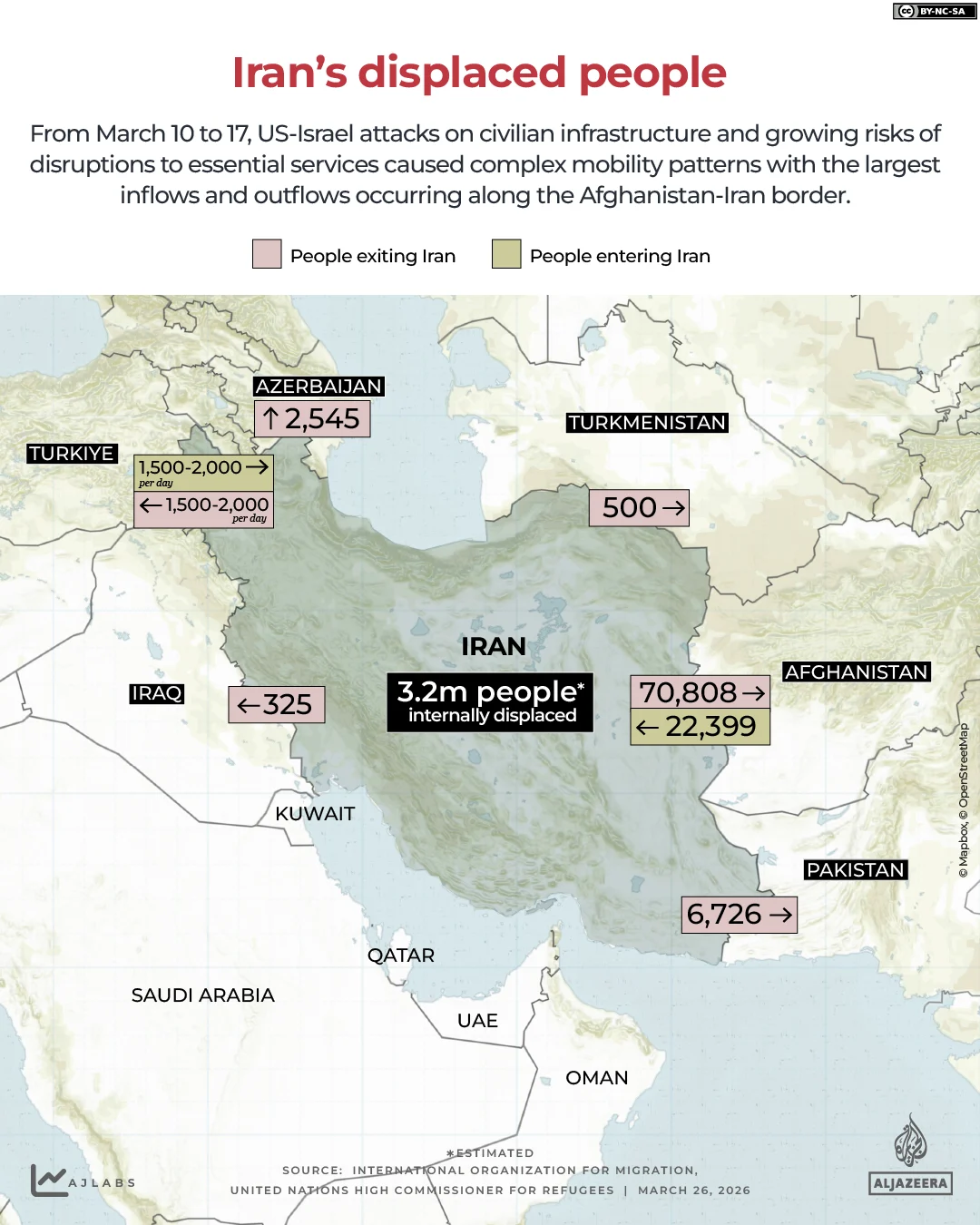
This escalating war, now in its 27th day, has created a volatile geopolitical landscape, pushing humanitarian organizations and neighboring nations to the brink of a potential refugee crisis. The sheer scale of displacement within Iran underscores the pervasive impact of the conflict on civilian life. More than 3.2 million individuals, representing over three percent of the nation’s population, have been internally displaced since the initial US-Israeli strikes commenced on February 28. These numbers are considered a conservative estimate by the United Nations refugee agency, UNHCR, suggesting the true figure could be even higher.
The conflict’s destructive reach has been indiscriminate, hitting vital civilian infrastructure and essential services. Over 85,000 civilian sites have sustained damage, including 282 healthcare facilities, 600 schools, and a staggering 64,583 homes. In the capital, Tehran, the administration has reported damage to nearly 14,000 residential units, with at least 6,000 displaced residents accommodated in municipal hotels. The ongoing disruption to critical services like water desalination plants, oil refineries, and nuclear facilities exacerbates the humanitarian challenge, creating complex mobility patterns as people navigate a war-torn landscape.

Southern Lebanon Faces Catastrophic Displacement
The humanitarian catastrophe is not confined to Iran; the conflict’s tentacles have reached deep into Lebanon, where the Israeli military’s extensive forced displacement orders have uprooted over a million people. The Israeli army has systematically expanded evacuation zones in southern Lebanon, encompassing an area stretching from the Litani River to north of the Zahrani River, approximately 40 kilometers north of the Israeli border. This vast region, covering about 14 percent of Lebanon’s total territory, is now under strict evacuation orders.
According to the Norwegian Refugee Council, Israeli evacuation directives now affect over 1,470 square kilometers, forcing a significant portion of the population from their homes. The visual evidence, corroborated by Al Jazeera, shows over 100 towns and villages across southern Lebanon under forced evacuation orders. This systematic displacement is part of a broader strategy by Israeli forces to establish what they describe as a "buffer zone" along the border.
The human cost of these operations is immense. Nearly one in five Lebanese citizens, or 18 percent of the population, has been displaced in the past two weeks alone. The International Organization for Migration (IOM) has registered 1,049,328 displaced individuals, with 132,742 residing in collective shelters. However, the pace of displacement has severely outstripped Lebanon’s shelter capacity. Many families find themselves without accommodation, forced to sleep in streets, vehicles, or public spaces as existing shelters reach their limits. For many, this represents a devastating recurrence of displacement.
A Looming Refugee Crisis on Neighboring Borders
The escalating displacement in both Iran and Lebanon has triggered serious concerns about a potential refugee crisis on the borders of neighboring countries. While cross-border flows have been largely limited and often characterized by short-term or economic reasons, the sheer volume of internally displaced persons suggests that external migration is an imminent threat.

In Afghanistan, a significant number of arrivals are reportedly Afghan nationals returning from Iran, citing insecurity or forced repatriation. Pakistan has maintained strict border controls, permitting only authorized entries for its citizens or traders, and has reported no significant refugee inflows. Similarly, Turkiye, Turkmenistan, and Azerbaijan have reported stable borders with limited authorized crossings and the occasional evacuation of third-country nationals.
Iraq has witnessed smaller-scale returns and a limited influx of Iranian nationals, with approximately 325 crossing the border and citing the escalating crisis. These figures, while seemingly modest, highlight the growing pressure on countries bordering the conflict zones. The potential for a mass exodus of refugees looms large, posing significant logistical and humanitarian challenges for the international community.
Infrastructure Collapses Under Sustained Attacks
The conflict has severely impacted critical infrastructure in both nations, further exacerbating the humanitarian crisis. In Lebanon, Israeli forces have systematically targeted and destroyed several bridges along the Litani River, severing vital transportation links in the south. Verified footage and photographs confirm the deliberate bombing of these key crossings, rendering them unusable and isolating communities.
The Israeli Defense Minister, Israel Katz, had previously ordered the military to destroy all crossings over the Litani River and homes situated near the border. These targeted attacks on infrastructure, particularly bridges, are seen by Lebanese officials as a deliberate attempt to sever the geographical connection between the southern Litani region and the rest of the country. Lebanese President Joseph Aoun has described these actions as part of "suspicious schemes to establish a buffer zone along the Israeli border, solidify the reality of the occupation and seek Israeli expansion within Lebanese territory."

The destruction of these bridges has profound implications for humanitarian aid delivery and the movement of people, effectively isolating large areas of southern Lebanon. This strategic targeting of infrastructure compounds the displacement crisis, making it even more challenging for affected populations to access essential resources and services.
Broader Implications and Public Impact
The escalating US-Israeli war and its devastating impact on civilian populations in Iran and Lebanon have far-reaching consequences that extend beyond immediate humanitarian concerns. The mass displacement not only strains resources within the affected countries but also places immense pressure on international aid organizations and neighboring states. The potential for a large-scale refugee crisis looms, demanding urgent international attention and coordinated efforts.
The destruction of critical infrastructure, including healthcare facilities, schools, and power generation plants, will have long-term repercussions for the economic and social recovery of both nations. Rebuilding these essential services will require substantial investment and sustained international support. Furthermore, the psychological toll on millions of displaced individuals, many of whom have experienced repeated cycles of violence and displacement, is immeasurable.
The conflict also carries significant geopolitical implications. The expansion of the war and the resultant humanitarian crisis have the potential to destabilize the region further, increasing tensions and fostering resentment. International diplomacy will be crucial in de-escalating the conflict, ensuring the protection of civilians, and addressing the root causes of the ongoing violence. The global community faces a critical juncture, requiring a concerted effort to provide humanitarian assistance, support reconstruction, and work towards a lasting peace. The current trajectory points towards a deepening humanitarian catastrophe, with millions of lives irrevocably altered by the ongoing hostilities.