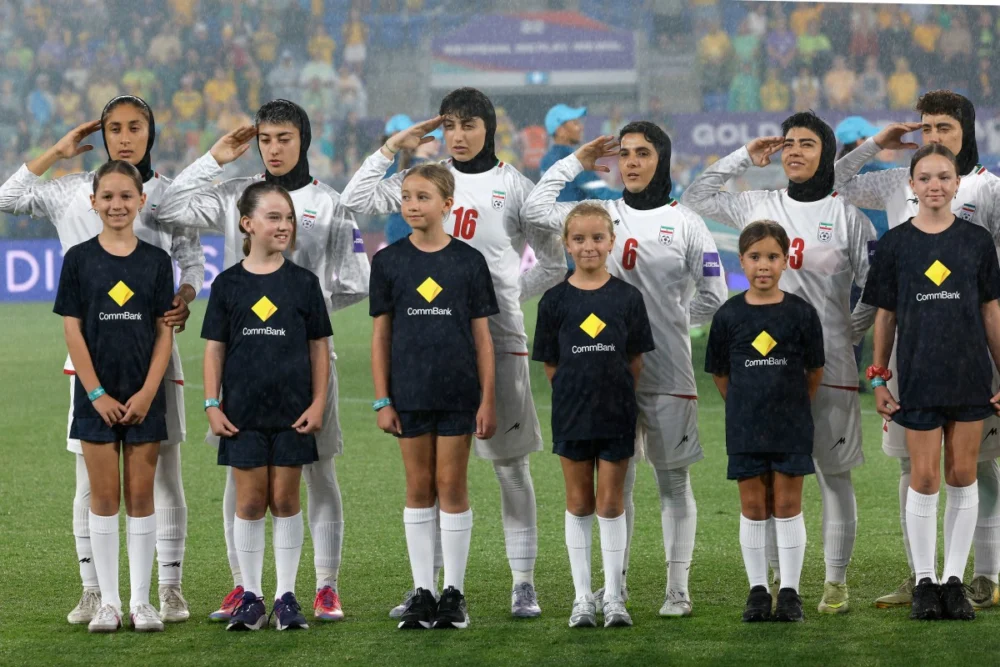
The Iranian women’s national football team opted to sing their national anthem, "Mehr-e Khavaran" (Eastern Sun), before their AFC Women’s Asian Cup match against host nation Australia, a stark contrast to their silent observance during the anthem at their previous game. This symbolic act unfolded on a rain-drenched Thursday evening in Gold Coast, Australia, where the team ultimately suffered a decisive 4-0 defeat. The decision to participate vocally in the anthem marks a significant moment for the squad, who have been outspoken about the profound anxieties they harbor for their families back home amidst escalating geopolitical tensions involving Iran, the United States, and Israel.
The team’s previous match, a fixture against South Korea on Monday, saw players and management maintain a stoic silence during the national anthem. This subdued approach reflected the immense pressure and concern weighing on the athletes, who have openly expressed their fears regarding the safety of their loved ones amid ongoing conflict. Their participation in the tournament, thousands of miles away from a nation grappling with significant external threats, has been overshadowed by a pervasive sense of unease and disconnection.
During the anthem against Australia, as heavy rain cascaded onto the pitch and sections of the crowd expressed their dissent through boos, the Iranian players stood together, their voices rising in song. This display was met with a complex reaction from the expatriate Iranian community present. While some spectators waved pre-1979 Iranian flags, signaling their opposition to the current regime, others displayed banners in support of then-U.S. President Donald Trump. These groups, though appearing to support the team’s on-field efforts, clearly voiced their disapproval during the playing of the national anthem, highlighting a deep political divide.
The precise reasons behind the team’s shift in their anthem observance between the two matches remain undisclosed. However, their candid discussions about the challenges of competing abroad while their country faces significant international pressure provide a crucial backdrop. The escalating conflict, marked by reported attacks from the U.S. and Israel, has created an environment of profound uncertainty. These attacks, which began on Saturday, have reportedly resulted in a substantial loss of life, including prominent figures and civilians in devastating incidents.
The imposition of internet blackouts within Iran has severely hampered the players’ and staff’s ability to communicate with their families. Coach Marziyeh Jafari has repeatedly voiced her gratitude for the support offered by the Iranian Australian community, acknowledging the vital lifeline it provides. "We are so happy that Iranian Australians here support us," Jafari stated to Australian media earlier in the week. "Obviously, we have so much concern for our families and our loved ones and all other people inside our country, which we are fully disconnected from. Here, we are coming to play football professionally, and we will do our best to concentrate on the match ahead."

The emotional toll on the players is palpable. Striker Sara Didar, a 21-year-old forward, visibly struggled to contain her emotions when speaking about the team’s collective worries. "Obviously, we’re all concerned, and we’re sad because of what has happened to Iran and our families and our loved ones," Didar shared with reporters, her voice heavy with emotion. The weight of their homeland’s situation undoubtedly impacts their focus and performance on the international stage.
The team’s on-field performance against Australia was overshadowed by the political and emotional undercurrents. The host nation secured a commanding 4-0 victory, a result that, combined with their earlier loss, places Iran on the brink of elimination from the tournament. Their path to the quarterfinals now hinges on a significant victory against the Philippines in their upcoming match, coupled with favorable results in other group games. Australia and South Korea have already secured their places in the knockout stage, setting a high bar for the remaining teams in their group and across the competition.
The AFC Women’s Asian Cup serves a dual purpose, acting not only as a continental championship but also as a critical qualification pathway for the following year’s FIFA World Cup in Brazil. For Jafari’s squad, the dream of representing Iran on the global stage remains a powerful motivator, despite the immense personal and national challenges they face. Their performance in the remaining matches will be closely watched, not just for their sporting merit but as a reflection of their resilience and determination amidst extraordinary circumstances.
Beyond the stadium, protests against the Iranian regime have become a recurring feature outside tournament venues. Clusters of demonstrators, many from the Iranian diaspora, have gathered to voice their opposition, amplifying the political dimensions of Iran’s participation. Nasrin Vaziri, an Iranian Australian resident of the Gold Coast, expressed her solidarity with the players, emphasizing their courage and strength. "I think they are brilliant because they haven’t had many chances to play," Vaziri told the Australian Broadcasting Corporation. "They are real people, even under pressure. We are proud of them. As a woman, I’m proud of them." Her sentiments echo the broader support extended to the team by many within the Iranian diaspora, who see them as symbols of hope and resilience.
The broader geopolitical context continues to loom large over the team’s presence in Australia. The reported ongoing bombardment of Iran has created a climate of fear and instability, making it exceptionally difficult for the athletes to maintain focus on their sporting endeavors. The disconnection from home, exacerbated by communication disruptions, intensifies their sense of isolation and concern.
Iran’s journey in the AFC Women’s Asian Cup is thus far defined by more than just football scores. It is a narrative interwoven with the geopolitical realities faced by their nation, the personal anxieties of the players, and the complex expressions of political dissent from their expatriate community. The team’s decision to sing their national anthem before the match against Australia can be interpreted as an assertion of national identity, even as they navigate a tumultuous period. Their continued participation, despite the overwhelming challenges, underscores a profound commitment to their sport and to representing Iran on an international platform, however fraught that representation may be. The outcome of their matches remains uncertain, but their presence and their stories have already made a significant impact, highlighting the intersection of sport, politics, and human resilience. The team’s aspiration to qualify for the FIFA World Cup remains, a beacon of hope amidst a deeply challenging period for their country.