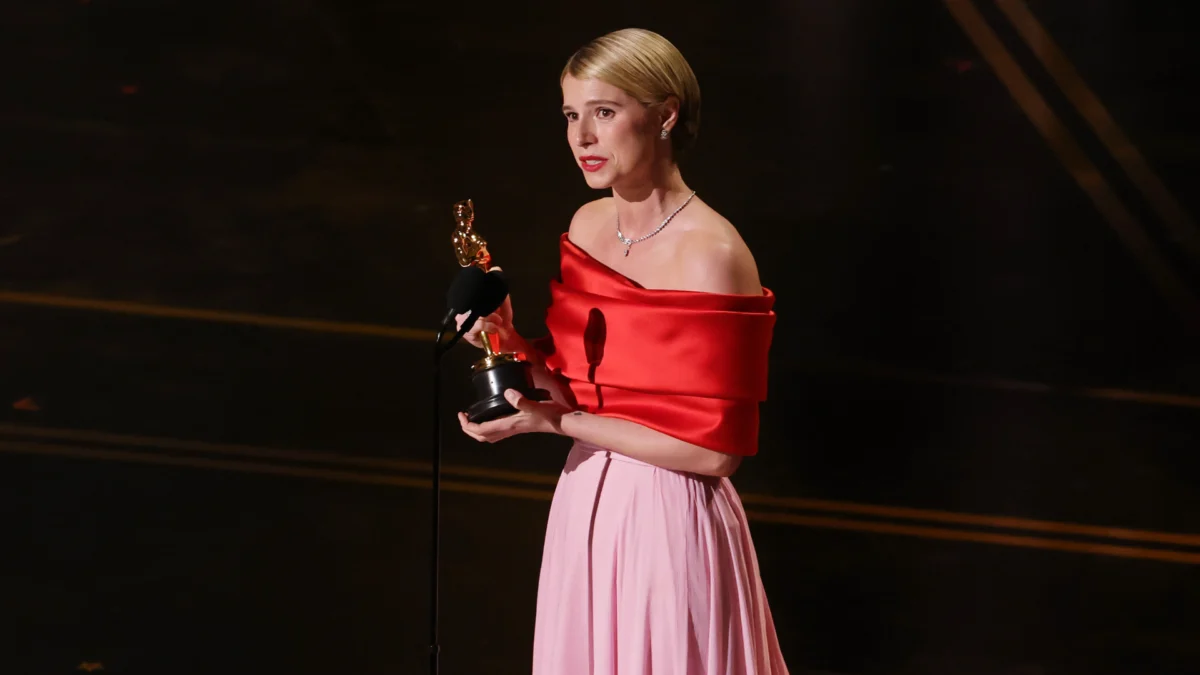
Jessie Buckley made history at the 98th Academy Awards, becoming the first Irish woman ever to secure the coveted Best Actress Oscar for her compelling performance in Hamnet. The Kerry native concluded her poignant acceptance speech with a heartfelt message in Gaelic, amplifying the cultural significance of her groundbreaking achievement on Hollywood’s most prestigious stage.
A Historic Night for Irish Cinema
Buckley’s victory was a momentous occasion, not only for her burgeoning career but also for Irish cinema, marking a significant milestone in the Academy’s near century-long history. Her win resonated deeply, recognizing her powerful portrayal of Agnes Hathaway, William Shakespeare’s wife, in the critically acclaimed period drama. The emotional culmination of the evening saw Buckley ascend the stage to accept the industry’s highest honor, her name called out by actor Mikey Madison, a 2025 winner for her role in Anora.
The journey to this historic win saw Buckley navigate a highly competitive category, triumphing over a formidable roster of actresses. Her fellow nominees included Rose Byrne for If I Had Legs I’d Kick You, Kate Hudson for Song Sung Blue, Renate Reinsve for Sentimental Value, and Emma Stone for Bugonia. Each nominee brought a distinct and celebrated performance to the fore, underscoring the exceptional talent recognized by the Academy.
The Power of Gaelic on a Global Stage
In a moment that garnered widespread attention and national pride, Buckley concluded her acceptance speech with the resonant phrase, "Go raibh maith agaibh, slán." This Gaelic expression, translating to "Thank you very much, goodbye," served as a powerful testament to her Irish heritage. The use of her native tongue on such a globally broadcast platform underscored the enduring strength of Irish culture and language, echoing across international airwaves and social media.
This linguistic choice was more than a mere farewell; it was a profound declaration of identity, connecting her personal triumph to the collective spirit of Ireland. For many, it symbolized a moment of profound cultural affirmation, bringing a piece of Ireland directly into the heart of Hollywood.
"The Chaos of a Mother’s Heart": A Resonant Dedication
Buckley’s acceptance speech was deeply personal, offering a glimpse into her own life while celebrating the universal experience of motherhood. After expressing gratitude to her husband and their eight-month-old daughter, she dedicated her award to "the chaos of a mother’s heart." This evocative phrase resonated with countless viewers, particularly as her win coincided with Mother’s Day celebrations in the United Kingdom.
Backstage, Buckley further elaborated on the confluence of these significant events, describing the experience as a "crazy alchemy." She shared intimate details, revealing that her daughter had cut her first tooth that week and that she had woken up that very morning with her child snuggled on her chest. This personal narrative profoundly enriched the context of her win, tying her artistic achievement to the profound journey of becoming a mother.
Connecting Art and Life: Thematic Resonance in Hamnet
Buckley articulated the profound connection between her role in Hamnet and her personal experience with motherhood. "I feel like what a gift to get to explore motherhood through this incredible mother this is and was," she reflected, "and then to become one myself, and then to receive this recognition of the incredible role mothers play in our world on this day is something I will never, ever forget." Her portrayal of Agnes Hathaway in Hamnet delves deep into the complexities of maternal love, grief, and resilience, themes that clearly found a powerful echo in Buckley’s own life.
Hamnet, the film that brought Buckley her Oscar, marked the only Academy Award win for the production. The story, adapted from Maggie O’Farrell’s bestselling novel of the same name, explores the life of Agnes Hathaway, William Shakespeare’s wife, and the devastating impact of the death of their son, Hamnet, on their family and creative partnership. Paul Mescal starred alongside Buckley as William Shakespeare, depicting two parents grappling with contrasting experiences of grief and loss. The screenplay was meticulously crafted by O’Farrell herself in collaboration with director Chloé Zhao, who brought a sensitive and nuanced vision to the adaptation.
Jessie Buckley’s Ascending Career
Buckley’s Oscar win was, for many industry observers, a confirmation of her consistent critical acclaim and burgeoning talent. Her path to the Academy Awards stage has been marked by a series of powerful and diverse performances across film, television, and theatre. Prior to Hamnet, Buckley had already garnered significant recognition, including an Oscar nomination for Best Supporting Actress in 2022 for her role in Maggie Gyllenhaal’s The Lost Daughter.
Her career trajectory showcases a remarkable versatility, from her breakout role in the musical drama Wild Rose to her chilling performance in Charlie Kaufman’s I’m Thinking of Ending Things. Buckley’s ability to inhabit complex characters with raw emotion and authenticity has made her a compelling presence on screen, earning her accolades at various preceding award shows, including the Actor Awards and the Golden Globes, where she swept her categories, solidifying her status as a frontrunner for the Academy Award.
A Formidable Best Actress Field
The Best Actress category at the 98th Academy Awards was widely considered one of the most competitive in recent memory. Each nominee delivered a performance that garnered critical praise and sparked considerable awards season buzz. Rose Byrne’s turn in If I Had Legs I’d Kick You showcased her dramatic depth, while Kate Hudson’s performance in Song Sung Blue marked a significant departure for the acclaimed actress. Renate Reinsve continued to impress audiences and critics alike with her work in Sentimental Value, building on her prior international recognition. Emma Stone, a previous Oscar winner, delivered another captivating performance in Bugonia, cementing her reputation as one of her generation’s most talented stars.
Buckley’s win in such a distinguished field underscores the exceptional nature of her performance in Hamnet. Her ability to convey profound grief, resilience, and an unwavering spirit in the face of unimaginable loss resonated deeply with Academy voters, ultimately earning her the top prize.
The Broader Landscape of the 98th Academy Awards
While Jessie Buckley’s win was a high point for international talent, the 98th Academy Awards largely saw a strong showing for American productions. Her victory stood out as the only major show-up for the international crowd in the top acting categories. The night’s dominant forces included Paul Thomas Anderson’s One Battle After Another, which garnered multiple awards, closely followed by Ryan Coogler’s Sinners.
Elsewhere, international cinema did receive recognition, with Joachim Trier’s Sentimental Value securing the Oscar for Best International Feature Film. However, Buckley’s Best Actress win served as a powerful individual triumph, highlighting a singular performance that transcended national boundaries and resonated with a global audience, proving that compelling storytelling and exceptional acting know no borders.
A Symbol of National Pride and Artistic Excellence
Buckley’s historic win has ignited a wave of national pride across Ireland. Her use of Gaelic on such a prominent global platform was celebrated as a powerful affirmation of Irish identity and culture. The win is expected to have a significant impact on the Irish film industry, potentially inspiring new talent and drawing further international attention and investment to the country’s burgeoning cinematic landscape.
Her achievement also speaks to broader conversations within the film industry regarding diversity and representation. As an Irish actress winning a top individual honor, Buckley’s success contributes to a more inclusive narrative at the Academy Awards, demonstrating the global reach of talent and the increasing recognition of diverse voices and stories on the world stage.
Looking Ahead: The Aftermath of an Oscar Win
An Academy Award win traditionally ushers in a new phase for an actor’s career, opening doors to more prominent roles, diverse projects, and increased artistic freedom. For Jessie Buckley, this Oscar is likely to solidify her position as a leading lady and a highly sought-after talent in both independent and mainstream cinema. Her ability to deliver raw, emotionally charged performances ensures that her future projects will be eagerly anticipated by critics and audiences alike.
The lasting impact of her acceptance speech, particularly her dedication to motherhood and her embrace of her Irish heritage, will undoubtedly become an iconic moment in Oscar history. Jessie Buckley’s win for Hamnet is not merely an accolade for an exceptional performance; it is a landmark achievement that celebrates cultural identity, the profound journey of motherhood, and the enduring power of cinematic storytelling.