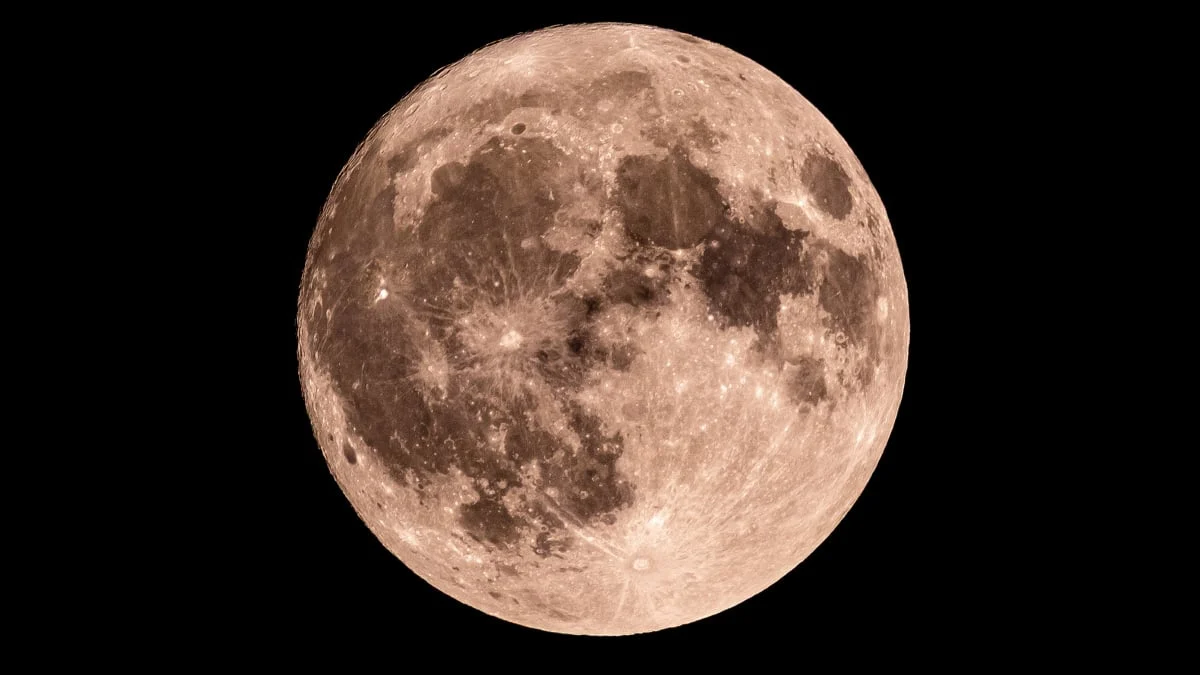
The lunar cycle reaches a critical transition point on Wednesday, March 25, 2026, as the Moon enters its First Quarter phase, offering a distinct visual profile to observers across the globe. According to the latest data from NASA’s Daily Moon Guide, the Earth’s natural satellite will reach approximately 44% illumination this evening, appearing as a precise half-disk in the night sky. This phase occurs when the Moon has completed one-quarter of its monthly orbit around the Earth, positioned at a 90-degree angle relative to the Sun and our planet.
For skywatchers and amateur astronomers, the First Quarter represents one of the most favorable times for observation due to the high contrast along the "terminator"—the line dividing the illuminated and dark sides of the lunar surface. On March 25, 2026, this line will bisect several prominent geological features, making them appear more three-dimensional as long shadows accentuate the lunar topography. As the Moon moves from its New Moon phase toward the Full Moon, this "waxing" period provides a nightly increase in visible surface area, a process that will culminate in the next Full Moon scheduled for April 1.
Visibility and Observation: What the Moon Phase Today Explained Means for Viewers
The moon phase today explained provides a unique opportunity for individuals to engage with celestial mechanics using nothing more than the naked eye. On the evening of March 25, several large lunar "seas" or maria will be clearly visible to the unaided observer. These dark, basaltic plains, formed by ancient volcanic eruptions, include the Mare Fecunditatis (Sea of Fertility), Mare Crisium (Sea of Crises), and Mare Serenitatis (Sea of Serenity). These features dominate the right-hand side of the lunar disk in the Northern Hemisphere, providing a stark contrast against the brighter, cratered highlands.
For those equipped with standard binoculars, the level of detail increases significantly during this First Quarter phase. Observers will be able to distinguish the Endymion Crater, located near the northeastern limb, and the Posidonius Crater, situated on the edge of the Mare Serenitatis. Additionally, the Mare Nectaris (Sea of Nectar) becomes a focal point for binocular users, showcasing the complex geological history of the lunar surface. The First Quarter is often preferred over the Full Moon for such viewing, as the direct overhead sunlight of a Full Moon tends to wash out the shadows that define these deep craters.
Advanced hobbyists using telescopes will find even more intricate details accessible during the March 25 event. High-powered lenses will reveal the Rupes Altai, a massive lunar mountain range that forms a scarp stretching hundreds of miles. Telescopic views will also bring the Rima Ariadaeus into focus, a linear rille or trench that suggests past tectonic activity. Perhaps most notably, the illumination levels tonight will provide the necessary contrast to locate the historical landing sites of the Apollo 11 mission, allowing modern observers to look upon the same Sea of Tranquility where humans first set foot in 1969.
The Science of the 29.5-Day Lunar Cycle
The moon phase today explained is part of a larger celestial rhythm known as the synodic month, which lasts approximately 29.5 days. This is the time it takes for the Moon to return to the same position relative to the Sun as seen from Earth. While the Moon’s physical rotation is tidally locked—meaning the same side always faces our planet—the amount of sunlight reflecting off that surface changes constantly as it orbits. This creates the eight distinct phases recognized by astronomers and utilized by various cultures for timekeeping and navigation.
The cycle begins with the New Moon, where the Moon sits between the Earth and the Sun, rendering its illuminated side invisible to us. As it moves in its counter-clockwise orbit, it enters the Waxing Crescent phase, where a thin sliver of light begins to emerge on the right side. The First Quarter, occurring today, marks the point where the Moon has traveled 25% of its orbital path. Following this, the Moon will transition into the Waxing Gibbous phase, where more than half of the surface is lit, leading eventually to the Full Moon on April 1, when the Earth is positioned between the Moon and the Sun.
Following the Full Moon, the process reverses through the "waning" phases. The Waning Gibbous sees a gradual reduction in light, followed by the Third Quarter (or Last Quarter), where the left half of the Moon is illuminated. Finally, the Waning Crescent brings the cycle back toward the New Moon. Understanding these phases is essential for various scientific fields, including marine biology, where lunar cycles dictate the breeding patterns of numerous species, and meteorology, where the Moon’s gravitational pull influences tidal movements.
Why the First Quarter Moon Phase Today Matters for Space Agencies
The specific details of the moon phase today explained are not merely of interest to backyard observers; they are critical data points for international space agencies like NASA and the European Space Agency (ESA). As humanity prepares for a sustained return to the lunar surface through programs like Artemis, understanding the lighting conditions of specific regions is vital for mission planning. The First Quarter phase provides ideal lighting for topographic mapping and the calibration of optical instruments on orbiting satellites.
NASA’s Daily Moon Guide serves as a primary resource for these agencies to synchronize their lunar reconnaissance efforts. On March 25, 2026, the 44% illumination allows for high-resolution imaging of the "twilight zone" along the terminator. These images help scientists study the depth of craters and the height of lunar ridges, which is essential information for selecting safe landing zones for future robotic and crewed missions. The shadow lengths provided by the First Quarter phase allow for the calculation of slope gradients that are otherwise difficult to determine under the flat lighting of a Full Moon.
Furthermore, the visibility of the Apollo 11 landing site tonight serves as a reminder of the ongoing efforts to protect lunar heritage sites. As commercial lunar exploration increases, there is a growing international dialogue regarding the preservation of historical locations. Being able to view these sites from Earth reinforces the connection between past achievements and future goals, such as the establishment of a permanent lunar base or the eventual mission to Mars.
Atmospheric Conditions and Public Impact
The clarity of the moon phase today explained will depend heavily on local atmospheric conditions across North America and the rest of the world. High-pressure systems typically provide the clear skies necessary for optimal viewing, while urban centers may face challenges from light pollution. However, because the Moon is the brightest object in the night sky, it remains visible even in moderately light-polluted areas, making it an accessible entry point for science education and public engagement.
Educational institutions and planetariums often use the First Quarter Moon as a teaching tool. Because it rises around noon and sets around midnight, it is often visible in the late afternoon and early evening, making it convenient for school-aged children and families to observe. This accessibility fosters a greater public interest in STEM (Science, Technology, Engineering, and Mathematics) fields. Observing the Moon’s transition on March 25 provides a tangible lesson in geometry, physics, and the scale of our solar system.
In addition to the scientific and educational impact, the lunar phases continue to hold significant cultural weight. The transition toward the Full Moon on April 1 is often associated with spring festivals and agricultural cycles in various traditions. While modern society relies on digital calendars, the physical presence of the First Quarter Moon serves as a persistent natural clock that has guided human activity for millennia.
Preparing for the Next Major Lunar Milestone
As the moon phase today explained concludes its 24-hour cycle, the focus of the astronomical community will shift toward the upcoming Full Moon. Predicted to take place on April 1 for North American viewers, the Full Moon will represent the opposite side of the lunar experience—maximum brightness and the complete absence of shadows on the Earth-facing side. This upcoming event will be particularly significant for photographers, as the "Moonrise" on that day offers a prime opportunity for capturing the lunar disk against the horizon.
Between now and April 1, the Moon will continue to grow in illumination each night, moving through the Waxing Gibbous phase. During this time, the terminator will sweep across the remaining dark portions of the lunar surface, gradually revealing the Mare Imbrium and the spectacular Copernicus Crater. For those who began their observations today, March 25, the coming week offers a night-by-night tour of lunar geography as the sun rises over new territories of the Moon’s surface.
The study of the Moon remains a cornerstone of modern astronomy, providing a "stepping stone" for deeper space exploration. Whether it is through a high-powered telescope at an observatory or a casual glance upward on a walk home, the First Quarter Moon of March 25, 2026, offers a moment of reflection on our place in the cosmos. The data provided by NASA and other scientific bodies ensures that the public remains informed about these celestial transitions, maintaining a bridge between complex orbital mechanics and the simple wonder of the night sky.