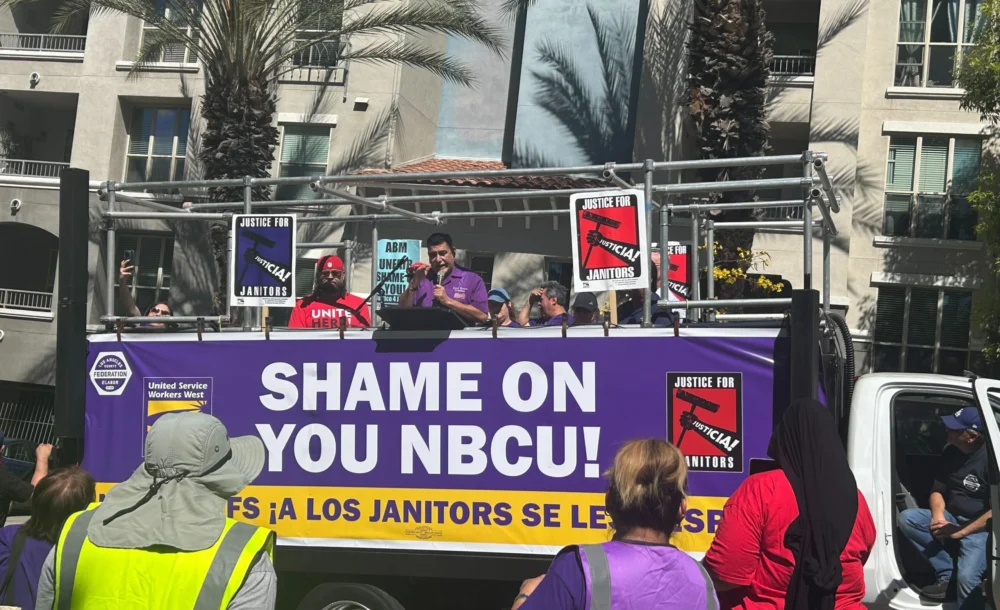
A significant labor confrontation was narrowly avoided in Studio City on Thursday when NBCUniversal and its facilities subcontractor, ABM Industries, agreed to rehire more than 100 union janitors, just hours before a large-scale protest was set to begin. The eleventh-hour agreement transformed what was intended as a public shaming of the entertainment giant into a jubilant celebration of worker solidarity and successful collective bargaining, underscoring the potent influence of organized labor in the modern economy.
Avert Major Labor Unrest
The air in Studio City’s South Weddington Park was thick with anticipation. Purple-shirted members of the Service Employees International Union-United Service Workers West (SEIU-USWW) gathered, equipped with protest signs, drums, and horns. Three school buses had delivered picketers, joining many more who arrived independently, all poised to march on NBCUniversal’s nearby Universal City Plaza. The demonstration, meticulously organized by the union, aimed to highlight what it called the unjust termination of over 100 janitorial staff.
The Brink of a Standoff
As the noon start time for the protest approached, the tension was palpable. The towering structure of 10 Universal City Plaza loomed in the background, a silent testament to the corporate power being challenged. However, behind the scenes, a flurry of intense negotiations was underway between representatives from NBCUniversal, ABM Industries, and SEIU-USWW. These discussions continued right up to the final moments, reflecting the high stakes for both the corporations and the affected workers. The outcome would determine whether the planned protest would erupt into a public display of anger or transition into an unexpected victory rally.
Unraveling the Dispute
The genesis of the dispute traced back to Monday, just days before the scheduled protest. More than 100 janitors, predominantly night shift workers, received sudden notification of their termination. These individuals, many of whom were Latino immigrant workers, had dedicated years of service to maintaining the cleanliness and operational efficiency of NBCUniversal’s sprawling properties. Their roles were critical, ensuring the pristine condition of offices, public spaces, and restrooms across key locations including 10 Universal City Plaza, the DreamWorks campus, and the Universal Studios Lot.
The Layoffs: A Sudden Move
The layoffs stemmed from NBCUniversal’s decision to cancel its contract with ABM Industries, the long-standing facilities services provider for these sites. According to David Huerta, president of SEIU-USWW, the affected workers received no clear justification for their sudden dismissal. The only explanation offered was a vague intention to shift janitorial services to the day shift, a change for which the laid-off employees were not given any opportunity to transition or apply. This abrupt change left many workers feeling blindsided and betrayed, questioning the fairness and transparency of the process.
Union’s Stance: "Unjustly Canceled"
The union swiftly condemned the layoffs as "unjustly canceled" jobs. Huerta articulated the union’s perspective, emphasizing that the terminations were a "knee-jerk reaction" from NBCUniversal, especially given ongoing contractual discussions. Prior to the layoffs, SEIU-USWW had been actively engaged in resolving various contractual issues with the employer, some of which pertained to worker seniority. The union argued that these pre-existing negotiations should have provided a framework for a more orderly and equitable resolution to any staffing changes, rather than a sudden mass termination that disregarded years of service and established worker protections. The union believed the company’s actions demonstrated a clear lack of respect for its workforce and established labor agreements.
Intense Negotiations and a Swift Resolution
The prospect of a highly visible protest, strategically timed and organized by SEIU-USWW, served as a powerful catalyst in compelling both NBCUniversal and ABM Industries to engage seriously in last-minute negotiations. The union’s unwavering commitment to its members, coupled with the potential for negative public relations for a major entertainment conglomerate, created an environment where a resolution became increasingly imperative.
Last-Minute Deal Saves Jobs
As the clock ticked towards the protest’s scheduled start, union president David Huerta delivered the breakthrough news to his members in Spanish. The announcement, met with immediate cheers and applause, confirmed that all laid-off janitors would be rehired and would receive backpay for the period they were out of work. Huerta underscored the union’s steadfast resolve, stating, "They knew the workers were coming. They knew the union was organizing for this and they knew the union was going to continue to organize until which time we got the justice we deserved." He added, "And that is making sure everybody got their jobs back that were unjustly canceled." This sentiment highlighted the belief that the corporations had "came to their senses" under pressure, recognizing that restoring jobs was the more prudent and ethical path forward.
Backpay and Reinstatement Terms
The agreement stipulated that all more than 100 janitors would be fully reinstated to their positions, ensuring continuity of employment for a workforce that suddenly faced economic uncertainty. Crucially, the deal also included backpay, compensating the workers for the wages lost during their brief period of unemployment. While the specific financial terms of the backpay were not immediately disclosed, its inclusion represented a significant victory for the union, validating their claim that the layoffs were unwarranted and causing undue financial hardship. The swiftness of the resolution and the comprehensive nature of the reinstatement and compensation package demonstrated the efficacy of organized labor’s tactics when faced with corporate decisions impacting worker livelihoods.
The Power of Collective Action
The sudden pivot from a planned protest to an impromptu celebration was a powerful demonstration of collective action’s ability to effect change. The gathering at South Weddington Park, initially configured for confrontation, rapidly transformed into a vibrant affirmation of solidarity and hard-won victory. The atmosphere, charged moments before with righteous anger, now resonated with relief and joy, illustrating the profound impact of organized labor on corporate decision-making.
From Protest to Celebration
Despite the celebratory mood, a large banner proclaiming "Shame on You NBCU!" remained prominently displayed on the bed of a truck, serving as a stark reminder of the initial intent and the struggle that preceded the resolution. Scheduled speakers, including Mark Ramos, the L.A. County Democratic Party chair and president of UFCW Local 1428, and Thom Davis, president of the California IATSE Council, pivoted their prepared remarks from condemnation to commendation. They lauded the union’s tenacity and the workers’ courage, emphasizing the importance of standing united against corporate overreach. Their presence, representing broader labor and political support, underscored the significance of the janitors’ fight within the larger labor movement.
Voices from the Front Lines
Among those who spoke was Ramon Segoviano, a shop steward at the Universal Studios Lot and one of the janitors who had been laid off. His testimony resonated deeply with the crowd, articulating the frustration and injustice felt by the workers. "Shame on you, ABM and NBCUniversal," Segoviano declared, highlighting the indispensable role of the janitorial staff. "The studios are a small city and we keep it running. We deserve to be treated with respect. Without us, these corporations like ABM and NBCUniversal wouldn’t make a profit." His words succinctly captured the argument for economic justice and the recognition of essential labor, emphasizing that the prosperity of entertainment giants is built upon the foundational work of its service employees.
Broader Implications for Contract Labor and the Entertainment Industry
This incident casts a spotlight on the complex and often precarious landscape of contract labor within the entertainment industry and beyond. Major corporations frequently outsource services like janitorial work, security, and catering to third-party providers such as ABM Industries. While this practice can offer companies flexibility and cost savings, it often places the subcontracted workers in a vulnerable position, distanced from the primary employer and sometimes subject to less favorable terms and conditions.
The Precariousness of Subcontracted Work
Subcontracted employees frequently navigate a more intricate web of employment relations, where their direct employer (the contractor) may be subject to the whims of the client (like NBCUniversal). This arrangement can complicate union organizing efforts and obscure accountability when disputes arise. The sudden cancellation of a contract can lead to mass layoffs, as seen in this case, leaving workers with little recourse unless strong union protections and collective bargaining agreements are in place. The SEIU-USWW’s success here serves as a potent reminder that even in a highly contracted environment, organized labor can still assert significant power and demand accountability from both the primary corporation and its subcontractors.
The Role of Immigrant Labor
The fact that many of the affected workers were described as "Latino immigrant workers" highlights a significant demographic reality within the service sector. Immigrant communities often form the backbone of essential service industries, frequently performing vital but undervalued labor. These workers can face unique challenges, including language barriers, immigration status concerns, and vulnerability to exploitation. The SEIU-USWW has a long history of organizing and advocating for immigrant workers, recognizing that their collective strength is paramount to achieving fair wages, benefits, and respectful treatment. This victory further solidifies the union’s role as a champion for these often marginalized segments of the workforce, demonstrating that their contributions are invaluable and their rights deserving of robust protection.
A Win for Worker Dignity
Beyond the immediate rehire and backpay, this resolution represents a broader victory for worker dignity and the principle that labor is not a disposable commodity. The union’s quick mobilization and the workers’ readiness to protest forced a powerful corporation to reconsider its actions, affirming that employees, regardless of their role, are integral to a company’s success and warrant fair treatment. This outcome can embolden other service workers in similar situations, providing a template for how collective action, backed by a strong union, can successfully challenge corporate decisions perceived as unjust.
A Resounding Message for Corporate Accountability
The resolution of the dispute between NBCUniversal, ABM Industries, and the SEIU-USWW sends a clear and resonant message across corporate America about the increasing demands for accountability, particularly concerning labor practices. In an era where corporate social responsibility is under heightened scrutiny, major companies are finding it increasingly difficult to disregard the well-being of their workforce, whether directly employed or through subcontractors.
The "Invisible" Workforce Made Visible
Union president David Huerta powerfully articulated the often-overlooked value of janitorial staff, stating, "I know a lot of folks think that somehow these workers are invisible or some pixie dust comes in and spreads magic around the place and it just gets cleaned up." He emphasized the reality: "But there’s people out there making sure that restrooms are clean, that offices are clean, that public spaces are clean." Indeed, during the brief period the janitors were off the job, Huerta reported receiving complaints from within NBCUniversal about declining cleanliness standards. This anecdotal evidence swiftly underscored the tangible and immediate impact of their absence, making the "invisible" workforce undeniably visible through the consequences of their removal. This realization likely played a role in the corporations’ decision to reverse the layoffs, highlighting that the smooth operation and pleasant environment of a workplace are directly tied to the consistent, diligent efforts of its service employees.
Looking Ahead: The Future of Labor Relations
This incident serves as a significant case study in contemporary labor relations, particularly within the entertainment sector, which has recently seen a surge in union activity, including the high-profile strikes by writers and actors. The swift resolution in favor of the union janitors suggests a growing sensitivity among corporations to the public and reputational risks associated with labor disputes. It reinforces the idea that strategic union organizing and the threat of public protest remain potent tools for advocating for worker rights and securing economic justice. As industries continue to evolve, the dynamics between corporate power and organized labor will undoubtedly face new challenges and opportunities, but this victory for the NBCUniversal and ABM Industries union janitors provides a hopeful precedent for workers seeking fair treatment and respect in their workplaces. The successful outcome underscores the enduring power of collective bargaining and the imperative for corporations to engage meaningfully with their labor force.