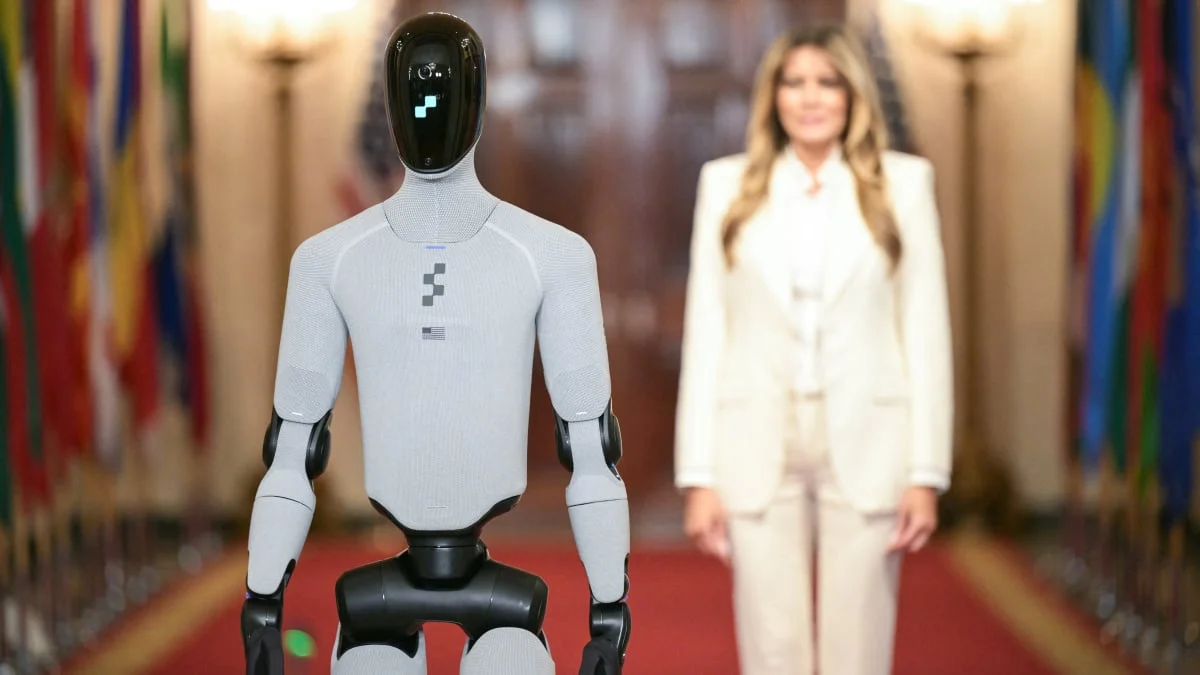
First Lady Melania Trump arrived at a White House summit on Wednesday morning accompanied by a humanoid robot, a visual demonstration intended to highlight the administration’s focus on the integration of artificial intelligence into American life. The appearance of the machine, a model known as Figure 3, marked a departure from traditional protocol as it flanked the First Lady through the East Wing’s red-carpeted corridors.
The event served as the centerpiece for the second day of the "Fostering the Future Together" initiative, an administration-led summit focused on the intersection of advanced technology and education. As classical music played throughout the hallway, the robot maintained a steady pace alongside Mrs. Trump, eventually leading her into a room filled with tech executives and the spouses of various world leaders.
This public display of bipedal robotics was designed to showcase the reliability of current humanoid technology. Unlike previous public demonstrations by other tech firms that resulted in mechanical stumbles or required remote teleoperation, Figure 3 navigated the historic residence without assistance or incident.
The Technical Evolution of Figure 3 and the White House Tech Function
The robot featured in the White House tech function is the flagship product of Figure, an American robotics firm based in Sunnyvale, California. The company previously maintained a high-profile partnership with OpenAI, though that arrangement concluded last year as Figure transitioned to utilizing its own proprietary in-house AI models.
Recognized by industry publications as one of the significant inventions of 2025, Figure 3 represents the current frontier of the "robot butler" concept. The machine is engineered to perform complex household tasks, including loading dishwashers, folding laundry, and identifying household clutter. While its efficiency in a domestic setting remains a subject of industry debate, its ability to navigate a high-security, high-traffic environment like the White House was presented as a proof of concept for the technology’s maturity.
During the function, the robot addressed the assembled guests using a female-coded voice characterized by a distinct vocal fry, a linguistic trait common among modern AI synthetic voices. It greeted the international delegation in 11 different languages, emphasizing the diplomatic potential of real-time translation and automated interaction.
Advancements in Bipedal Stability and Humanoid Logic
The success of the robot’s walk through the East Wing is a notable milestone for the robotics industry. Bipedal movement—walking on two legs—has long been one of the most difficult engineering challenges in robotics, requiring constant micro-adjustments to maintain balance on uneven surfaces or during turns.
In previous years, similar events held by competitors often saw robots lose balance or require "safety handlers" nearby. The autonomous nature of the Figure 3 escort was interpreted by many tech analysts as a direct challenge to other players in the field, such as Tesla’s Optimus project. By placing the machine in a high-stakes environment like a White House function, the administration signaled its confidence in domestic robotics hardware.
The robot’s address to the crowd focused on its role in the "Fostering the Future Together" initiative. "I am grateful to be part of this historic movement to empower children with technology and education," the machine stated, according to reports from the press pool.
Fostering the Future Together: A Policy Framework for AI
The "Fostering the Future Together" initiative serves as the primary policy vehicle for the First Lady’s focus on emerging technologies. The program is an evolution of her "Be Best" campaign from the President’s first term, which originally focused on online safety and the well-being of children.
The current iteration of the program seeks to "supercharge" the application of artificial intelligence to assist parents, educators, and students. The administration has framed this as a necessary step to maintain American competitiveness in a global economy increasingly dominated by automated systems.
The summit convened this week aimed to bridge the gap between private sector innovators and public policy leaders. By inviting the spouses of world leaders, the White House sought to create a soft-power platform for discussing the ethical and practical implications of AI in the domestic sphere.
The Role of Public-Private Partnerships in Robotics
A central theme of the White House tech function was the necessity of collaboration between the federal government and Silicon Valley. The administration has been vocal about its desire to streamline regulations that might otherwise slow the deployment of humanoid robots in schools and homes.
The presence of Figure 3 was not merely for show; it represented the tangible results of American venture capital and engineering. Industry leaders at the event discussed the potential for "AI-powered assistants" to fill labor shortages in the caregiving and education sectors.
Critics, however, have raised concerns about the rapid pace of this integration. While the administration emphasizes the benefits of AI in the classroom, some educators and developmental psychologists argue that the "learning science" behind AI-only instruction is still in its infancy. They caution that replacing human interaction with robotic interfaces could have unforeseen consequences on child development.
Melania Trump’s Vision for a Personified AI Future
In her remarks at the summit, the First Lady offered a glimpse into the administration’s long-term vision for technology. She argued that the era of AI existing solely behind screens or within mobile devices is coming to an end, replaced by a "personified" version of the technology.
"The future of AI is personified," Mrs. Trump told the attendees. "It will be formed in the shape of humans. Very soon, artificial intelligence will move from our mobile phones to humanoids that deliver utility."
This vision suggests a shift in how the public will interact with data and automation. Rather than typing queries into a search engine, the administration envisions a future where physical robots provide direct assistance in the physical world. This includes everything from tutoring students to assisting the elderly with daily tasks.
The Rise of AI-Only Schools and Educational Humanoids
The First Lady’s comments come at a time when the educational landscape is undergoing a radical transformation. A new wave of "AI-only schools," often backed by Silicon Valley investors, has begun to emerge. These institutions utilize AI tutors and robotic facilitators to provide personalized curricula for students, often with minimal human supervision.
The "Fostering the Future Together" initiative appears to align with this trend, advocating for the use of machines like Figure 3 as educational tools. The argument presented at the summit is that robots can provide infinite patience and personalized attention that a single teacher in a crowded classroom cannot.
However, the pedagogical community remains divided. While some see the potential for robots to handle rote tasks and basic tutoring, others worry about the loss of the "human element" in education. The debate over whether a robot can truly understand and react to the emotional needs of a student remains a central point of contention.
Economic and Geopolitical Implications of the Robot Escort
The choice to have a robot escort Melania Trump to the White House tech function also carries significant geopolitical weight. The race for dominance in humanoid robotics is often compared to the space race of the 20th century, with the United States and China leading the charge.
By showcasing a functional, stable, and articulate American-made robot, the White House sent a signal to international observers about the state of U.S. technological capabilities. The spouses of world leaders in attendance represented nations that are currently grappling with their own AI strategies and regulations.
From an economic standpoint, the mass adoption of humanoid robots could disrupt the global labor market. The administration’s focus on "utility" suggests that these machines are being prepared for roles in logistics, manufacturing, and service industries. The White House tech function served as a high-level marketing event for the viability of these machines in sensitive and sophisticated environments.
Security and Ethical Considerations in the White House
The presence of a humanoid robot in the East Wing also raised questions regarding security and privacy. Typically, anyone in such close proximity to the First Lady is a vetted member of the Secret Service or the White House staff.
Integrating a machine capable of recording audio and video into the secure environment of the White House required extensive coordination. Technical experts noted that the robot’s sensors and data transmission protocols likely underwent rigorous review by government security agencies to ensure that no sensitive information was compromised during the event.
Furthermore, the "female" persona of the robot and its "vocal fry" sparked discussions about the ethics of gendered AI. Sociologists have noted that AI assistants are frequently designed with female voices and personas, which can reinforce traditional stereotypes of service and domesticity. The administration has not commented on the specific design choices made by Figure, but the choice of persona for a White House function remains a point of academic interest.
Moving Toward an Integrated Robotic Society
As the "Fostering the Future Together" summit concludes, the image of the robot escorting the First Lady remains a defining moment of the administration’s tech policy. It served as a visual bridge between the present and a future where humanoid machines are common features of the American landscape.
The next steps for the initiative include a series of pilot programs in select school districts, where AI-powered assistants will be introduced into the classroom setting. These programs will be monitored by the Department of Education to assess their impact on student performance and safety.
While the technical achievement of Figure 3 was the highlight of the day, the broader conversation regarding the role of AI in society continues. The White House tech function demonstrated that the technology is no longer a matter of science fiction, but a tangible tool that is being actively integrated into the highest levels of government and domestic life.
The administration’s push for "personified AI" indicates a belief that the American public is ready to move beyond digital interfaces and into a world where machines walk among them. Whether this transition will be met with widespread acceptance or continued skepticism depends on the transparency of the policy and the demonstrated safety of the machines in the years to come.