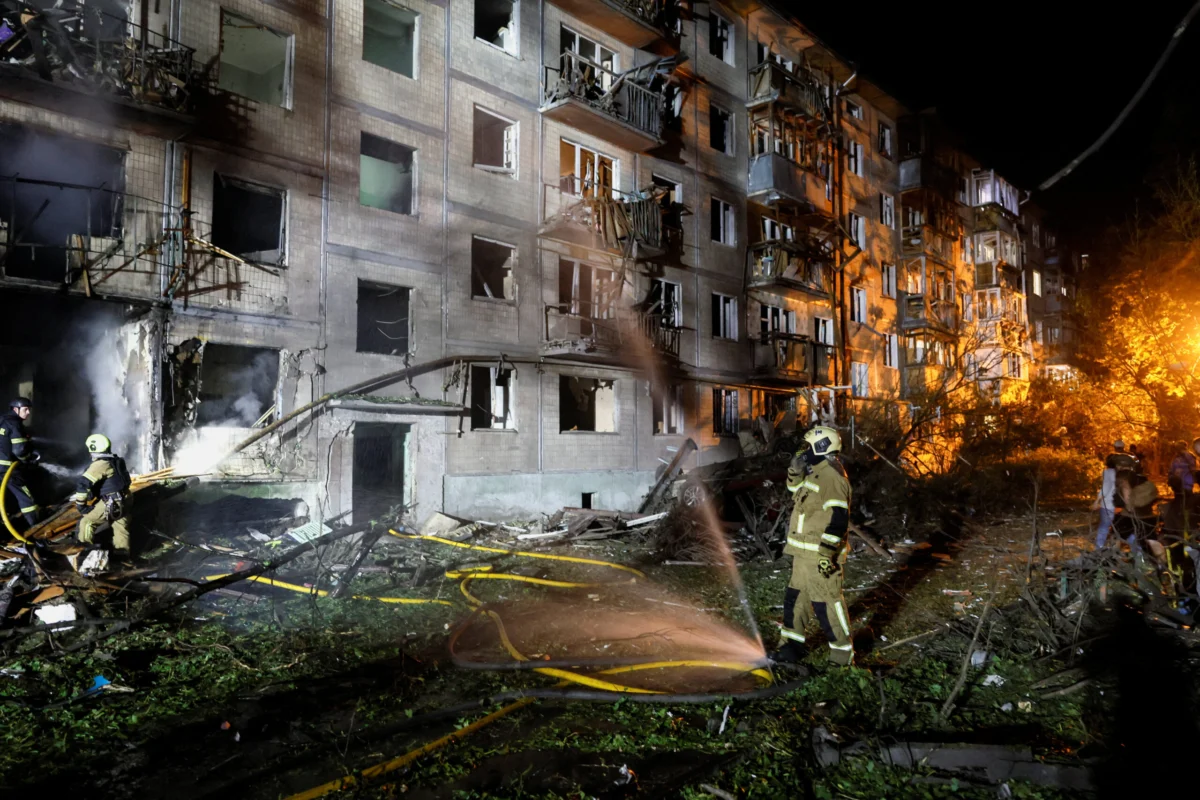
At least three people were killed and 15 injured in a Russian missile attack that struck Ukraine’s capital, Kyiv, early Saturday morning, according to city officials. The pre-dawn assault, which sent shockwaves across the city and triggered a series of explosions, left residents trapped in damaged buildings and ignited fires. The latest strikes underscore a sustained escalation of Russian aerial assaults targeting Ukrainian urban centers, particularly the capital, as Kyiv grapples with dwindling air defense capabilities.
Intensified Attacks on Kyiv
The Saturday morning barrage reverberated through Kyiv, with witnesses reporting more than a dozen explosions. The attacks concentrated on the Shevchenkivskyi and Solomyanskyi districts, where partially collapsed buildings caught fire and trapped residents. Emergency services were immediately deployed to the scene, launching intensive rescue operations amidst the debris and ongoing damage assessment.
Among the injured, city Mayor Vitali Klitschko confirmed that 15 individuals required hospitalization. The casualties included two minors, a 13-year-old boy and a 17-year-old, highlighting the indiscriminate nature of the attacks. One of the injured was reported to be in serious condition, emphasizing the severity of the impact.
Fires and structural damage were also reported in other parts of the capital, including burning warehouses in the Darnytskyi district and debris raining down on buildings in Holosiivskyi. The scale of destruction suggests a deliberate and widespread targeting of civilian infrastructure.
Ukraine’s Air Defense Challenges
This latest deadly strike on Kyiv comes as Ukraine continues to face significant challenges in defending its skies against increasingly sophisticated Russian aerial weaponry. Russia has intensified its attacks on the capital in recent months, often leveraging ballistic missiles against which Ukraine’s air defense systems are less effective.
Ukrainian President Volodymyr Zelenskyy has repeatedly appealed to international allies for enhanced military support, particularly advanced air defense systems capable of intercepting ballistic missiles. These pleas have been central to Ukraine’s diplomatic efforts, aiming to bolster its defensive capabilities against a relentless Russian air campaign.
The strategic importance of such systems is paramount. Ukraine’s existing air defense network, while bolstered by Western aid, struggles to counter the speed and trajectory of ballistic missiles, which offer minimal reaction time for interception. This vulnerability leaves major cities like Kyiv exposed to devastating strikes.
Diplomatic Maneuvers for Advanced Weaponry
In parallel with the escalating attacks, diplomatic efforts are underway to secure critical air defense technology. President Zelenskyy has been actively engaged in negotiations with the United States regarding a license to manufacture Patriot interceptor missiles on Ukrainian soil. This proposed collaboration aims to address Ukraine’s long-term air defense needs by enabling domestic production.
However, the prospect of such a technology transfer has faced careful consideration from Washington. U.S. President Donald Trump, while acknowledging ongoing discussions, has expressed caution regarding the broad dissemination of such advanced weaponry. He emphasized the need for a "judicious" approach, citing concerns about the potential for the technology to eventually be used against U.S. interests.
Trump’s statements, delivered in recent days, reflect a nuanced debate within the U.S. administration about the balance between providing immediate security assistance to Ukraine and safeguarding sensitive military technology. While a license for Patriot production remains under discussion, the administration’s stance highlights the complex geopolitical considerations involved in arming an ally facing a protracted conflict.
A Pattern of Escalating Russian Aggression
The Saturday attack on Kyiv is part of a broader pattern of intensified Russian aerial assaults that have plagued Ukraine throughout the week. Early Thursday, a series of Russian missile strikes across the country claimed the lives of at least eight people, including children, underscoring the grave human cost of the ongoing conflict. These attacks demonstrate a deliberate strategy by Russia to inflict damage on Ukrainian cities and erode civilian morale.
The targeting of civilian areas and infrastructure has been a recurring feature of the conflict since Russia’s full-scale invasion in February 2022. International human rights organizations have documented numerous instances of alleged war crimes, including indiscriminate attacks on residential areas, hospitals, and schools. The repeated strikes on Kyiv, a symbol of Ukrainian resilience, signal a sustained effort by Russia to demoralize the population and disrupt the country’s ability to function.
Broader Geopolitical Implications
The ongoing missile attacks and Ukraine’s desperate need for advanced air defenses have significant geopolitical implications. The conflict continues to serve as a crucial test of Western unity and resolve in supporting Ukraine. The effectiveness of air defense systems in protecting civilian populations directly influences the broader narrative of the war and the potential for further escalation.
The United States, as a leading provider of military aid to Ukraine, plays a pivotal role in shaping the battlefield dynamics. Decisions regarding the transfer of advanced weaponry, such as the Patriot missile system, have far-reaching consequences not only for Ukraine’s defense but also for the global security landscape. The careful deliberation over licensing domestic production of such systems reflects the strategic calculations involved in managing a complex international conflict.
Furthermore, the persistent attacks highlight the critical need for sustained international support for Ukraine. Beyond military hardware, humanitarian aid and economic assistance remain vital for Ukraine’s recovery and its ability to withstand the prolonged aggression. The international community’s commitment to Ukraine’s sovereignty and territorial integrity is being tested on a daily basis through these devastating aerial bombardments.
Public Impact and Resilience
The human toll of the Russian missile attacks on Kyiv is profound. Residents live under the constant threat of air raid sirens and the potential for destruction. The psychological impact of such sustained aggression weighs heavily on the population, demanding immense resilience and fortitude.
The images of damaged apartment buildings, burning structures, and injured civilians serve as stark reminders of the brutal reality of the war. Yet, amidst the devastation, there is also a powerful display of Ukrainian determination. The swift response of emergency services and the continued efforts to rescue those trapped underscore the unwavering spirit of the Ukrainian people.
The international community’s response to these attacks is closely watched. The extent to which allies can provide effective air defense solutions will significantly influence Ukraine’s ability to protect its citizens and its critical infrastructure. The ongoing dialogue surrounding the Patriot missile system exemplifies the high stakes involved in securing these vital defensive assets.
Looking Ahead: The Quest for Security
The Saturday morning missile attack on Kyiv is another grim chapter in Ukraine’s ongoing struggle for survival. The loss of life and the extensive damage serve as a potent reminder of the urgent need for enhanced air defense capabilities. Ukraine’s pursuit of advanced weaponry, including the potential for domestic Patriot missile production, remains a critical priority in its efforts to safeguard its cities and its people.
The international community’s continued engagement and support will be crucial in addressing the immediate humanitarian crisis and in bolstering Ukraine’s long-term security. As the conflict continues, the effectiveness of air defense systems will play a decisive role in shaping the outcome and mitigating the devastating impact of Russian aerial assaults. The resilience of the Ukrainian people, coupled with robust international assistance, will be paramount in navigating the challenging path ahead.