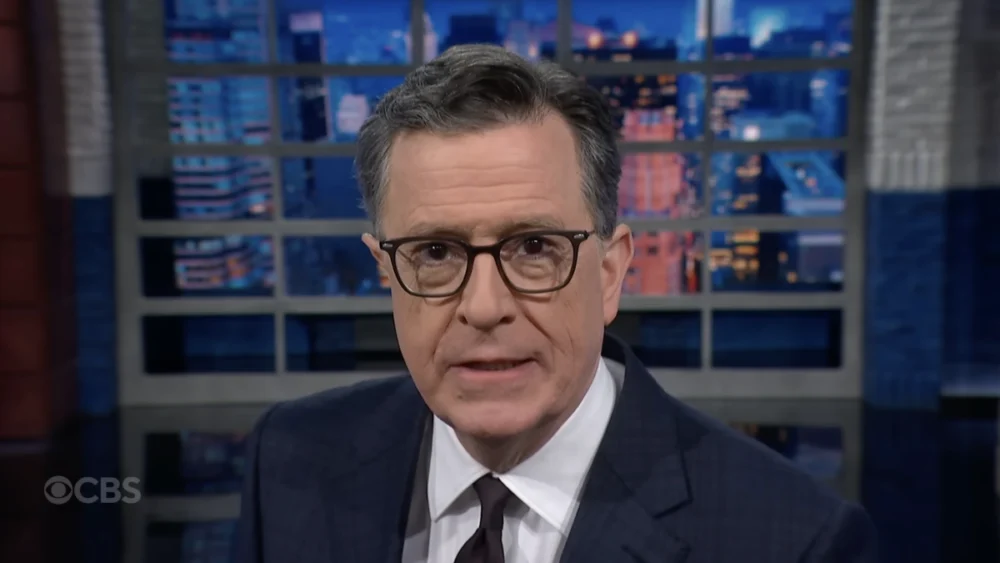
Late-night host Stephen Colbert recently utilized his platform on The Late Show to provide a satirical breakdown of former President Donald Trump’s comments regarding the potential risks associated with international military conflict. During a segment that has since gained significant traction online, Colbert examined a specific exchange between Trump and reporters concerning the tactical and political ramifications of an escalation in the Middle East.
The monologue centered on the former president’s assessment of what he termed the "worst case scenario" for a hypothetical war, specifically in the context of ongoing tensions with Iran. Trump’s response to the inquiry—which suggested that the primary risk was merely the replacement of one unfavorable regime with another—served as the primary catalyst for Colbert’s comedic critique.
As the United States continues to navigate complex diplomatic and military challenges in the Persian Gulf and beyond, the intersection of political rhetoric and late-night commentary remains a significant factor in shaping public discourse. Colbert’s reaction highlights the ongoing polarization regarding American foreign policy and the specific communication style that defined the Trump administration’s approach to global security.
Stephen Colbert Roasts Trump’s Answer on What War’s ‘Worst Case Scenario’ Could Be during Late-Night Monologue
The segment on The Late Show featured footage of Donald Trump addressing the media regarding the possibility of "major combat operations." When pressed by a reporter to define the most catastrophic outcome of such an engagement, Trump provided an answer that many analysts found surprisingly candid, if not reductive. He suggested that the ultimate failure would be a cyclical return to the status quo, stating that the worst case would be "we do this, then someone takes over who’s as bad as the previous person."
Colbert immediately seized upon the irony of the statement, framing it within the context of domestic politics rather than international relations. The comedian noted that the prospect of a leader being removed only to be replaced by someone equally problematic was a scenario that hit close to home for many observers of the current American political landscape.
"Yeah. Yeah, that could happen," Colbert told his audience, leaning into the punchline that has since been shared across social media platforms. He further elaborated on the irony by suggesting that the most concerning scenario involves a leader leaving office, only to return several years later in a state that he characterized as "somehow worse."
The Geopolitical Context of the Iran Tensions
To understand why Stephen Colbert roasts Trump’s answer on what war’s ‘worst case scenario’ could be with such fervor, one must look at the underlying geopolitical instability that prompted the original question. The relationship between Washington and Tehran has been characterized by a series of escalations following the U.S. withdrawal from the Joint Comprehensive Plan of Action (JCPOA) in 2018.
Under the "maximum pressure" campaign, the Trump administration sought to cripple the Iranian economy through a series of stringent sanctions. This policy was intended to force Iran back to the negotiating table to secure a more comprehensive deal that would address not only its nuclear program but also its ballistic missile development and regional influence. However, the strategy resulted in a cycle of provocations, including the seizure of oil tankers and the downing of unmanned aerial vehicles.
The peak of this tension occurred with the 2020 drone strike that killed Major General Qasem Soleimani, the head of Iran’s elite Quds Force. Following that event, the rhetoric surrounding "major combat operations" became a frequent topic of discussion in the White House briefing room. It was in this environment of heightened military readiness that Trump offered his assessment of the "worst case scenario."
The Rhetoric of Regime Change
For decades, American foreign policy has been haunted by the unintended consequences of regime change. From the 1953 coup in Iran to the 2003 invasion of Iraq, the removal of a hostile leader has frequently led to a power vacuum or the rise of an even more radicalized successor. Trump’s comment, while criticized by Colbert for its phrasing, touched upon a historical reality that has long plagued the Department of State and the Pentagon.
Critics of the former president argue that his "worst case" description lacked the gravity typically associated with the loss of human life, the displacement of millions, or the total destabilization of a region. By focusing on the administrative outcome of "who takes over," Trump’s rhetoric signaled a transactional view of warfare that differed sharply from the moral and democratic justifications used by his predecessors.
Satire as a Tool for Political Critique
The tradition of late-night hosts serving as de facto news ombudsmen has grown increasingly prominent in the 21st century. Figures like Stephen Colbert, following in the footsteps of Jon Stewart, have transitioned from traditional joke-tellers to influential commentators who shape how millions of Americans perceive political events.
When Stephen Colbert roasts Trump’s answer on what war’s ‘worst case scenario’ could be, he is engaging in a form of media criticism that points out perceived absurdities in official government communication. By stripping away the formal setting of a presidential press conference and applying the logic to a different context, Colbert highlights the perceived circularity of Trump’s logic.
This specific roast also served as a commentary on the 2024 election cycle. By referencing a "bad guy" who returns after four years, Colbert was making a thinly veiled reference to Trump’s own bid to reclaim the presidency. This double meaning allowed the comedian to critique both the former president’s foreign policy mindset and his current political aspirations simultaneously.
The Impact of Late-Night Viral Clips
In the current media ecosystem, a four-minute segment on a late-night show can often reach a wider audience than a standard news report. Clips of Colbert’s monologues are frequently disseminated across YouTube, X (formerly Twitter), and TikTok, where they are consumed by a demographic that may not tune in for nightly network news broadcasts.
The "worst case scenario" clip is a prime example of how political satire can distill complex geopolitical issues into digestible, shareable content. While the nuance of U.S.-Iran relations might be lost in a short segment, the perceived character of the leader in question is brought into sharp focus. This influence has made late-night hosts significant players in the broader political strategy of both major parties.
Public Perception and the "Forever War" Sentiment
Trump’s comments and Colbert’s subsequent roast also reflect a broader American fatigue with overseas interventions. Both the "America First" movement and the progressive left have expressed a desire to move away from the "forever wars" that characterized the early 2000s.
When Trump suggested that the worst case was simply getting another bad leader, he was tapping into a cynical view of interventionism that resonates with a segment of the electorate. This view suggests that no matter how much blood or treasure is spent, the political outcome in certain regions remains unchanged. Colbert’s roast, conversely, suggested that the true "worst case" was the domestic return of the very person who holds such a cynical view.
The Role of Foreign Policy in Domestic Elections
Historically, foreign policy has rarely been the primary driver of American elections, which are typically decided by economic concerns. However, the way a candidate discusses war and peace serves as a proxy for their perceived temperament and judgment.
The ongoing discussion surrounding Trump’s "worst case scenario" remarks provides insight into how his opponents intend to frame his return to the world stage. By portraying his rhetoric as flippant or self-defeating, critics aim to raise questions about his fitness for the role of Commander-in-Chief. Meanwhile, supporters often view such comments as a refreshing departure from the "polished" but ultimately unsuccessful rhetoric of the political establishment.
The Evolution of Late-Night Commentary
The shift in late-night television from broad, non-partisan humor to sharp, targeted political satire has changed the way these shows are produced. The Late Show with Stephen Colbert has consistently led in the ratings by leaning into this role, particularly during the Trump administration and its aftermath.
This evolution has not been without controversy. Critics argue that the heavy focus on political roasting alienates half the potential audience and contributes to the echo-chamber effect of modern media. Proponents, however, argue that in a time of political crisis, the role of the satirist is to speak truth to power and provide a necessary outlet for public frustration.
As the 2024 election approaches, the frequency and intensity of these exchanges are expected to increase. The "worst case scenario" segment is likely just one of many instances where late-night hosts will attempt to frame the stakes of the upcoming vote through the lens of the former president’s past statements.
Future Implications for Presidential Communication
The incident also serves as a case study in the risks of off-the-cuff presidential communication. While Trump’s supporters often praise his lack of a filter as "authenticity," the resulting soundbites provide endless material for political opponents and satirists alike.
For future administrations, the challenge will be to balance the need for transparency and direct communication with the reality that every sentence can be deconstructed and satirized within minutes of being spoken. The "worst case scenario" comment, once a brief moment in a busy news day, has been transformed into a lasting political narrative through the medium of late-night television.
The enduring nature of this story suggests that the public remains highly attuned to the rhetoric of its leaders, particularly when that rhetoric touches on the life-and-death stakes of military conflict. As the geopolitical landscape continues to shift, the way leaders define "success" and "failure" will remain under the microscope of both the serious press and the satirical stage.
The intersection of comedy and tragedy in these discussions highlights the unique way American culture processes its political reality. Whether through a formal briefing or a late-night monologue, the debate over the "worst case scenario" for the nation continues to evolve, reflecting the deep-seated anxieties and divisions of the modern era.