Copenhagen, Denmark – The Copenhagen International Documentary Film Festival (CPH:DOX) has opened its Inter:Active Exhibition, a cutting-edge showcase titled “Hypervigilance,” at Kunsthal Charlottenborg, offering a profound exploration of contemporary anxieties through immersive art and technology. The exhibition, running as part of the festival’s 23rd edition, features a curated selection of virtual reality experiences, educational games, and multi-sensory installations designed to challenge traditional cinematic boundaries and engage audiences actively.
The exhibition’s central theme, “Hypervigilance,” resonates acutely with the current global climate, marked by digital saturation, geopolitical instability, the rise of authoritarian regimes, and pervasive surveillance. This thematic choice aims to reflect a societal state of heightened alert, where individuals and communities navigate complex pressures that challenge their autonomy and sense of security. The showcase stands as a testament to the power of art to interpret and respond to the urgent issues of our time, pushing the boundaries of documentary storytelling into new interactive realms.
Unpacking the State of Hypervigilance
Mark Atkin, the curator of CPH:DOX Inter:Active and head of studies at the talent development program CPH:LAB, articulated the exhibition’s core philosophy during the program unveiling. Atkin described the featured works as exposing "the collective anxiety of a society on high alert," where the struggle to maintain agency over one’s image, body, and voice has become paramount. He emphasized that for marginalized communities—including queer, disabled, and displaced individuals—this state of watchfulness is deeply ingrained, serving as a survival instinct in a world often built on scrutiny and exclusion. For the broader population, this hypervigilance has increasingly become the new norm, shaped by relentless 24-hour news cycles, extractive capitalism, authoritarian violence, and the constant pressure to conform under omnipresent observation.
Atkin further highlighted the prescient nature of the theme, noting its heightened relevance amid escalating global conflicts, such as the bombings in the Middle East. He suggested that the feeling of being manipulated by unseen forces, though not fully understood, is a widespread sentiment, contributing to a rising general level of hypervigilance across societies worldwide. This pervasive sense of unease and the need for constant awareness form the emotional and intellectual backbone of the exhibition.
Artistic Resistance and Curatorial Vision
The artists featured in “Hypervigilance” are united by their endeavor to confront these societal pressures, seeking to reclaim control through diverse forms of resistance. Their responses manifest through artistic creation, acts of defiance, sexual expression, and direct activism. While the tone of many works is acknowledged as "quite dark," Atkin stresses that each piece inherently embeds a form of rebellion or hope, providing a counter-narrative to the prevailing anxieties.
Atkin’s curatorial approach diverges from traditional film programming, aligning more closely with the methodology of an art exhibition. His process involves extensive engagement with artists and curators, alongside reviewing numerous submissions, particularly from programs like CPH:LAB. This method allows him to identify recurring themes and concerns that preoccupy artists, enabling him to draw these threads together under a cohesive concept like hypervigilance. A particular focus is placed on narratives from marginalized groups, whose inherent experiences of watchfulness offer profound insights into the exhibition’s central theme.
Navigating Complex Realities: A Showcase of Immersive Works
The exhibition presents a diverse array of interactive experiences, each delving into specific facets of hypervigilance and societal pressure:
-
Systemic Racism and AI Bias: Coded Black by Maisha Wester is a social justice game that unearths the insidious histories of systemic racism in the U.S. and U.K., celebrating Black resilience through immersive, atmospheric storytelling derived from primary sources. Similarly, Daniela Nedovescu and Octavian Mot’s The Pledge is an interactive installation that confronts participants with AI bias, generating personalized statements rooted in machine prejudices and transforming these encounters into a collective digital monument. Chisato Minamimura’s The Lost Golden Lotus reimagines China’s foot-binding legacy through multisensory art and Deaf-led performance, connecting historical beauty ideals to contemporary exacting body standards, offering a powerful commentary on cultural pressures.
-
Identity, Liberation, and Vulnerability: Dark Rooms by Mads Damsbo and Laurits Flensted-Jensen offers an intimate exploration of sexual awakening across virtual spaces, inviting audiences to move beyond societal shame and prejudice to experience personal liberation. In the Current of Being by Cameron Kostopoulos is a haptic VR experience chronicling the harrowing journey of Carolyn Mercer, a survivor of electroshock conversion therapy aimed at "correcting" her gender identity. Sam Wolson and Lilli Carré’s No Place at Home highlights the personal impact of political decisions, focusing on a mother and her trans teen who decided to leave the U.S. following an executive order signed by then-President Trump restricting access to gender-affirming care for minors, illustrating the profound anxieties driving personal migration.
-
Global Conflict and Displacement: Mohamed Jabaly’s My Tent Is Not a Shelter serves as a poignant memorial for Gaza. Stitched from the artist’s own clothes, a fragile tent becomes a powerful symbol for those living in tents amidst the rubble of destroyed homes, embodying both resilience and fragility while featuring video screenings of daily life in Gaza. This work directly addresses the extreme conditions that necessitate constant hypervigilance for survival.
-
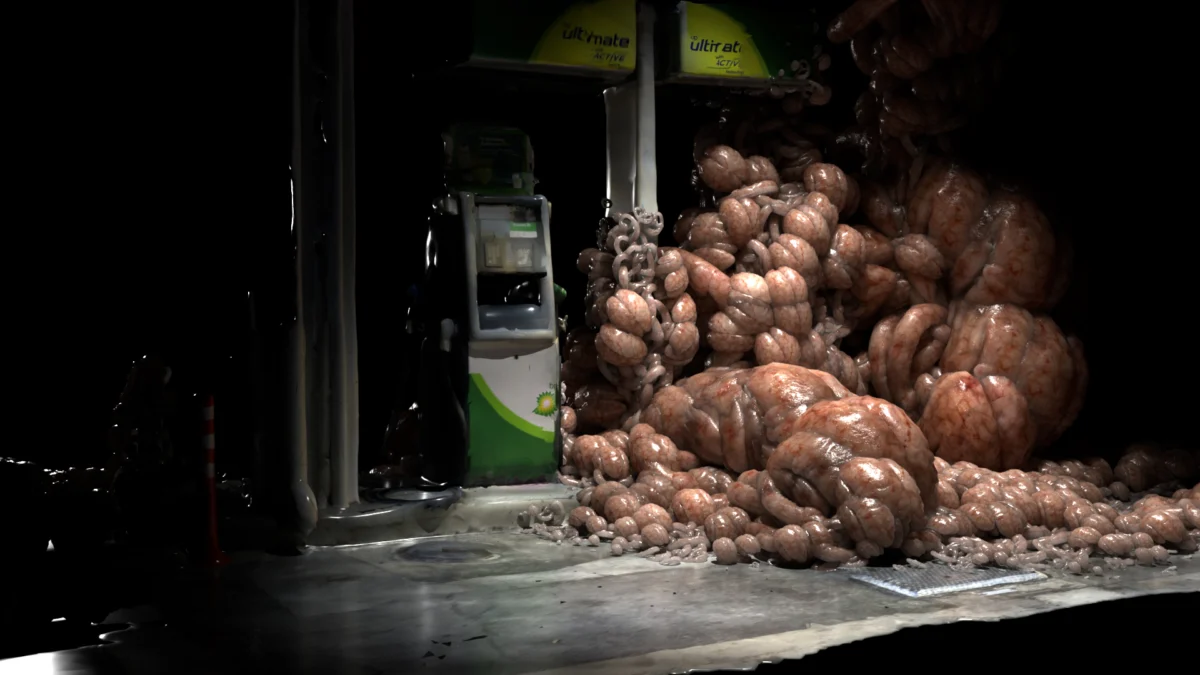
The Future and Technology’s Perils: Kakia Konstantinaki’s live performance horror film, Brains in the State of Suspension, delves into disembodied intelligence and the monstrous consequences of humanity’s drive for control, exploring the impulses of intelligence stripped from its physical form. Celestis Obscura by Cecilie Waagner Falkenstrøm draws parallels between the historical Gold Rush and the modern space race, examining how corporate power in asteroid and lunar exploitation threatens to replicate Earth’s inequalities across the solar system, demanding hypervigilance against new forms of exploitation. Pierre-Christophe Gam’s The Sanctuary of Dreams is an immersive film and multi-sensory installation that invites collective future-dreaming, using imagination as a tool to envision new social, spiritual, and cultural realities shaped by shared human desires, offering a counterpoint to dystopian anxieties.
-
Narrative Innovation and Urban Transformation: Burden of Other People’s Dreams: Chapter One – Ganymede by renowned editor Joe Bini offers a unique live cinema experience, an 80-minute surreal abstract memoir of his life as a film editor, blurring the lines between author, reader, and viewer. Tales of a Nomadic City by Med Lemine Rajel and Christian Vium is a VR experience co-created with Nouakchott youth, artists, poets, and scholars, weaving personal stories and archives to portray the complex history and ongoing urban transformation of Mauritania’s capital. Sacha Wares’ Inside: The Childhood of an Artist provides an evocative multisensory biography, transporting audiences to the moment artist Judith Scott’s life profoundly changed, exploring themes of love and separation.
Activating Empathy and Engagement
A core objective of the Inter:Active exhibition is to foster a deeper connection between the audience and the artworks, transforming passive viewers into active participants. Through multisensory and immersive designs, the exhibition aims to create experiences that resonate on a visceral level, moving individuals beyond mere observation. Atkin expressed the hope that this heightened engagement will not only cultivate greater empathy but also serve to activate a sense of activism within individuals, inspiring them to confront the challenges highlighted by the works in their own lives and communities.
The “Hypervigilance” exhibition at CPH:DOX stands as a potent commentary on the contemporary human condition, reflecting the anxieties and struggles of an increasingly complex world. By embracing innovative technological and artistic forms, the festival continues to push the boundaries of documentary, inviting audiences to not just witness, but to actively participate in the critical dialogues of our time. The diverse range of works underscores the festival’s commitment to providing a platform for voices often unheard, challenging viewers to confront uncomfortable truths and consider pathways toward resistance and liberation.