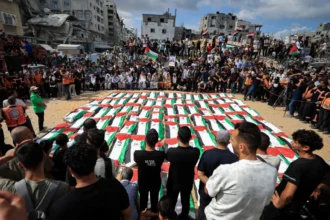
Belgrade, Serbia – Thousands of mourners, many of them hailing him as a hero, gathered in the Serbian capital on Tuesday for the funeral of Ratko Mladic, the former Bosnian Serb military commander convicted of genocide and war crimes by a United Nations tribunal. The large turnout underscores the deep divisions that persist in the region more than two decades after the brutal Balkan wars of the 1990s.
The funeral service, held in a Belgrade cemetery, saw a significant number of attendees, including some politicians and public figures who have expressed support for Mladic. Flags and symbols associated with Serb nationalism were visible among the crowds, reflecting a segment of Serbian society that views Mladic not as a war criminal, but as a defender of his people.
Convicted War Criminal Laid to Rest Amidst Divided Tributes
Ratko Mladic, whose name became synonymous with the atrocities committed during the Bosnian War, was laid to rest following a ceremony attended by a significant gathering of sympathizers. The presence of individuals who openly praise Mladic highlights the contentious legacy he leaves behind and the ongoing struggle for reconciliation in the former Yugoslavia.
The Bosnian War, which raged from 1992 to 1995, resulted in the deaths of an estimated 100,000 people and displaced millions. Mladic, as commander of the Bosnian Serb Army, played a central role in many of the conflict’s most brutal campaigns, including the infamous Srebrenica massacre.
Mladic’s Conviction and the Srebrenica Massacre
In 2017, the International Criminal Tribunal for the former Yugoslavia (ICTY) convicted Ratko Mladic of genocide, crimes against humanity, and war crimes. The most damning charge related to the 1995 Srebrenica massacre, where Bosnian Serb forces under his command systematically killed over 8,000 Bosniak Muslim men and boys.
The tribunal’s judgment detailed Mladic’s direct involvement in orchestrating the persecution, extermination, murder, and deportation of Bosniak civilians. His conviction at the ICTY marked a pivotal moment in international justice, aiming to hold individuals accountable for the widespread violence and ethnic cleansing that characterized the conflict.
Despite the international legal consensus on his guilt, a significant portion of the Serbian population continues to view Mladic as a national hero. This perspective often frames him as a protector of Serbian interests during a period of intense conflict and geopolitical upheaval.
The Complex Legacy of Ratko Mladic in Serbia
The funeral procession and the attendance figures offer a stark illustration of the enduring divisions within Serbian society regarding the legacy of the Bosnian War and its key figures. For many, Mladic represents a symbol of resistance against perceived external pressures and a defender of Serb national identity.
This narrative often downplays or outright denies the scale and nature of the war crimes committed by Serb forces. Instead, it emphasizes the suffering of Serbs and portrays Mladic as a victim of political persecution by international bodies. This viewpoint is often amplified by certain media outlets and political factions within Serbia.
Conversely, for victims of the war, their families, and a considerable segment of the international community, Mladic is unequivocally a war criminal responsible for immense suffering and the systematic violation of human rights. His conviction at the ICTY is seen as a crucial step towards acknowledging the truth and seeking justice for the victims.
International Reactions and Regional Implications
The funeral of Ratko Mladic has drawn international attention, with many observing the event as a reflection of the challenges still facing the Western Balkans in confronting their past. The continued veneration of convicted war criminals by some segments of society raises concerns about the progress of reconciliation and the rule of law in the region.
Officials from Bosnia and Herzegovina, particularly from the Bosniak community, have expressed deep disappointment and anger over the widespread support for Mladic. They view the tributes as a painful reminder of the ongoing denial of atrocities and a significant obstacle to healing and building trust between communities.
The European Union, which has made progress in the Western Balkans a key foreign policy objective, has consistently stressed the importance of accountability for war crimes and the need for a collective commitment to reconciliation. The persistent glorification of figures like Mladic poses a challenge to these efforts and can undermine regional stability.
The War Crimes Tribunal and its Impact
The establishment of the ICTY in 1993 was a groundbreaking initiative by the United Nations Security Council. Its mandate was to prosecute individuals responsible for grave breaches of international humanitarian law committed in the former Yugoslavia. Over its 24-year history, the tribunal indicted 161 individuals and brought to justice many of the key architects of the wars.
Mladic’s trial was one of the longest and most complex proceedings at the ICTY. His arrest in 2011, after years on the run, was hailed as a significant victory for international justice and a critical step towards closing a painful chapter in Balkan history. His conviction was seen by many as a vindication for the victims and a definitive statement on the nature of the crimes committed.
However, the aftermath of the trials has shown that legal convictions do not automatically translate into societal acceptance or widespread remorse. The lingering divisions and differing interpretations of history continue to shape political discourse and inter-ethnic relations in the region.
The Future of Reconciliation in the Balkans
The funeral of Ratko Mladic serves as a poignant reminder of the deeply entrenched historical narratives that continue to influence the present in the Western Balkans. The path towards genuine reconciliation requires a sustained effort to confront the past, acknowledge the suffering of all victims, and promote a shared understanding of the events that tore the region apart.
The presence of politicians and public figures at the funeral who continue to champion Mladic’s cause raises questions about the commitment of some leadership to the principles of justice and human rights. Their actions can embolden those who deny war crimes and perpetuate divisive ideologies.
Moving forward, fostering a culture of remembrance that honors all victims, regardless of their ethnicity or religion, is crucial. Educational initiatives, inter-community dialogue, and the promotion of objective historical accounts are vital components in building a more inclusive and peaceful future for the Western Balkans. The struggle for a unified and truthful understanding of the wars of the 1990s remains a significant undertaking for the region and its international partners.