The White House social calendar reached a high-profile peak on Thursday as President Donald Trump hosted Chinese President Xi Jinping for a lavish state dinner, yet the event remained shielded from the eyes of the American public. In a significant break from diplomatic tradition, the major U.S. television networks—ABC, CBS, NBC, and Fox News—declined to provide live broadcast coverage of the evening’s festivities. The decision came as a direct response to the administration’s refusal to grant full access to CNN’s editorial team, despite a federal court order issued earlier that day.
The standoff began roughly an hour before President Xi’s arrival. White House officials informed CNN that it could only cover the event with a photojournalist and an audio technician, explicitly barring the network’s reporter and producer. This move effectively sidelined the editorial staff responsible for contextualizing and reporting on the diplomatic proceedings. In a rare display of industry solidarity, the other four members of the White House press pool refused to provide video feeds, arguing that a pool is only legitimate if all rotating members are permitted to function fully.

The Legal Battle Over White House Access
The exclusion of CNN occurred against the backdrop of an intense legal battle between the executive branch and the press corps. Just hours before the state dinner, U.S. District Judge Timothy Kelly had issued a temporary restraining order, instructing the Trump administration to restore the press passes of journalists from CNN, Politico, and MS Now. These outlets had been banned from the premises last week following what the President characterized as "overly negative" coverage of his administration.
Despite the judicial mandate, the implementation was fraught with delays and technical hurdles. Journalists arriving for work on Thursday morning reported that their "hard passes" remained disabled at security checkpoints. In some instances, Secret Service agents reportedly confiscated the credentials of reporters attempting to enter. While access was eventually restored for some individuals later in the afternoon, the administration’s specific restrictions on CNN’s state dinner coverage suggested an ongoing effort to circumvent the court’s intent.
Lawyers for the affected news organizations filed for an emergency hearing on Thursday afternoon, asserting that the White House was in "apparent defiance" of the law. Judge Kelly ordered the administration to respond to these concerns imminently, noting that time was of the essence given the global significance of the Xi visit. The administration has maintained in court filings that the bans were rooted in national security concerns, though critics argue the President’s own social media posts—which frequently cite "Fake News" and electoral landslides—suggest a purely political motive.
Diplomacy and the "Super Intelligence" Agenda
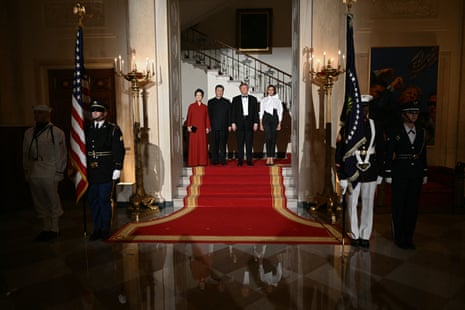
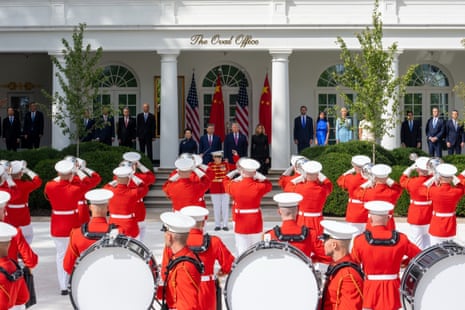
Inside the White House, the atmosphere was starkly different from the tension at the gates. President Trump and First Lady Melania Trump welcomed President Xi and his wife, Peng Liyuan, with a military review on the South Lawn. The visit, Xi’s first state visit to the U.S. in over a decade, was intended to address a range of friction points, including trade imbalances, the status of Taiwan, and the ongoing conflict in Iran.
During their initial bilateral meeting, the two leaders focused heavily on the future of technology. President Trump used the occasion to promote his preferred terminology for artificial intelligence, referring to it as "Super Intelligence" or "SI." In a post on his social media platform, the President claimed that both the U.S. and China agreed that development in this field should remain unhindered by international agreements, suggesting instead that the Department of Justice would serve as the primary "guardrail."
President Xi echoed the importance of the technological frontier but added a cautionary note. He told reporters that both nations "shoulder a responsibility to promote human progress" and must ensure that the development of AI "is always under human control and serves the wellbeing of the people." The dialogue underscored a shared recognition that the U.S.-China relationship remains the most consequential bilateral tie in the world, even as tensions simmer beneath the surface of formal toasts.
Trump’s State Dinner for Xi Jinping Will Not Be Televised Amid Pool Boycott
The absence of a television broadcast for such a high-stakes event is nearly unprecedented in the modern era. Typically, state dinners are choreographed for maximum visual impact, serving as a platform for "soft power" and diplomatic signaling. The White House attempted to bypass the network boycott by streaming the arrival ceremony on its official YouTube channel, but the effort met with limited success, drawing only about 18,000 live viewers.
Industry analysts noted that the network blackout deprived the administration of a massive domestic and international audience. The pool system, which allows the five major networks to share the burden and the access of filming the President, is built on a foundation of mutual cooperation with the White House Press Office. By targeting one member of that pool, the administration effectively broke the mechanism that ensures consistent national coverage.
The President, however, took to social media to blame the networks for the lack of coverage. He described the event as "magnificent" and "made for television," claiming that the outlets "refused to be there" because they did not want to give him credit for the summit’s success. He further asserted that his popularity was at an all-time high following his 2024 electoral victory, though data from Ballotpedia and other trackers suggest the 2024 popular vote margin was among the narrowest in recent history.
A Guest List of Tech Titans and Judicial Figures
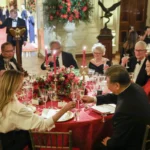
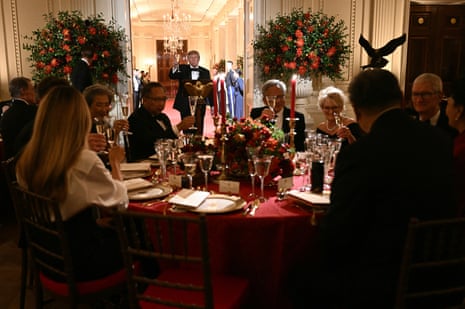
While the cameras were absent, the guest list for the dinner revealed the administration’s strategic priorities. The "top table" featured not only the two heads of state and their spouses but also the architects of the American tech economy. Elon Musk, Apple’s Tim Cook, and Nvidia’s Jensen Huang were seated prominently, highlighting the central role of the semiconductor and EV industries in U.S.-China negotiations.
The broader guest list was a "who’s who" of Silicon Valley and Washington power. Attendees included Sam Altman and Greg Brockman of OpenAI, Jeff Bezos of Amazon, Mark Zuckerberg of Meta, and Google’s Sundar Pichai. The presence of these executives suggested that the evening’s "Super Intelligence" agenda was as much about private sector interests as it was about statecraft.
In addition to the tech sector, the dinner was attended by three Supreme Court Justices—John Roberts, Amy Coney Barrett, and Brett Kavanaugh—alongside several prominent Fox News hosts. The inclusion of judicial and media figures known for their proximity to the administration further emphasized the domestic political alignment the President sought to project during the summit.
Soft Power and the First Ladies’ Tour
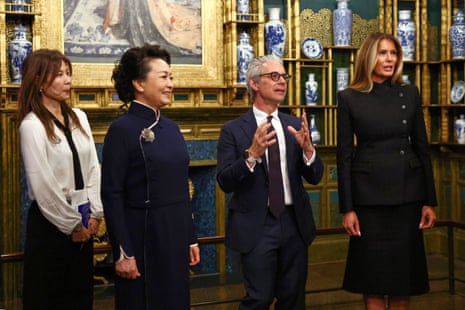
While the presidents focused on trade and technology, Melania Trump and Peng Liyuan engaged in a parallel track of cultural diplomacy. The two first ladies toured the Smithsonian’s National Museum of Asian Art, their first public meeting in nearly a decade. The tour included a visit to the "Peacock Room," a gilded masterpiece of interior design by James McNeill Whistler that symbolizes the fusion of Western and Eastern aesthetics.
The visit was punctuated by a performance from students at the Hope Chinese School, who serenaded the women with folk songs. Crowds gathered outside the museum waving both Chinese and American flags, a rare moment of public harmony in a week otherwise dominated by protest and litigation. This display of soft power was intended to signal that, despite the trade wars and geopolitical maneuvering, the cultural ties between the two nations remain resilient.
Global Pressures at the United Nations
The domestic media dispute occurred simultaneously with the third day of the United Nations General Assembly in New York City, where the Israeli-Palestinian conflict took center stage. Prime Minister Benjamin Netanyahu delivered a fiery address that was marked by mass walkouts from various international delegations. Netanyahu utilized part of his speech to attack New York City Mayor Zohran Mamdani, a progressive critic who has previously called for the Prime Minister’s arrest on war crimes charges.
Mayor Mamdani responded by releasing a video of himself hosting Palestinian families from Gaza at Gracie Mansion, planting an olive tree as a symbol of peace. Meanwhile, Palestinian Authority President Mahmoud Abbas addressed the assembly via a pre-recorded video, having been denied a visa by the Trump administration. Abbas urged the President to fulfill a 20-point peace plan for Gaza, warning that the "transitional period" must not become a permanent state of displacement for the Palestinian people.
Domestic Policy and the FDA Break
The administration also faced internal challenges on Thursday during a Senate confirmation hearing for Dr. Heidi Overton, the nominee to lead the Food and Drug Administration (FDA). In a notable departure from the President’s rhetoric, Dr. Overton affirmed under questioning that the MMR (measles, mumps, and rubella) vaccine is "safe and effective."
This testimony stood in contrast to President Trump’s previous descriptions of the vaccine as "lethal" and his executive order to break up the vaccination schedule. Senator Bill Cassidy, a physician and Republican from Louisiana, pressed Overton on whether she would allow political pressure to override scientific evidence. While Overton avoided a direct critique of the President, her insistence on the safety of the current vaccine market signaled a potential point of friction within the administration’s health policy team.
Conclusion and Next Steps
As the state dinner for Xi Jinping concluded in the quiet of a non-televised evening, the broader implications of the day’s events began to take shape. The media blackout has set a new and uncertain precedent for the relationship between the White House and the press corps. With the 14-day temporary restraining order now in effect, the courts will soon decide whether the administration’s attempts to limit access constitute a violation of the First Amendment.
For now, the administration remains locked in a multi-front battle: negotiating the future of global technology with Beijing, navigating a contentious war in the Middle East, and managing a domestic political environment increasingly defined by legal challenges and industry boycotts. The silent state dinner may well be remembered as a turning point in how the American presidency communicates—or fails to communicate—with the world.