London’s High Court has rejected a bid by British prosecutors to reinstate a "terrorism" charge against Liam O’Hanna, a member of the Irish rap group Kneecap, who had been accused of displaying a Hezbollah flag during a London concert. The ruling confirms a previous decision to dismiss the case, a move celebrated by O’Hanna and his bandmates as a victory against what they term a politically motivated prosecution.
Legal Battle Over Hezbollah Flag Culminates in High Court Decision
The Crown Prosecution Service (CPS) had appealed a lower court’s September decision to throw out the charge against O’Hanna, also known by his Irish name Liam Og O hAnnaid and his stage name Mo Chara. The initial dismissal was based on a technicality, and the CPS sought to overturn it, arguing for a broader interpretation of the law concerning the display of symbols associated with proscribed organizations. However, the High Court’s rejection means the case will not proceed, bringing a significant legal chapter to a close for the popular Irish-language hip-hop group.
The CPS acknowledged the High Court’s judgment, stating that the ruling had "clarified how the law applies" to such circumstances. The agency indicated it would review and update its internal processes in light of the decision. This outcome marks a significant setback for the prosecution’s efforts to pursue the charge under the United Kingdom’s 2000 Terrorism Act.
Background of the Allegations and Kneecap’s Stance
Liam O’Hanna was charged in May of the previous year with displaying a Hezbollah flag during a concert in London in November 2024. Hezbollah, a Lebanese political party and militant group, is designated as a terrorist organization by the United Kingdom and several other countries. The accusation specifically related to the alleged violation of the Terrorism Act, which prohibits the display of support for banned groups.
Kneecap, known for their energetic performances and lyrics delivered in both Irish Gaelic (Gaeilge) and English, has been a prominent voice criticizing Israel’s actions in the Gaza Strip. The band members have consistently characterized the prosecution as a "British state witch-hunt," asserting that the charges were intended to silence their activism and political commentary, particularly concerning the ongoing conflict in Palestine.
O’Hanna’s Declaration: A Political Statement, Not a Terror Threat
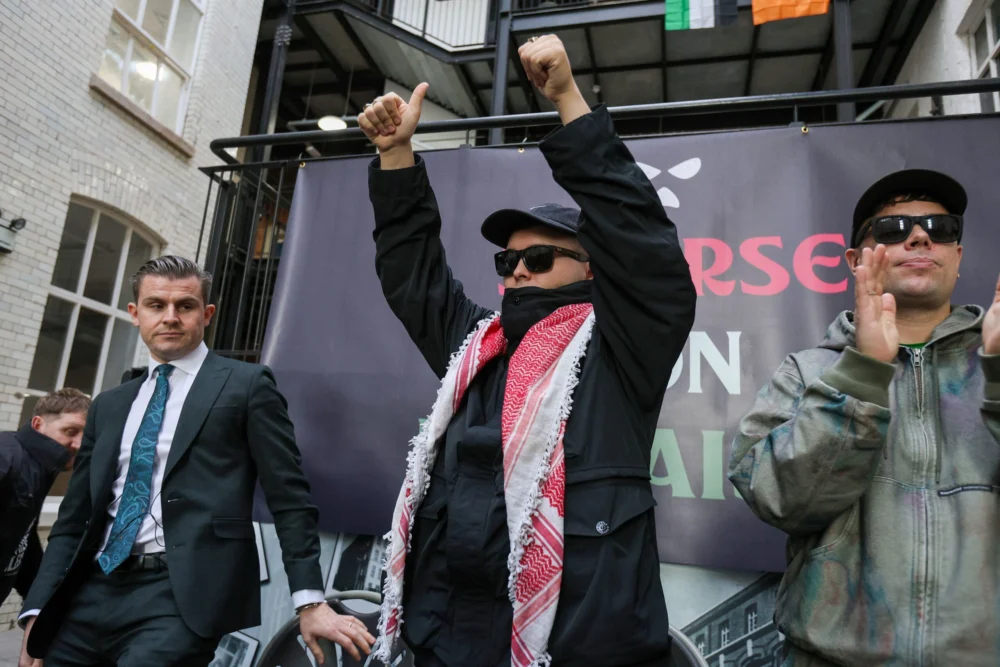
Following the High Court’s ruling, O’Hanna addressed supporters at a press conference in Belfast, Northern Ireland, expressing his relief and reaffirming his position. He declared that the case was "never about me, never about any threat to the public and never about terrorism." Instead, he argued, the prosecution was a direct response to his and Kneecap’s outspoken advocacy for Palestine and their efforts to expose perceived hypocrisy and war crimes.
"It was always about Palestine, about what happens if you dare to speak up, about what happens if you can reach large groups of people and expose their hypocrisy, about the lengths Britain will go to cover up Israeli and US war crimes," O’Hanna stated. His remarks, delivered with visible emotion and cheered by fellow band members and supporters, underscored the deeply political nature of the legal proceedings as perceived by the group.
Broader Implications: Free Speech, Activism, and International Politics
The case has resonated far beyond the legal arena, sparking debates about freedom of expression, the boundaries of protest, and the potential for state overreach in suppressing dissent, particularly when linked to international political issues. Kneecap’s supporters argue that the prosecution was an attempt to criminalize political speech and stifle activism critical of government foreign policy, particularly in relation to the Middle East.

O’Hanna directly challenged the UK government, stating, "Your own High Court ruled against you." He further accused British ministers of complicity in what he described as "genocide in Gaza, the destruction of Lebanon, and the senseless slaughter of schoolkids in Iran," drawing a stark contrast between the government’s actions and the charges brought against him. This rhetoric highlights the broader geopolitical context in which the legal battle took place, with Kneecap positioning themselves as opponents of state-sanctioned violence and oppression.
Kneecap’s Cultural Significance and Political Activism
Kneecap, comprising O’Hanna (Mo Chara), JJ O Dochartaigh (DJ Provai), and Naoise O Caireallain (Moglai Bap), has gained significant traction for their unique blend of Irish language hip-hop and potent political messaging. Their music often addresses themes of identity, social justice, and resistance, resonating with a growing audience that feels marginalized or unheard.
The band’s commitment to rapping in Gaeilge has also been a significant aspect of their identity, promoting the Irish language and culture while simultaneously engaging with global political issues. Their outspoken stance on the conflict in Palestine has aligned them with a broader movement of artists and activists using their platforms to raise awareness and demand accountability. The legal challenge they faced, therefore, was seen by many as an attack not just on an individual but on a movement and its right to speak out.
Technicalities and Legal Precedents
The initial dismissal of the charge due to a "technical error" points to the intricate nature of legal proceedings and the importance of procedural accuracy. While the CPS sought to re-evaluate the substance of the charge, the High Court’s decision to uphold the dismissal suggests that the procedural grounds for throwing out the case were sufficiently strong. Legal experts suggest that such technicalities can often hinge on precise wording in charging documents, the interpretation of specific statutes, or the proper application of evidential rules.
The CPS’s acceptance of the judgment and commitment to updating their processes indicates a recognition of the legal clarification provided by the High Court. This could have implications for how similar cases are handled in the future, potentially setting a precedent for the prosecution of charges related to displaying symbols of banned organizations.
Public Reaction and Solidarity
The outcome of the case has been met with widespread support from Kneecap’s fanbase and various human rights organizations. Many have viewed the attempted prosecution as an attempt to silence critical voices and to criminalize solidarity with Palestinian rights. The press conference in Belfast saw O’Hanna joined by his bandmates, who stood in solidarity as he addressed the media and his supporters.
The presence of his bandmates underscored the collective nature of Kneecap’s activism and the broader support network they have cultivated. The cheers from the assembled crowd reflected a sense of vindication and celebration of what many see as a victory for free speech and political expression.
Looking Ahead: Continued Activism and Artistic Expression
With the legal challenges now behind them, Kneecap is expected to continue their musical pursuits and their advocacy. The band has consistently demonstrated a commitment to using their platform to address social and political issues, and this experience is likely to further embolden their activism. The ruling allows them to focus on their art and their message without the cloud of a pending legal battle.
The case serves as a potent reminder of the complex interplay between artistic expression, political activism, and legal frameworks. It highlights the ongoing debates surrounding free speech, the definition of terrorism, and the rights of individuals to protest and express solidarity with international causes, particularly in the context of highly charged geopolitical conflicts. The resolution of this particular legal dispute allows Kneecap to move forward, their message amplified by the very controversy that sought to suppress it.