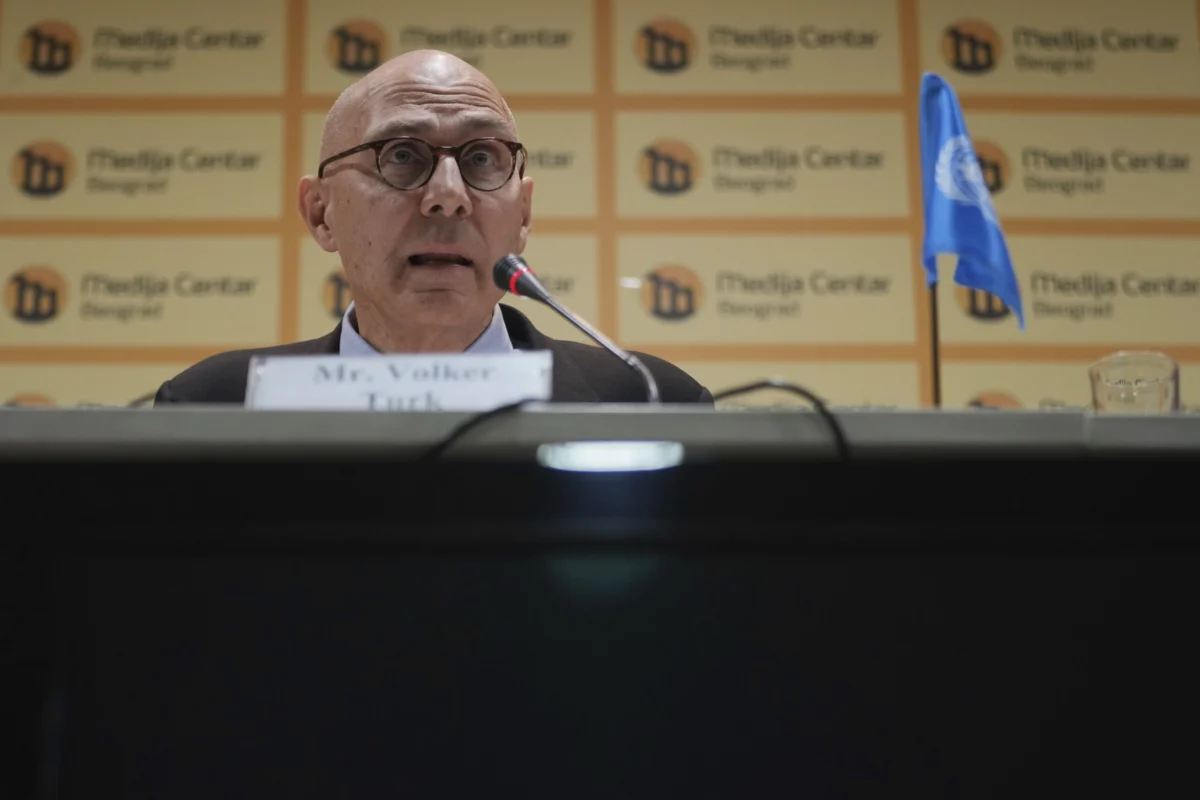
The United Nations General Assembly has overwhelmingly reappointed Volker Turk as the UN High Commissioner for Human Rights, granting him a second four-year term despite significant objections from the United States, Russia, and Israel. The decisive vote, with 144 member states in favor, 10 against, and 13 abstentions, underscores a stark division within the international body regarding Turk’s tenure and his assertive approach to human rights advocacy. Turk, an Austrian lawyer who has held the position since 2022, is now set to become the first individual to serve two full terms since the creation of the High Commissioner’s office in 1993.
The reappointment of Volker Turk comes after a contentious process, highlighting the delicate and often politically charged nature of the UN’s top human rights role. While the vast majority of member states backed Secretary-General António Guterres’s proposal to extend Turk’s mandate, the vocal opposition from three influential nations signals ongoing geopolitical tensions and differing interpretations of human rights priorities on the global stage. This outcome sets the stage for continued scrutiny of Turk’s work and the UN’s human rights machinery.
Who is Volker Turk? A Career Dedicated to Human Rights
Volker Turk’s career within the United Nations system spans over two decades, marked by extensive experience in refugee affairs and human rights advocacy. He joined the UN in 1999 and spent significant time with the UN Refugee Agency (UNHCR), serving in various capacities across diverse and challenging environments. His previous postings include assignments in Malaysia, Kosovo, Bosnia and Herzegovina, and the Democratic Republic of the Congo, where he gained firsthand experience with complex humanitarian crises and human rights violations.
Prior to assuming the role of High Commissioner for Human Rights, Turk held several senior positions at UN headquarters in New York. Notably, he served as the Assistant Secretary-General for Strategic Coordination under UN Secretary-General António Guterres, a role that is understood to have fostered a close working relationship between the two. This background has shaped his approach to the High Commissioner’s office, emphasizing a proactive and often critical stance on global human rights issues.
The Roots of Opposition: Turk’s Unflinching Criticisms
The controversy surrounding Volker Turk’s reappointment stems directly from his outspoken criticisms of several member states, including powerful nations like the United States, Russia, and Israel. In his capacity as UN High Commissioner, Turk has not shied away from publicly denouncing alleged human rights abuses and violations of international law, even when directed at countries with significant geopolitical influence.
Turk has been particularly vocal regarding the ongoing conflict in Gaza, labeling Israel’s actions as a "genocidal war" and condemning its operations in Lebanon. He has also expressed deep concern over the lack of accountability for alleged Israeli rights abuses in the occupied Palestinian territories, describing the situation as "shameful." His office’s reports and public statements have consistently highlighted the severe humanitarian impact and the violation of international norms.
Simultaneously, Turk has unequivocally condemned Russia’s invasion of Ukraine, characterizing it as "senseless" and a "blatant affront to the UN Charter and the whole body of international law." His office has documented extensive evidence of war crimes and human rights violations committed during the conflict, putting him at odds with Moscow.
Beyond these high-profile conflicts, Turk has also addressed human rights concerns in Afghanistan, Sudan, Bangladesh, Myanmar, and Nicaragua. His willingness to confront powerful governments has made him a target for criticism from those he has challenged.
Navigating Geopolitical Fault Lines: The Reappointment Process
The process leading to Volker Turk’s reappointment was marked by procedural debates and political maneuvering. Secretary-General Guterres put forward Turk’s name for a second term, a decision that triggered immediate reactions from member states with reservations. The UN General Assembly’s vote of 144-10, with 13 abstentions, demonstrates a clear majority in favor of Guterres’s recommendation, overriding the objections of a minority bloc.
Earlier attempts to derail or alter the timeline of the vote were made by key opposing nations. The United States proposed delaying the vote until the following week, an effort that was ultimately unsuccessful. Russia, meanwhile, sought to limit Turk’s term extension to only the end of the current year, a proposal that also failed to gain traction. These maneuvers highlight the intense diplomatic efforts undertaken by countries seeking to influence the outcome of the selection process.
US, Russian, and Israeli Objections: A Pattern of Discontent
The objections raised by the United States, Russia, and Israel against Volker Turk are rooted in his consistent and often sharp critiques of their foreign policies and actions. The role of the UN High Commissioner for Human Rights is inherently adversarial, requiring the officeholder to challenge governments when evidence suggests human rights violations. Turk’s tenure has been characterized by a commitment to this mandate, leading to friction with those he has publicly criticized.
Israel has been particularly incensed by Turk’s assessments of its actions in Gaza. The Israeli Ministry of Foreign Affairs issued a strong statement criticizing Turk’s record, alleging that under his leadership, the Office of the High Commissioner for Human Rights has "erased the atrocities of October 7, misused funds, and betrayed UN neutrality in favor of corrupt political radicalism." This accusation points to a fundamental disagreement over the framing and accountability of actions related to the conflict.
Russia’s Deputy Ambassador to the UN, Dmitry Chumakov, accused Turk of exhibiting bias and making unsubstantiated allegations against Russia. This criticism reflects Moscow’s broader stance against international scrutiny of its military operations and its perceived efforts to deflect blame for alleged human rights abuses.
The United States, while not directly targeted by Turk’s criticisms in the same manner as Israel or Russia concerning ongoing conflicts, has also expressed reservations. Historically, the US has sometimes taken issue with the UN Human Rights Council and its High Commissioner’s office, particularly when their pronouncements are seen as politically motivated or overly critical of US allies. During the Trump administration, Turk had raised concerns about the "dehumanisation" of immigrants and the treatment of migrants and refugees.
Criticisms of the Reappointment Process
Beyond the substantive criticisms of Turk’s performance and pronouncements, questions have also been raised about the process by which his reappointment was managed. Some critics have argued that the vote was "rushed," suggesting that the selection of a new rights chief should have been left to the successor of Secretary-General Guterres, whose own term concludes at the end of the year.
Guterres, in an effort to secure Turk’s reappointment before his departure, sent letters to UN regional groups informing them of his intention to reappoint Turk, leading to the vote taking place just weeks later. This timeline has been a point of contention. The US Department of State, for instance, criticized the swiftness of the vote, calling it "another example of the UN’s inherent corruption and incompetence." US Deputy Ambassador Jeff Bartos stated that reappointing Turk under these circumstances would demonstrate that the General Assembly "is dysfunctional."
Israel’s Foreign Ministry echoed this sentiment, labeling Guterres’s push for a second term for Turk a "moral failure" and reiterating that the decision should have been deferred to his successor.
However, UN spokesperson Stephane Dujarric defended the process, asserting that Guterres had adhered to UN rules and acted "in a very transparent manner." Dujarric highlighted that consultations with member states and regional groups had taken place prior to the formal appointment, aiming to counter accusations of impropriety.
Broader Scrutiny and Lingering Questions
Volker Turk has faced other criticisms during his tenure that extend beyond the immediate controversies with the US, Russia, and Israel. Some observers have pointed to his handling of the report issued by his predecessor, Michelle Bachelet, concerning China’s detention of Uyghurs and other Muslim ethnic groups in Xinjiang. Critics have suggested that Turk could have been more assertive in following up on Bachelet’s findings, which indicated potential crimes against humanity.
Turk’s office has stated that it has engaged with Beijing both privately and publicly to advocate for human rights in China. Similarly, while independent UN human rights experts have accused Israel of genocide in Gaza, Turk himself has stopped short of using that specific terminology in his public statements, a stance that has drawn criticism from some human rights advocates who believe a stronger condemnation is warranted.
The reappointment of Volker Turk as the UN High Commissioner for Human Rights represents a significant moment for international human rights diplomacy. While the overwhelming vote in the General Assembly signals a broad consensus among member states in support of his leadership, the persistent opposition from key global powers underscores the deep divisions and complex political dynamics that characterize the pursuit of human rights on the international stage. His second term will undoubtedly be closely watched as he continues to navigate these challenging geopolitical currents.