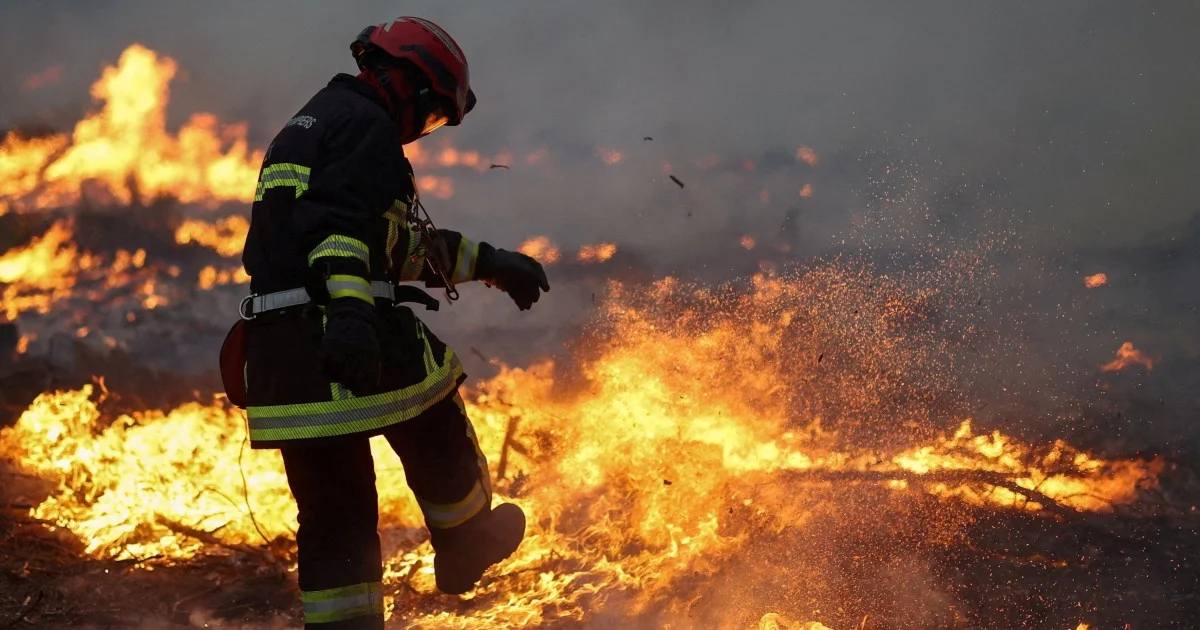
Southwestern Europe is grappling with a devastating surge of wildfires, forcing mass evacuations and straining emergency resources as blazes scorch vast tracts of land in France and Spain. More than 325,000 people have been displaced from their homes in a crisis described by authorities as unprecedented, with thousands of firefighters battling infernos that have been exacerbated by record-breaking heatwaves.
The current wildfire season has seen some of the most severe fires in France since World War II, painting a grim picture of escalating climate-related disasters across the continent. The sheer scale of the destruction underscores the growing challenge faced by European nations in combating increasingly intense and frequent wildfires.
Scale of Destruction and Displacement
In France, Interior Minister Laurent Nunez reported that approximately 115,000 hectares (284,171 acres) have been consumed by wildfires since the beginning of the year. Spain has fared no better, with 119,458 hectares (295,187 acres) burning as of July 22, according to data from the Copernicus European Forest Fire Information System (EFFIS). Prime Minister Pedro Sanchez of Spain stated that over 150,000 hectares have been lost nationwide since January, a figure six times greater than that recorded during the same period last year.
These figures are part of a concerning continental trend. In 2025, wildfires ravaged 2.2 million hectares (5.4 million acres) across Europe, a significant increase from the 1.4 million hectares (3.5 million acres) destroyed in 2022, according to United Nations data. This escalation highlights the growing vulnerability of European landscapes to fire.
Key Developments and Hotspots
The current crisis has intensified since early July, with southern and western Europe bearing the brunt of the devastation. France and Spain have seen the most severe impacts, leading to widespread evacuations and emergency responses.
In Spain, a rapidly advancing wildfire in the Andalusia region claimed at least 12 lives on July 10. By July 20, the fires had spread hundreds of kilometers, reaching the outskirts of the capital, Madrid. In the central Madrid region alone, at least 10,000 people were evacuated, with an additional 30,000 ordered to shelter in place. On July 24, Spanish authorities declared a national emergency, acknowledging that two major blazes were "out of control."
A separate wildfire in Spain’s eastern Castellon province ravaged over 4,300 hectares (10,625 acres) over a weekend. Regional leaders described the situation as technically difficult to manage due to adverse weather conditions. This particular blaze entered the Sierra de Espadan natural park, a region known for its extensive pine and cork oak forests.
France is experiencing wildfires of a magnitude not seen since the Second World War. The Cap Ferret peninsula, a popular holiday destination on the southern Atlantic coast near Bordeaux, has been particularly hard-hit. Al Jazeera correspondent Nina Montagu-Smith reported from Maubec, near Toulouse, witnessing the fires from across the bay in Arcachon. Within hours, the sky darkened with thick smoke, leading to the cancellation of all trains from Arcachon due to an alleged "electrical fault." Fire engines were observed en route from Bordeaux towards Arcachon, with smoke reaching as far as Libourne, where ash fell from the sky. Further east, near Toulouse, a persistent smoky haze and the smell of burning remained evident.
The wildfires have also spread to areas surrounding Bordeaux, a major city and a hub for tourists visiting the Atlantic coast. Firefighters are working to prevent the flames from reaching the regional capital, with Bordeaux Mayor Thomas Cazenave stating the fire was just 15 kilometers (9 miles) from the city’s entrances. Interior Minister Laurent Nunez described the situation as "unprecedented" and "very unfavorable," with the fire moving towards urban areas. Approximately 197,000 people have been evacuated from areas around Bordeaux, including popular tourist resorts. The region, famous for its vineyards, is a critical transport hub, and the fires have significantly disrupted travel plans.
The Challenge of Pyrocumulonimbus Clouds
A significant factor contributing to the ferocity and difficulty of controlling these wildfires is the formation of pyrocumulonimbus clouds, a phenomenon described as unprecedented in southwestern Europe. These towering thunderclouds are generated by the intense heat from the Earth’s surface, fueled by the fires themselves.
According to the British Royal Meteorological Society, these fire-generated clouds create conditions that make firefighting operations exceedingly challenging. While they can produce rain, this precipitation can carry burning embers, igniting new fires far from the original blaze. In some instances, dry lightning strikes from these storms can occur without rain, further spreading the wildfires.
A spokesperson for the National Firefighters Federation of France (FNSPF) explained that lightning forming within these clouds can strike embers on the ground, intensifying the fire. This phenomenon, common in regions like Canada and Australia, is a new and alarming development for France. The situation has led to what firefighters describe as "operational impossibility," necessitating a strategic retreat and acknowledgment of natural forces beyond immediate control. The focus has shifted from offensive to defensive tactics, prioritizing the safety of personnel and residents in a "war-like scenario."

International Response and Resource Strain
The overwhelming nature of these wildfires has prompted Spanish and French authorities to appeal for international assistance. The European Union’s civil protection mechanism is actively monitoring the situation and coordinating aid. Greece and Italy have dispatched firefighting aircraft to Spain, while Portugal has sent over 100 military personnel and equipment. Turkey is also expected to send two additional aircraft.
Spanish Prime Minister Pedro Sanchez visited fire-affected areas, emphasizing the critical window to combat the blazes and protect lives and communities. His government announced plans to declare a civil protection emergency for the central provinces most impacted by the wildfires, which would unlock additional recovery funding.
French Prime Minister Sebastien Lecornu has convened multiple crisis meetings to address the escalating emergency, stating that the fires have reached an unprecedented level. President Emmanuel Macron was also scheduled to hold a cabinet crisis meeting.
Underlying Causes: Climate Change and Land Management
Experts point to a confluence of factors driving the severity of the current wildfires, with climate change playing a pivotal role. Increasingly extreme weather events, such as the record-breaking heatwaves experienced this summer, have created tinderbox conditions across Europe.
Eduardo Rojas, chairman of the Board at the Programme for the Endorsement of Forest Certification, highlighted the complex interplay of factors. He noted that fires often occur in wildland-urban interfaces where development has occurred without proper urban planning, leading to inadequate infrastructure, limited water availability, and a lack of local knowledge about fire risks. This complexity can create hesitation and slow down response efforts.
Furthermore, agricultural practices, such as cereal harvesting, can become ignition points. A small lightning strike or spark can ignite dry crops, leading to extensive agricultural area fires that cause significant damage to farmers. Rojas stressed that these fires require distinct approaches due to their varied causes and environmental conditions.
Laurie Laybourn, executive director of the Strategic Climate Risks Initiative, stated that governments across Europe are struggling to keep pace with the accelerating rate of climate change. He explained that current planning tools and analyses often fall behind the speed at which climate change is intensifying disasters.
The European Forest Institute defines a wildfire as a chemical combustion requiring heat, oxygen, and fuel. It asserts that wildfire risks are increasing globally due to climate change and land-use changes. The World Health Organization’s regional director for Europe has issued warnings that climate change is directly intensifying wildfires and increasing their frequency.
Laybourn described climate change as "supercharging" events like wildfires, making existing vulnerabilities more pronounced. He emphasized that while disasters are complex and involve multiple factors, including human settlement patterns, climate change is creating the underlying conditions that amplify these risks. This has been a predicted outcome for decades, and its tragic manifestation is now unfolding.
Copernicus, the EU’s climate change service, reports that Europe is warming at twice the global average since 1980, making it the fastest-warming continent. The summer heatwaves are a direct consequence of this warming trend, underscoring the urgent need for governments to prioritize climate action. Laybourn urged a moment of "profound alarm and reflection, particularly for governments."
Broader Implications and Future Outlook
The escalating wildfire crisis in southwestern Europe serves as a stark reminder of the profound and immediate impacts of climate change. The displacement of hundreds of thousands of people, the destruction of natural landscapes, and the strain on emergency services highlight the urgent need for enhanced preparedness and mitigation strategies.
The economic consequences are also significant, affecting tourism, agriculture, and vital infrastructure. The disruption to events like the Tour de France, where security forces were redeployed to aid firefighting efforts, illustrates the cascading effects of these environmental emergencies.
The situation demands a multi-faceted approach, encompassing not only immediate firefighting and disaster response but also long-term climate adaptation and mitigation policies. Investing in climate-resilient infrastructure, promoting sustainable land management practices, and accelerating the transition to renewable energy sources are crucial steps to building a more resilient future in the face of escalating climate threats. The ongoing wildfires in France and Spain are a clear signal that the time for decisive action is now.