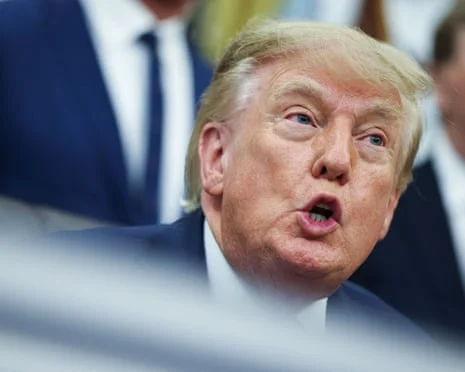
President Donald Trump solidified his administration’s aggressive stance against several major media organizations Friday, confirming that CNN, MS Now, and Politico have been indefinitely barred from White House grounds. Speaking during an Oval Office event primarily intended to discuss healthcare reforms and vaccine schedules, the president defended the move as a necessary response to what he characterized as a persistent stream of "fake news." The decision marks a significant escalation in the administration’s long-standing conflict with the press, signaling a potential permanent shift in how the executive branch manages media access.
The president’s announcement comes as the United States approaches the 2026 midterm elections, with control of both the House and Senate hanging in the balance. During the Friday event, which was ostensibly held to promote lower drug prices and a reduction in childhood vaccine doses, Trump was confronted by reporters regarding his oath of office and the First Amendment protections of the U.S. Constitution. When asked if the ban violated the right to free speech, Trump replied that he had grown "tired of reading and seeing fake news" and insisted that "somebody has a right to keep them away if they’re going to write false stories all the time."
Trump Doubles Down on Banning CNN, MS Now and Politico from White House as Media Tensions Escalate
The move to exclude these specific outlets—including MS Now, the digital successor to MSNBC—appears to be part of a broader strategy to curate a more favorable media environment for the administration. Trump specifically praised right-wing outlets like Breitbart and segments of Fox News for providing what he termed "fair press," while accusing non-partisan organizations of failing to provide even a "semblance of truth." The president further hinted that this list of restricted organizations is not finalized, explicitly mentioning the New York Times and the Washington Post as potential candidates for future bans.
This is not the first time the Trump administration has attempted to revoke the credentials of journalists. In 2018, the White House famously attempted to ban CNN’s Jim Acosta, a move that was eventually overturned by a federal judge. On Friday, the president attempted to reframe that historical loss, claiming the administration "didn’t have to take it too far" because the reporter had "discredited himself." However, legal records confirm that the first Trump administration relented only after a court order mandated the restoration of Acosta’s press pass. Legal experts suggest that this latest effort to bar entire organizations will likely face immediate challenges in the federal court system.
Constitutional Challenges and the First Amendment
The executive director of the Knight First Amendment Institute at Columbia University, Jameel Jaffer, issued a sharp rebuke of the president’s actions, stating that the First Amendment prohibits the punishment of journalists based on the tenor of their coverage. Jaffer argued that the White House press pool functions as a "public forum," meaning the government cannot exclude participants based on their viewpoints. Despite these warnings, the administration appears undeterred, with the president suggesting that the courts should not allow "fake news to be written day after day."
Democratic lawmakers have also reacted with alarm. Senate Minority Leader Chuck Schumer characterized the ban as a move "straight out of the authoritarian playbook," accusing the president of attempting to manipulate public perception and hide the truth. Governor JB Pritzker of Illinois, a frequent critic of the administration and a rumored 2028 presidential contender, posted on social media that the ban was an attempt to distract from a "failing record" as the midterms approach.
The Broader Context of the 2026 Midterm Elections
The escalation of hostilities with the press occurs against a backdrop of significant domestic and international challenges. Early voting began Friday in several states, including Virginia, Minnesota, and South Dakota. These elections are being held under a cloud of economic anxiety and the continuing war in Iran, a conflict that has entered its seventh month despite initial administration promises of a swift victory.
Economic indicators show that mortgage rates are nearing 7% and consumer prices have risen 3.4% over the last year. Gas prices remain near their highest levels since 2022, creating a difficult political landscape for Republican candidates. A recent poll by the Washington Post and the Schar School indicated that more than 60% of voters in Michigan, a critical swing state, disapprove of the administration’s tariffs on Canada. The trade war with America’s northern neighbor has disrupted vital supply chains, particularly in border states that rely heavily on cross-border commerce.
International Turmoil and the War in Iran
The human cost of the administration’s foreign policy is also coming under renewed scrutiny. While the Pentagon officially reports 18 American service member deaths in the Iran conflict, a new report from the Washington Post suggests the true figure is at least 22. Frustrated officials who spoke to the paper indicated that the Department of Defense may be undercounting casualties to mitigate public opposition to the war.

President Trump, however, remains optimistic about the conflict’s trajectory. In a recent interview with NewsNation, he claimed that the Iranian regime is "losing in every way" and expressed a desire to "make a deal," provided the terms are favorable to the United States. The administration has implemented secondary sanctions and a counter-blockade after Iran effectively closed the Strait of Hormuz, a move that has strangled global energy supplies and contributed to rising costs at home.
Ethics and Oversight: The Kremlev and Patel Controversies
The Friday Oval Office event also touched on ethical questions surrounding the president’s family. Reporters questioned Trump about reports that Umar Kremlev, a Russian official with ties to the Kremlin, had partially funded Donald Trump Jr.’s wedding celebration in the Bahamas. The president defended the arrangement, calling it "totally allowed" and suggesting that such gifts are common among friends. He added that his son had since "paid him back," though he admitted he did not know if a background check had been performed on the Russian oligarch.
Simultaneously, the administration’s relationship with international law enforcement has been strained by the actions of FBI Director Kash Patel. Reports emerged Friday that Patel briefly halted cooperation with the Royal Canadian Mounted Police (RCMP) in retaliation for editorial guidelines issued by the Canadian Broadcasting Corporation (CBC). The CBC had reportedly advised staff not to use the word "terrorist" to describe the September 11 attacks without attribution, prompting Patel to threaten a break in ties with any Canadian agency that did not "publicly reject this bastardization of history."
Technology, AI, and Global Diplomacy
As the administration navigates these various crises, it is also preparing for a high-stakes state dinner with Chinese President Xi Jinping next week. The meeting is expected to focus on stability in the U.S.-China relationship, with discussions ranging from Taiwan to the global implications of artificial intelligence. High-profile tech executives, including OpenAI CEO Sam Altman and Nvidia’s Jensen Huang, are expected to attend, as is JPMorgan Chase CEO Jamie Dimon.
The summit comes as domestic pressure for AI regulation grows. Governors Josh Shapiro of Pennsylvania and Gavin Newsom of California have both recently called for federal guardrails on the technology. This follows warnings from industry insiders at Anthropic who suggested that runaway AI development could pose an existential threat to humanity within the decade. While Trump has generally favored a deregulatory approach to AI to maintain a competitive edge over China, his administration now faces a growing bipartisan consensus that some form of oversight is necessary.
Immigration and Law Enforcement Under Scrutiny
On the domestic front, the administration’s immigration policies continue to draw criticism. Analysis shared with the Guardian indicates that over 90% of undocumented children who arrived in the U.S. unaccompanied in August have been sent to unlicensed shelter networks in Texas. Advocates describe these facilities as a "deportation churn-out factory," where access to legal counsel is severely limited.
Furthermore, a federal immigration officer in Minneapolis, Christian Castro, pleaded not guilty Thursday to charges of lying to the FBI. Castro is accused of shooting a Venezuelan man in the leg during a deportation sweep and then falsely claiming he was attacked first. He is the first federal officer to be charged in connection with "Operation Metro Surge," a massive deployment of armed agents to Minnesota cities earlier this year.
Institutional Battles in Washington
The administration is also locked in legal battles over the naming of iconic Washington institutions. Former staff members of the U.S. Institute of Peace have asked a federal court to prevent the administration from carving the president’s name into the building’s facade, following its renaming as the "Donald J. Trump United States Institute of Peace." A similar dispute is unfolding at the Kennedy Center, where a judge recently ordered the board to provide 30 days’ notice before making any physical changes to the structure. This follows threats from the president to "rip down" the center amid a disagreement over a proposed $257 million renovation that would also bear his name.
As President Trump doubles down on banning CNN, MS Now and Politico from White House events, the move is increasingly viewed as a central component of his broader effort to consolidate executive authority and marginalize dissent. With the midterms looming and multiple legal and international crises unfolding, the administration’s battle with the press corps appears likely to remain a defining feature of the current political era.