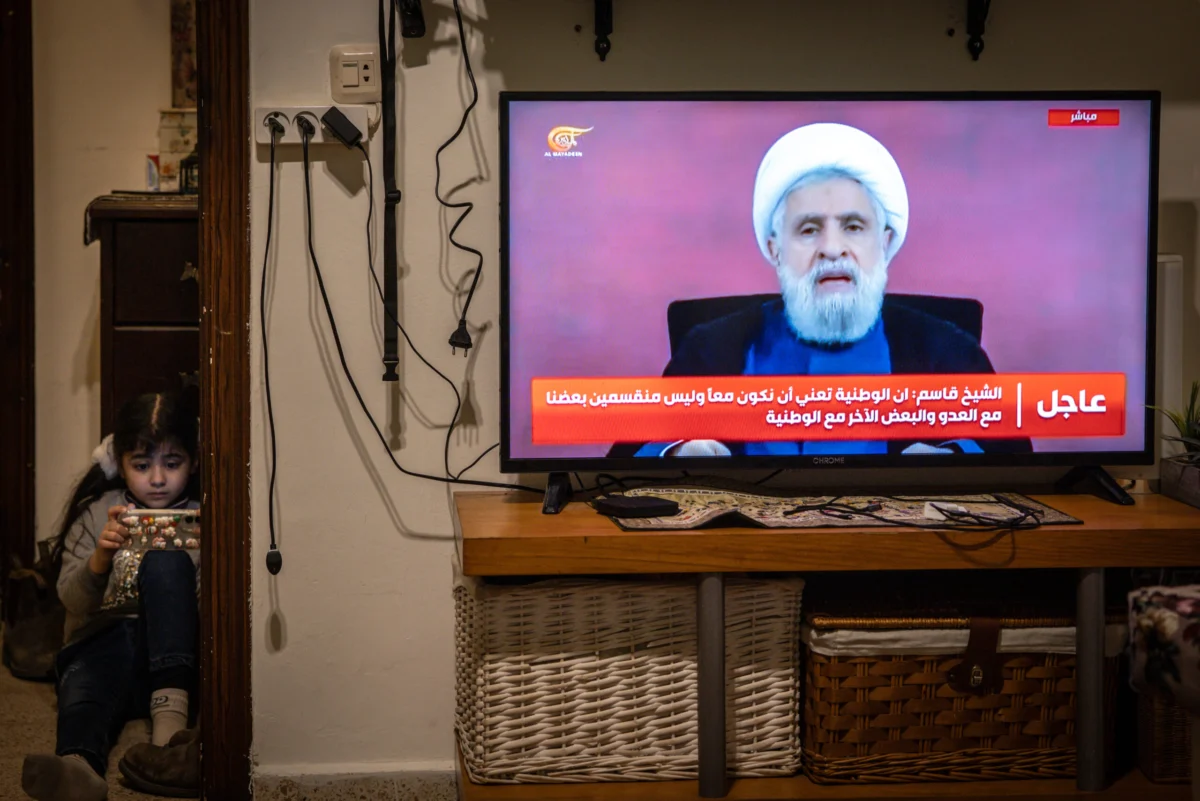
Hezbollah’s deputy leader, Naim Qassem, issued a stark warning Tuesday, urging the Lebanese government to boycott scheduled talks with Israel in Washington D.C., denouncing them as a disingenuous American-led maneuver aimed at disarming the powerful Shiite militia. Qassem’s forceful condemnation comes amid escalating cross-border hostilities and deepens the chasm between Hezbollah’s militant stance and the Lebanese government’s diplomatic overtures.
Hezbollah Rejects Diplomatic Path, Cites Israeli Objectives
Speaking in a televised address, Qassem characterized the planned U.S.-hosted meeting between Lebanese and Israeli representatives as "futile" and a clear attempt to coerce Hezbollah into relinquishing its arms. He directly challenged the legitimacy of any negotiation where the predetermined objective, as articulated by Israeli Prime Minister Benjamin Netanyahu, is the disarmament of his organization. "Israel clearly states that the goal of these negotiations is to disarm Hezbollah," Qassem stated, directly questioning the wisdom of participating in such a dialogue.
The Hezbollah leader unequivocally rejected any compromise on the group’s armed resistance, declaring, "We will not rest, stop or surrender. Instead, we will let the battlefield speak for itself." This defiant declaration underscores Hezbollah’s commitment to its military operations as its primary means of engagement, viewing diplomacy under current conditions as a strategic concession rather than a path to lasting peace.
Escalating Conflict Fuels Diplomatic Tensions
The proposed talks emerge against a backdrop of significantly intensified Israeli military operations in southern Lebanon. These actions followed a substantial rocket barrage launched by Hezbollah in early March, which, according to the group, was a direct response to the killing of Iran’s Supreme Leader Ayatollah Ali Khamenei and a retaliatory strike in the context of a broader U.S.-Israel war on Iran.
Prior to this escalation, a fragile ceasefire had ostensibly been in place since November 2024, brokered after an earlier period of intense conflict. However, Israel’s continued near-daily attacks on Lebanese territory, characterized by deadly strikes and a ground invasion in the south, have shattered any semblance of a lasting truce. The human toll has been devastating, with Lebanese authorities reporting at least 2,055 fatalities, including 165 children and 87 medical workers, alongside over 6,500 wounded and an estimated 1.2 million displaced.
Lebanon’s Strategic Dilemma: Ceasefire vs. Peace Talks
Lebanese officials have consistently emphasized that their immediate priority is securing a comprehensive ceasefire to halt the ongoing violence and humanitarian crisis. In contrast, Israel has publicly articulated its desire for formal peace negotiations with Lebanon, with the disarmament of Hezbollah placed at the forefront of its agenda. Prime Minister Netanyahu reiterated this stance on Saturday, stating, "We want the dismantling of Hezbollah’s weapons, and we want a real peace agreement that will last for generations."
This divergence in objectives places the Lebanese government in a precarious position. The prospect of direct negotiations, particularly those orchestrated by the United States with a clear Israeli precondition of Hezbollah’s disarmament, is viewed by many within Lebanon as a dangerous gamble. Qassem’s appeal for a "historic and heroic stance" from the government highlights the internal political pressures and the deep divisions surrounding engagement with Israel.
Public Opposition Mounts Against U.S.-Brokered Talks
Qassem’s pronouncements were echoed by widespread public dissent in Lebanon. Hundreds of citizens took to the streets in the capital, Beirut, over the weekend, protesting vehemently against the planned U.S.-mediated discussions. Demonstrators accused Prime Minister Nawaf Salam of betraying the Lebanese populace by considering direct talks with Israel while the nation endures relentless bombardment and an expanding ground offensive. The protests underscore a significant segment of Lebanese society that views any diplomatic overtures under current circumstances as a betrayal of national sovereignty and a capitulation to Israeli demands.
The sentiment of betrayal is amplified by Hezbollah’s perception of being undermined by its own government. Qassem accused Beirut of "backstabbing" the group by declaring Hezbollah’s military activities illegal at the outset of the wider conflict, a move he believes was influenced by U.S. and Israeli pressure. He further argued that the Lebanese army, which the U.S. and Israel reportedly aim to strengthen to counter Hezbollah, is incapable of fulfilling such a role.
Battlefield Developments Underscore Military Reality
The ongoing military engagements continue to shape the political and diplomatic landscape. On Monday, the Israeli military announced that its forces had completely encircled the strategically important southern Lebanese town of Bint Jbeil. Simultaneously, Hezbollah claimed responsibility for ongoing attacks against Israeli forces operating in the area, highlighting the persistent and fierce resistance encountered by the Israeli military.
Qassem’s rhetoric extended to issuing direct threats to northern Israeli territories, asserting that these areas "will not be safe, even if the Israelis were to enter any area of Lebanon." This statement serves as a potent reminder of Hezbollah’s capacity to project force beyond the immediate border region and to inflict significant costs on Israel should the conflict intensify or expand.
The Strategic Imperative for Hezbollah
For Hezbollah, the proposed negotiations represent a critical juncture. The organization has long positioned itself as a bulwark against Israeli occupation and aggression, and its armed wing is a cornerstone of its political and social influence within Lebanon. The prospect of disarming under duress, particularly when coupled with the ongoing Israeli military pressure, is seen as an existential threat to the group’s identity and operational capacity.
Qassem’s emphasis on the need for Lebanese consensus to shift from non-negotiation to direct talks also points to the complex internal political dynamics at play. Such a shift would require overcoming significant domestic opposition and the deeply entrenched historical animosity towards Israel. He characterized the potential move toward negotiations as a "free concession" to Israel and the United States, implying that Lebanon would gain little and concede much without achieving its primary objective of ending the violence.
Broader Regional Implications and Future Trajectories
The standoff between Hezbollah and the Lebanese government, mediated by the United States and framed by the ongoing conflict with Israel, has significant regional implications. The involvement of Iran, a key backer of Hezbollah, looms large in the background, with any perceived concessions by Beirut potentially impacting the broader Iran-U.S. geopolitical contest.
The continued Israeli military operations in southern Lebanon, coupled with the diplomatic deadlock, suggest a prolonged period of instability. The failure to achieve a lasting ceasefire, let alone a comprehensive peace agreement, points towards a continuation of the current cycle of violence. The Lebanese government faces the unenviable task of navigating these treacherous waters, balancing the immediate need for peace and reconstruction with the formidable challenges posed by regional power dynamics and the unyielding stance of powerful domestic actors like Hezbollah. The proposed talks, therefore, represent not just a bilateral diplomatic engagement but a flashpoint in a much larger regional struggle, with the future of Lebanon and the stability of the wider Middle East hanging in the balance.