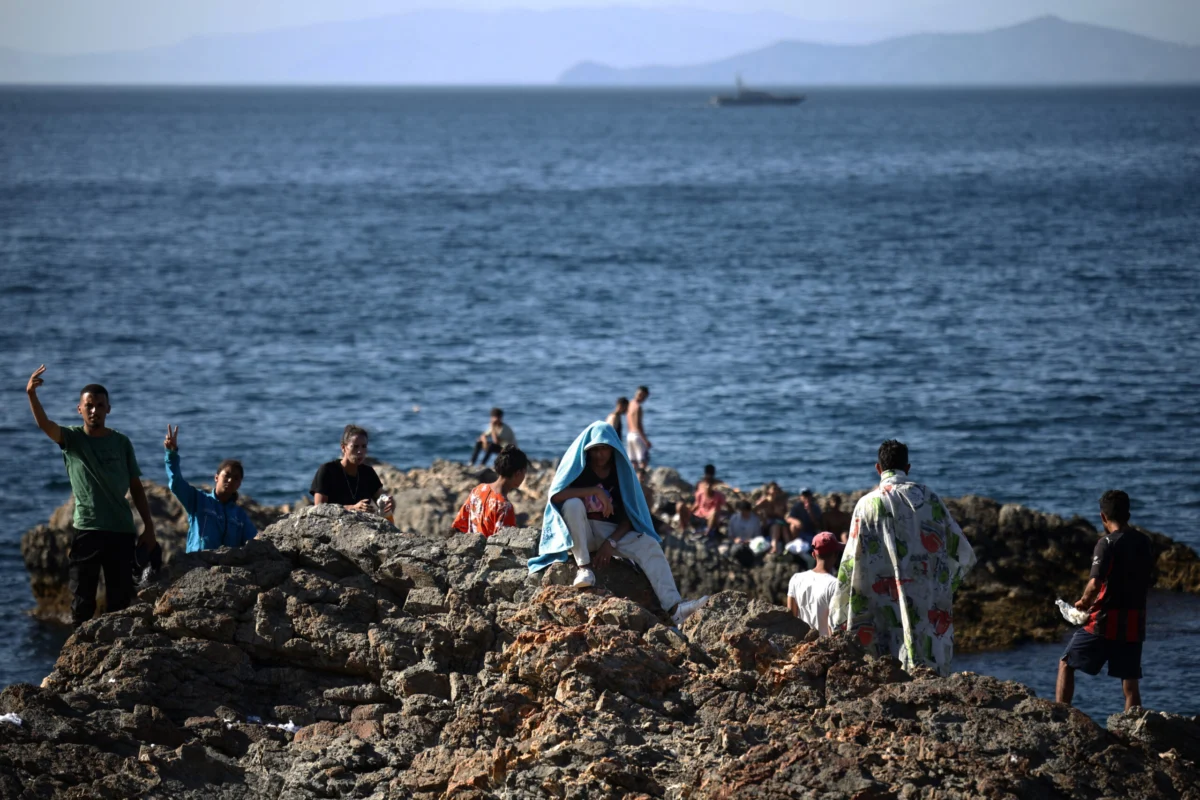
An unprecedented surge of tens of thousands of Moroccan migrants, swimming and clambering across the border into Spain’s North African enclave of Ceuta, has overwhelmed local resources, triggered a significant military deployment, and exposed the perilous realities of clandestine migration, with dozens confirmed dead and many more attempting the dangerous journey again.
The sudden influx, which saw an estimated 60,000 individuals arrive in Ceuta over a 24-hour period, created a humanitarian crisis that stretched the autonomous city’s infrastructure to its breaking point. Businesses shuttered their doors, and the limited accommodation available for migrants was quickly filled, forcing many to sleep on the streets. The sheer scale of the arrival necessitated a rapid response from Spanish authorities, including the deployment of military personnel to bolster border security and manage the chaotic situation.
For residents like Isabel Hossein, a port police officer who commutes from the mainland Spanish city of Algeciras to her home in Ceuta, the experience was jarring. Hossein, who holds the necessary documentation to cross freely, described the scene as overwhelming and frightening. "People were afraid; there were so many young men everywhere," she stated, reflecting the palpable anxiety that gripped the city.
Ceuta, a city with a unique cultural tapestry where Christian and Muslim communities have historically coexisted peacefully, found its social fabric tested by the sheer volume of arrivals. Hossein, who identifies as half Christian and half Muslim, emphasized the shock of the numbers. "We live peacefully together," she said. "But the numbers this time were scary." The rapid influx contrasted sharply with the usual flow of people who cross legally, often for routine visits or to return home for holidays.
The journey to Ceuta for these undocumented migrants is often a desperate gamble driven by promises of a better life, economic opportunity, and safety. Many were reportedly lured by social media posts and word-of-mouth information, suggesting that reaching Spain would lead to employment and improved living conditions. "For the good life, humanity, safety, and all the things you need," one migrant, Abdelmajid, explained as his motivation for undertaking the perilous voyage.
However, the reality upon arrival was far from what was promised. Many migrants faced extreme heat, thirst, and a hostile reception. The perilous crossing itself, often undertaken by swimming or using makeshift flotation devices, claimed numerous lives. By Saturday evening, police divers were still recovering bodies from the waters surrounding Ceuta, a grim testament to the deadly consequences of this migration route.
The sheer number of arrivals in such a short span of time highlighted the porous nature of the border between Morocco and the Spanish enclave. While Spanish authorities reported that approximately 90 percent of the estimated 60,000 arrivals had been returned to Morocco by Saturday night, the resolve of many to try again was evident. Some migrants indicated their intention to reattempt the crossing, signaling a persistent drive to reach European shores.
The Spanish government has attributed the crisis to criminal gangs and human traffickers who exploit vulnerable individuals. This narrative is echoed by some opposition politicians who have criticized the current government’s immigration policies, with some using terms like "invasion" to describe the events.
The situation in Ceuta also became a focal point for political actors seeking to shape public discourse on immigration. Zia Yusuf, a prominent figure from the anti-immigration Reform UK party, was present in Ceuta, engaging with migrants and sharing his observations on social media. Yusuf posted on his X account, describing the scene as a "60,000 strong invasion" and noting that some Moroccan men he spoke with expressed a desire to reach Britain.
This account from Yusuf contrasts with the immediate observations of many migrants interviewed on the ground, who did not explicitly state Britain as their primary destination. However, the allure of a better life in Europe, regardless of the specific country, remains a powerful motivator for those undertaking these dangerous journeys.

The concept of this migration being a "game" was articulated by one individual who witnessed the social media influences. "They were told to come. I saw it on Instagram, ‘Go to Spain and get money, jobs,’" she said. "It’s all a game." This perspective underscores the manipulative tactics employed by some to entice migrants, turning their desperation into a risky pursuit.
The Perilous Journey to Ceuta
The journey across the Strait of Gibraltar to Ceuta is fraught with danger, particularly for those without any form of watercraft. The distance between the Moroccan coast and the Spanish enclave can be covered by swimming, but the sea conditions, strong currents, and the sheer physical exertion required make it a life-threatening endeavor. Many migrants resort to using inflatable rafts, inner tubes, or other improvised flotation devices, which often prove inadequate against the unpredictable nature of the sea.
The migrants who arrived in Ceuta were predominantly young men, many of whom had undertaken journeys from various parts of Morocco. Their motivations ranged from escaping poverty and lack of opportunity to seeking refuge from conflict and political instability in their home regions. The economic disparities between Morocco and Spain, coupled with perceived social freedoms and access to welfare systems in Europe, act as significant pull factors.
Escalation of Border Security
In response to the unprecedented influx, Spain significantly heightened its border security measures. The Spanish interior ministry announced the deployment of 60 members of the armed forces and an additional 30 Guardia Civil officers to Ceuta. This militarization of the border aims to deter further mass crossings and regain control of the situation. The presence of military personnel was evident as migrants were seen being escorted back towards Morocco under their watchful gaze.
Political Ramifications and Narratives
The events in Ceuta quickly became a highly politicized issue in Spain. The government faced criticism from opposition parties, who accused it of mishandling the immigration crisis. The framing of the situation varied widely, with some labeling it an "invasion" and others emphasizing the humanitarian aspect of the migrants’ plight. This political rhetoric often dictates the public perception and policy responses to such events.
The presence of figures like Alvise Pérez, a far-right influencer and Member of the European Parliament, further amplified the political discourse. His appearance in Ceuta, under police protection, highlighted the growing influence of right-wing and anti-immigration movements in shaping the narrative surrounding migration. His social media posts, which framed the situation as an "invasion," reached a large audience, contributing to the polarization of the debate.
The Role of Traffickers and Social Media
The investigation into the mass arrivals has focused on the alleged involvement of criminal networks and human trafficking organizations. These groups are accused of orchestrating the crossings, often making false promises to migrants and charging them substantial sums of money for the perilous journey. Social media platforms have been identified as key channels for disseminating information and recruitment, with posts promising opportunities in Spain and other European countries.
The effectiveness of these social media campaigns in mobilizing such large numbers of people underscores the growing reliance on digital platforms for information dissemination, even for clandestine activities. The ease with which such messages can spread, often without verification, contributes to the allure of dangerous migration routes.
Long-Term Consequences and Broader Implications
The crisis in Ceuta has far-reaching consequences, not only for the migrants themselves but also for Spain and the broader European Union. It exacerbates existing tensions surrounding immigration policies and border control. The humanitarian cost, with lives lost and many more facing perilous journeys, raises urgent questions about international responsibility and the root causes of irregular migration.
The events also highlight the complex geopolitical relationship between Spain and Morocco, particularly concerning border management and security. The situation demands a coordinated approach involving both countries, as well as international cooperation, to address the underlying factors driving migration and to ensure the safety and dignity of those seeking a better life. The recurring nature of these attempts, with migrants signaling their intent to try again, suggests that without addressing the fundamental drivers of migration, such crises are likely to persist. The detritus of flippers and rubber floating devices left behind on Ceuta’s beaches serve as a stark reminder of a game played with tragic and often fatal consequences for those seeking refuge and opportunity.