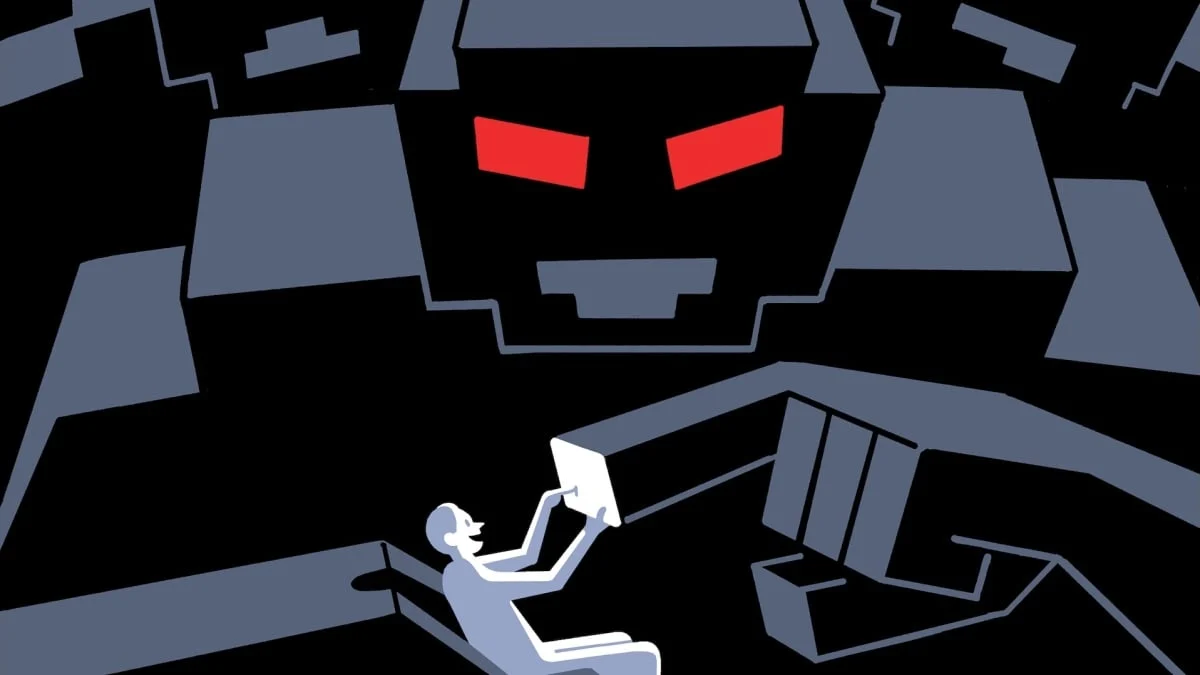
The New Yorker has released its highly anticipated "Future Issue," dated April 13, 2026, featuring a cover illustration that captures the growing anxiety surrounding the rapid advancement of artificial intelligence. Titled "New Horizon," the artwork by celebrated illustrator Christoph Niemann depicts a dystopian landscape where massive, looming robotic entities shadow a solitary, unsuspecting human user. The visual serves as a stark commentary on the shift from AI as a productivity tool to AI as a dominant force in the creative and professional landscape.
Niemann, a long-time contributor to the magazine, utilized a palette of deep reds and mechanical grays to evoke a sense of impending dread. The bots in the image are characterized by glowing red eyes that mirror the crimson sky, creating a monochromatic atmosphere of surveillance and intimidation. While the human figure in the foreground appears relaxed and engaged with a handheld device, the scale of the machines behind him suggests a power dynamic that has shifted entirely out of human control.
The release of this cover comes at a time when the tension between the creative community and AI developers has reached a boiling point. For many artists, the "Future Issue" is not merely a speculative exercise but a reflection of a current economic reality. The illustration has quickly become a focal point for discussions regarding the displacement of human labor and the ethical implications of machine-learning models trained on proprietary creative works.
The Artistic Vision of Christoph Niemann and the Evolution of the New Yorker’s Scary New Cover
Christoph Niemann is no stranger to technological experimentation, having created the magazine’s first augmented reality cover nearly a decade ago in 2016. However, his latest contribution signals a departure from his previous optimism regarding digital integration. In developing "New Horizon," Niemann collaborated closely with Françoise Mouly, the art editor of The New Yorker, to refine a concept that balances literal imagery with metaphorical depth.
Niemann has noted that the creative process for such a significant piece often involves a quick conceptual spark followed by intensive execution. The goal for "New Horizon" was to create an image that felt both immediate and timeless, capturing the duality of technology as something that feels benign on the surface but possesses a massive, underlying weight. The title itself serves as a double pun, referencing both the literal horizon depicted in the red-washed landscape and the metaphorical "new horizon" of human history dominated by synthetic intelligence.
The choice of a "horror-movie" aesthetic was intentional, aiming to cut through the polished, corporate marketing often associated with AI products. While tech companies frequently use soft colors and friendly interfaces to present their bots as helpful assistants, Niemann’s work strips away that veneer. By portraying the bots as gargantuan, faceless observers, the artist highlights the inherent power imbalance between the individual user and the massive datasets controlled by a handful of global corporations.
AI Bots Are Coming for Us: The Psychological Disconnect in Technology
One of the most striking elements of the cover is the oblivious nature of the human subject. Despite the terrifying scale of the AI bots looming over him, the person in the illustration appears content, bathed in the soft glow of his screen. Niemann has pointed out that this reflects the "obedient and relaxed" tone of modern AI interfaces, which are specifically designed to feel harmless and fun.
This psychological design choice by tech companies creates a disconnect between the user experience and the broader societal impact. While an individual may enjoy the convenience of a chatbot or an image generator, the cumulative effect of these technologies often involves the erosion of professional standards and the devaluation of human expertise. The "scary" element of the cover lies in this contrast—the person is enjoying the "benign" nature of the tool while remaining blind to the massive structural changes occurring just behind them.
Industry analysts suggest that this "cluelessness" is a primary reason why AI has been able to integrate so rapidly into the workforce. By framing the technology as a personal assistant or a "co-pilot," developers have mitigated public resistance. The New Yorker’s cover acts as a visual wake-up call, urging a move away from individual convenience toward a more holistic view of how these bots are reshaping the cultural and economic horizon.

The Economic Consequences for the Global Creative Community
As the narrative of "AI bots are coming for us" moves from science fiction to corporate strategy, the economic impact on artists has become a central theme of the 2026 discourse. Niemann has voiced significant concerns regarding the way AI models utilize human-made art. Unlike previous technological disruptions, such as the invention of photography, modern AI is often viewed by creators as a system built to plagiarize and repurpose existing work for profit without compensation or consent.
In the mid-2020s, the art world saw a surge in legal battles as illustrators, writers, and photographers fought back against tech giants. These creators argue that their portfolios are being used to train the very systems that are now replacing them in the commercial market. The "New Horizon" cover encapsulates this struggle, representing the feeling of being dwarfed by an entity that was built using the stolen labor of the people it now threatens to replace.
The transition has been particularly difficult for mid-level commercial artists who previously made a living through editorial illustration, stock photography, and graphic design. As AI bots become more capable of producing high-quality visuals in seconds, the demand for human-derived art has shifted. The industry is currently grappling with the question of whether "human-made" will remain a premium brand or if the efficiency of the machine will eventually render human creators obsolete in the eyes of corporate stakeholders.
Analyzing the Long-Term Impact on Media and Culture
The implications of the New Yorker’s scary new cover extend far beyond the visual arts. It raises fundamental questions about the value of human experience in media. Niemann has argued that while a robot might be able to play a piano with five times the speed and accuracy of a human, the performance lacks the essential human connection that audiences crave. This sentiment is at the heart of the current cultural debate: does the "perfection" of AI output compensate for the loss of human intent?
In the realm of journalism and media, the rise of AI bots has led to a saturation of content that is technically proficient but often lacks depth and original perspective. The "Future Issue" explores the risk of a feedback loop where AI models are trained on AI-generated content, leading to a degradation of cultural nuance. By centering the cover on the "terrifying days ahead," the magazine suggests that the real danger is not just the loss of jobs, but the loss of a human-centric reality.
Policy experts are also looking at the cover as a symbol of the need for stronger regulation. In 2026, the push for "AI labeling" and "provenance tracking" has become a major political issue. Advocates argue that consumers have a right to know if the media they are consuming was created by a person or a machine. The menacing figures in "New Horizon" represent the unchecked growth of these systems in a landscape that lacks sufficient legal and ethical guardrails.
Public Reaction and the Path Toward a Human-Centric Future
The public response to the New Yorker’s latest cover has been polarized, reflecting the broader societal split on technology. For tech enthusiasts, the image is seen as alarmist, an example of "Luddite" fear-mongering that ignores the potential for AI to solve complex global problems. However, for many in the labor and creative sectors, the image is a validation of their lived experience and their fears regarding the future of work.
Despite the dark imagery, there remains a persistent hope that the value of human-derived art will endure. The "piano player" analogy used by Niemann resonates with those who believe that art is fundamentally a form of communication between two human souls. If art is reduced to a mere commodity produced by an algorithm, it loses its ability to challenge, inspire, and reflect the human condition.
As 2026 progresses, the conversation sparked by the "New Horizon" cover is expected to influence upcoming legislative sessions regarding copyright and AI ethics. The image serves as a permanent record of a pivotal moment in history—a time when humanity stood on the brink of a new era, looking up at the massive structures it had built and wondering if there was still a place for the individual in the shadow of the machine.
The "Future Issue" of The New Yorker does not provide easy answers, but through Niemann’s haunting vision, it forces a confrontation with the reality of the present. Whether the AI bots are coming for us in a literal or metaphorical sense, the "New Horizon" is already here, and the way society chooses to navigate this landscape will define the next century of human achievement.