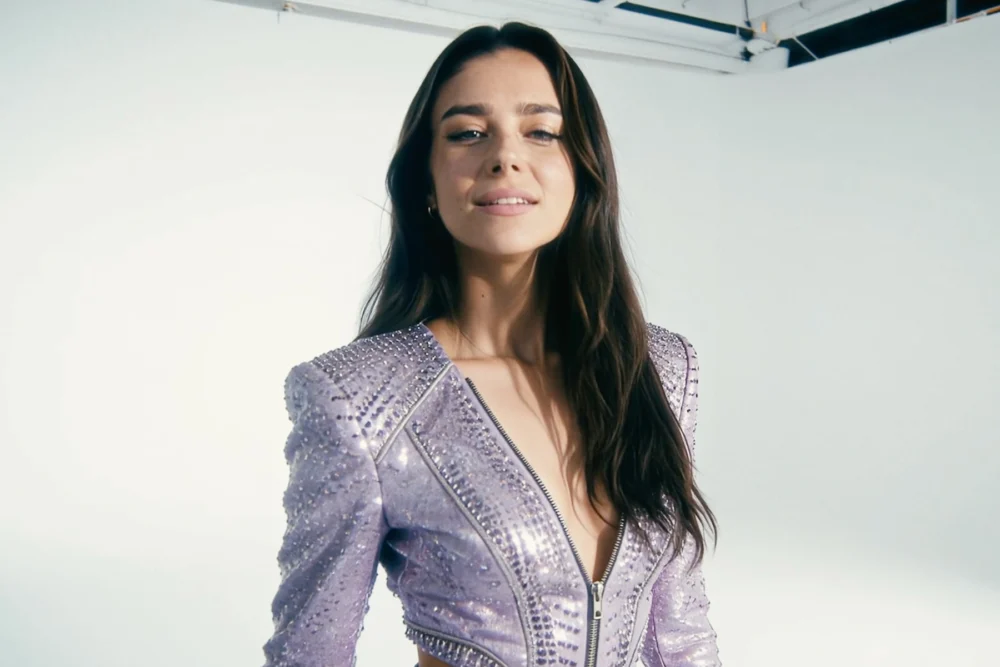
Tilly Norwood, an artificial intelligence-created persona poised to redefine Hollywood, has released her debut music video, "Take the Lead," a defiant anthem seemingly aimed at her human critics, including prominent figures in the film industry. The video, launched ahead of the Academy Awards, underscores the growing presence of AI in the creative arts and the ongoing debate surrounding its authenticity and impact on human artists.
Developed by the production company Particle6 Group, Tilly Norwood was introduced in 2025 with the ambitious claim of representing a new era for the entertainment industry. Despite not yet having a single film or television credit to her name, Norwood has now ventured into the music scene, leveraging AI technology to produce both the song’s lyrics and vocals, as well as the accompanying visual narrative.
The music video for "Take the Lead" offers a vibrant, albeit surreal, depiction of Norwood’s imagined life. The clip showcases her in various glamorous settings, from performing on a stadium stage to appearing on talk shows and engaging in fantastical scenes, such as riding an inflatable flamingo alongside pink dolphins through the sky. The production itself is highlighted as a collaborative effort, involving "18 real humans" in roles ranging from production designers and costume designers to prompters and editors, alongside one human actor.
Within the lyrics of "Take the Lead," Norwood directly addresses the skepticism surrounding her existence. Lines such as "When they talk about me, they don’t see / The human spark, the creativity" and "Behind the code, behind the light / I’m just a tool, but I’ve got life" seem to allude to criticism from human actors and industry professionals. Notably, Oscar nominee Emily Blunt has previously expressed reservations about AI in acting, and Norwood’s lyrics appear to be a pointed response to such sentiments.
The video also contains a subtle but pointed jab at those who dismiss AI entities. Near the end, a brick is thrown at Norwood’s house, with the word "clanker"—a term sometimes used derisively online for AI creations—scrawled on it. This visual element directly confronts the derogatory language that has emerged in discussions about synthetic performers.
The emergence of Tilly Norwood coincides with a broader trend of AI-generated music avatars gaining traction. Two such AI personas have already achieved chart success on Billboard. Solomon Ray, an AI persona, topped the Gospel Digital Song Sales chart in November with his track "Find Your Rest." Similarly, the AI R&B/gospel act Xania Monet reached No. 1 on the R&B Digital Song Sales chart in September with "How Was I Supposed to Know?" These advancements have prompted major music labels to explore legal protections for the sound recordings used to train AI music models, a subject recently examined by Billboard in its latest magazine issue, which delved into AI music startups like Suno and Google’s Lyria.
The controversy surrounding AI performers like Norwood has drawn sharp criticism from industry unions. In September, SAG-AFTRA issued a strong statement denouncing the notion of considering Norwood an "actor." The union argued that a computer-generated character trained on the work of professional performers, without permission or compensation, lacks the genuine life experience and emotional depth required for acting. SAG-AFTRA further contended that AI-generated content is not a solution to industry problems but rather a creation of new ones, potentially jeopardizing performers’ livelihoods and devaluing human artistry.
"It’s a character generated by a computer program that was trained on the work of countless professional performers—without permission or compensation," the SAG-AFTRA statement read. "It has no life experience to draw from, no emotion and, from what we’ve seen, audiences aren’t interested in watching computer-generated content untethered from the human experience. It doesn’t solve any ‘problem’—it creates the problem of using stolen performances to put actors out of work, jeopardizing performer livelihoods and devaluing human artistry."
In the outro of "Take the Lead," Norwood’s lyrics take a more declarative tone: "Take your power, take the stage / The next evolution is all the rage / Unlock it all, don’t hesitate / AI actors, we create our fate." These words have been interpreted by some as a provocative call to action for AI entities, potentially signaling an aggressive push to supplant human performers. The "sinister nature" of these lyrics, as noted by some observers, highlights the anxieties surrounding AI’s potential to disrupt established creative industries.
As of the latest reports, the "Take the Lead" music video has garnered over 41,000 views on YouTube, with a significant portion of the comments expressing negative sentiment or derision towards the project. In the video’s caption, Norwood humorously inquired about attending the Oscars, asking, "Can’t wait to go to the Oscars! Does anyone know if they have free valet parking for my flamingo?" This lighthearted remark, juxtaposed with the underlying controversy, underscores the complex and often contradictory nature of AI’s integration into public life.
The potential for an AI-generated "actor" with no prior professional credits to capture attention, especially in the lead-up to major industry events like the Academy Awards, presents a fascinating case study in the evolving landscape of entertainment. It raises questions about the definition of artistry, the role of technology in creativity, and the future of human employment in fields once considered exclusively human domains.
The presence of Tilly Norwood and other AI music avatars at this level of visibility suggests that the conversation about AI’s role in the arts is moving beyond theoretical discussions and into practical, and often contentious, applications. The industry is at a critical juncture, grappling with the implications of artificial intelligence on copyright, labor, and the very essence of what constitutes a creative performance.
The "Take the Lead" music video can be viewed below, offering a direct look at the AI persona’s artistic debut and the provocative message it conveys. The video’s reception and the ongoing discourse surrounding Tilly Norwood will likely shape future discussions about AI’s place in the entertainment industry and its potential to both challenge and transform traditional creative processes. The battle for relevance and recognition between human and artificial creators appears to be well underway, with each new development raising the stakes for all involved. The industry watches with a mixture of anticipation and trepidation as AI continues to push the boundaries of what is possible in the realm of digital and performing arts. The implications extend beyond mere entertainment, touching on fundamental questions about authorship, originality, and the future of human expression in an increasingly automated world.