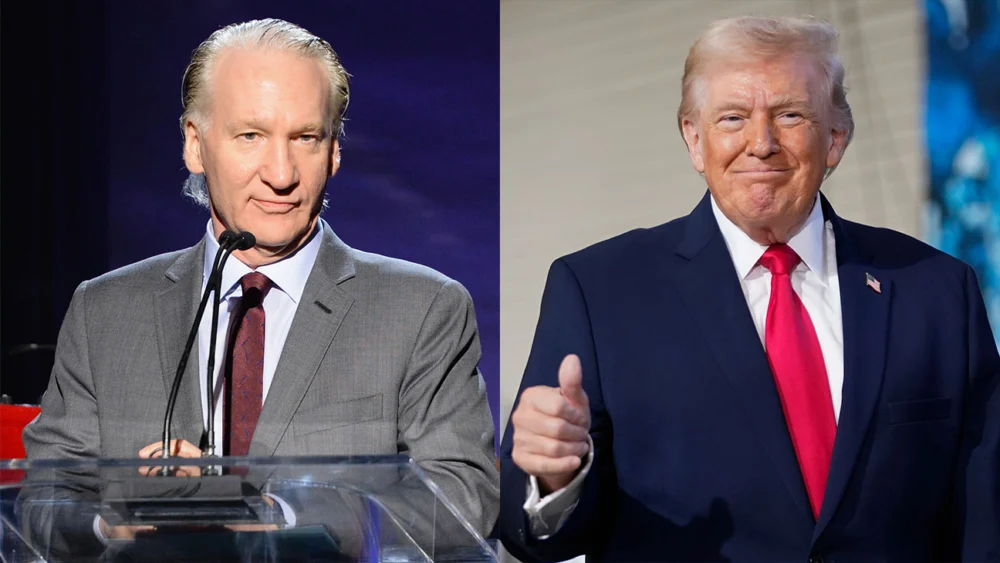
Comedian and political commentator Bill Maher recently offered a comprehensive and unfiltered assessment of former President Donald Trump’s tenure, detailing both his accomplishments and significant missteps, following a renewed public spat between the two figures. This direct appraisal came nearly three weeks after Trump publicly castigated Maher on social media, claiming a dinner they shared in 2023 was a “waste of time,” prompting Maher to articulate his nuanced position on the former president.
The Genesis of a Renewed Feud
The latest friction ignited on Valentine’s Day, when Donald Trump took to his Truth Social platform to vent his frustrations with Maher. Trump alleged that Maher had initiated the dinner, was "extremely nervous" during their meeting, and "immediately, within seconds, asked for a ‘Vodka Tonic’" to calm his nerves, confessing to being "scared." Trump asserted that Maher had seemed respectful immediately after their meal, but subsequently "devolved into the same old story — Very boring, ANTI TRUMP," ultimately comparing him unfavorably to other late-night hosts like Jimmy Kimmel, Jimmy Fallon, and Stephen Colbert. The former president expressed bewilderment at Maher’s continued criticism, given "everything I have done in bringing our Country back from ‘OBLIVION.’"
Maher had briefly addressed Trump’s initial comments on his February 20th "Real Time" episode, promising a more detailed response after a scheduled one-week break. During that initial retort, Maher quipped about Trump’s expectations, stating, "I know how women feel now: A guy buys you dinner and then expects you to put out. I’m not that guy." This set the stage for his more extensive rebuttal, delivered during his "New Rules" segment on March 6th.
Maher’s Rebuttal: Debunking Claims and Asserting Independence
During his "New Rules" segment, Maher directly challenged Trump’s narrative, asserting he does not "suffer from Trump Derangement Syndrome." Instead, Maher suggested, it is the former president who exhibits "Bill Maher Derangement Syndrome," citing Trump’s continued social media posts about him, even amidst unfolding international events.
Maher clarified the circumstances of their dinner, which took place in the spring of 2023. He revealed he was invited by their mutual friend, Kid Rock, and that he "had a drink before dinner and then a couple more during," emphasizing that he was "having a good time." He also contended that Trump, too, seemed to enjoy the interaction, speaking "like real humans, not like that crazy act you put on in public." Maher observed that Trump, "a man who wears his heart on his sleeve," used the opportunity to list his accomplishments and expressed hurt over a perceived lack of recognition, a sentiment Maher claimed to understand.
Following the dinner, Maher recounted, Trump texted him, complaining that Maher was "still part of the lunatic left" and insisting he deserved a Nobel Prize for "ending wars." Maher’s candid response was, "Yeah, and I should have won 20 Emmys." Despite this humorous exchange, Maher highlighted a moment of apparent cordiality when Trump reportedly told him, "Bill, you know what? Don’t change. I wouldn’t know what to do with you if you did OK." Maher interpreted this as a glimpse of the "normal human being" he encountered that evening, expressing hope that "even a spark of a possibility to bring that guy out more" would justify the dinner as not a waste of time, even if it meant returning to name-calling.
Acknowledging Successes: Maher’s Unconventional Praise
Maher proceeded to outline specific areas where he believes Trump deserves credit, often playing clips from past "Real Time" episodes where he had expressed support for these initiatives. He acknowledged that these endorsements frequently drew "hate" from his own political alignment.
Among the successes Maher attributed to Trump were:
- Border Security: He highlighted the focus on border control, including the "mass removal of stone cold criminals," asserting that this policy was a key factor in Trump’s initial election victory.
- Foreign Policy Actions: Maher supported Trump’s decision to bomb a nuclear facility in Iran and expressed no "hate" for the U.S. military operation aimed at removing Nicolás Maduro from power in Venezuela.
- Domestic Initiatives: He listed various other policies, including those related to animal rights, marijuana reform, the refurbishment of the White House ballroom, and the development of a "golden dome missile shield."
- NATO Contributions: Maher conceded that Trump "wasn’t wrong" in pushing NATO members to pay "their fair share" toward collective defense.
- Rejection of Extremism: Significantly, Maher credited Trump for publicly stating, "We don’t want you," regarding the "Nick Fuentes Jew-hating wing of the Republican Party."
- Economic Outlook: In a moment of self-correction, Maher admitted he was wrong in his earlier prediction that the economy would be "in the shitter" by a certain date, using this to illustrate his capacity for honesty.
"See, that’s the difference between you and me, Don, I can admit when I’m wrong and I can be honest," Maher stated, positioning himself as a rare "honest broker" from the left.
Delivering "Tough Love": Identifying Failures
Having acknowledged Trump’s perceived successes, Maher shifted to what he considered the former president’s significant failures, emphasizing his democratic right to voice criticism. He expressed regret that Trump’s inability to "take criticism" prevented potentially "helpful" honest conversations.
Maher’s list of Trump’s shortcomings included:
- Immigration Enforcement (ICE): While supporting the removal of criminals, Maher condemned the "sadism and stupidity that went along with it" in the implementation of ICE policies.
- Economic Policies and Outcomes: He criticized initiatives like Elon Musk’s DOGE (likely a mishearing or misattribution of "deregulation" or a specific economic policy), which Maher claimed was "a complete disaster. People died for no reason, and it cut no government waste." He also maintained that coal was "not beautiful or clean," contradicting Trump’s pro-coal stance.
- International Relations: Maher strongly opposed Trump’s tendency to "take the side of autocrats instead of democratic allies around the world" and his public antagonism towards countries like Canada.
- Suppression of Dissent: He condemned "criminalizing dissent" and the "juvenile trolling and suing people into silence" as antithetical to democratic principles.
- Election Denial and Governance Style: Maher labeled Trump’s "election-denying obsession" as "not derangement" for him to call out. He also criticized the "pardons-for-my-friends-and-punishment-for-my-enemies mode of governing" and the consistent appearance of "side deals for your family that always seem to be part of everything." He noted the evident enrichment of the Trump family, contrasting it with the struggles of ordinary Americans, particularly in places like West Virginia.
Maher concluded this segment with a warning, echoing a Democratic senator’s observation: if Democrats ever effectively "weaponize" the message that Trump’s administration represents the "elites they pretend to hate," the "MAGA movement is in big trouble."
Broader Implications and Public Reaction
Maher’s willingness to engage with Trump, even over dinner, has historically drawn considerable backlash from segments of his liberal audience. In the spring of 2023, news of the dinner sparked a satirical essay in The New York Times by comedian Larry David, titled "My Dinner With Adolf," which implicitly mocked Maher’s visit to the White House. This public criticism evidently strained their friendship, with Maher stating near the end of 2023 that David "certainly is not really my friend anymore," indicating a lack of recent communication.
This ongoing public dialogue between Maher and Trump underscores the deep polarization within American political discourse. Maher, known for his often iconoclastic views and willingness to criticize both the left and the right, attempts to occupy a unique space as a commentator who values honesty and open debate above strict partisan loyalty. His latest segment highlights the challenge of maintaining such a position, as both sides often demand unwavering allegiance.
The exchange also offers a rare glimpse into the private interactions of public figures who are typically at odds. Maher’s description of Trump as "gracious and measured" during their dinner, a stark contrast to his public persona, suggests a complexity often obscured by political rhetoric. This duality raises questions about authenticity in politics and the performative aspects of public leadership.
Maher’s assertion of his democratic right to criticize, even while acknowledging successes, serves as a powerful statement on the role of free speech and critical analysis in a vibrant democracy. His approach, while controversial, continues to spark debate about how to engage with political adversaries and the potential for independent thought in an increasingly partisan media landscape. As the political climate intensifies, Maher’s unique blend of praise and critique ensures he remains a central, albeit polarizing, figure in the ongoing national conversation.