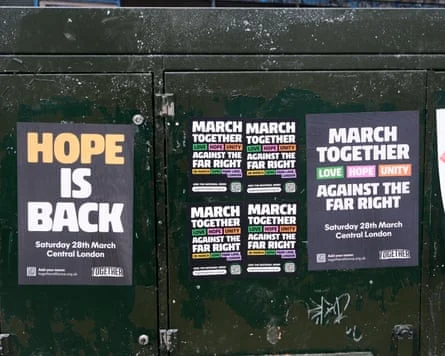
Musician and political activist Billy Bragg is spearheading a massive mobilization effort, calling on British citizens to participate in what organizers describe as the largest multicultural demonstration in the history of the United Kingdom. The event, scheduled for Saturday in central London, aims to provide a unified response to the rise of nationalist and anti-immigrant movements that have gained momentum across the country over the last year. Organized by the Together Alliance, the demonstration is designed to showcase a broad coalition of support for multiculturalism and social cohesion.
Bragg, a long-time fixture in the British protest music scene, emphasized the importance of public visibility in countering the "politics of hate." Speaking ahead of the event, he characterized the march as a vital opportunity for citizens to take a stand against ideologies that he believes are being imported into the United Kingdom from abroad. The musician noted that the objective is to send a clear message to fellow citizens and the international community that the British public remains committed to a diverse and inclusive society.
The "Together" march is expected to draw hundreds of thousands of participants from every corner of the British Isles. Organizers have spent weeks coordinating a logistics network to facilitate the massive influx of people into the capital. Dozens of chartered coaches are scheduled to depart from various cities on Saturday morning, with Manchester alone contributing at least 10 buses. The procession is slated to begin at Park Lane at midday, winding through the heart of the city before concluding at Trafalgar Square.
A Nationwide Mobilization Against Divisive Rhetoric
The impetus for the London march against far right stems from a series of volatile events that occurred in late 2023 and throughout 2024. In September of last year, a "Unite the Kingdom" rally saw approximately 110,000 individuals march through London. That event was marked by nationalist slogans, anti-immigrant rhetoric, and the heavy presence of Union Jacks and St. George’s Crosses. The Together Alliance was formed specifically to provide a counterweight to that movement, which organizers say does not represent the majority of the British public.
Sabby Dhalu, a representative for Stand Up to Racism and a key member of the Together Alliance, stated that the coalition was born out of a necessity to respond to the violence and division seen during previous far-right demonstrations. Dhalu noted that the overwhelming majority of people in the UK reject the "racism, Islamophobia, and hatred" promoted by figures such as Tommy Robinson. She expressed confidence that the turnout on Saturday would dwarf previous right-wing gatherings, demonstrating the same spirit of unity that helped quell the civil unrest seen in the summer of 2024.
The 2024 riots, which erupted in various English towns and cities following a tragic stabbing incident in Southport, serve as a grim backdrop to this weekend’s event. During those riots, misinformation spread via social media led to attacks on mosques, businesses owned by minorities, and hotels housing asylum seekers. The Together Alliance aims to use the London march against far right to reclaim the public square and reassert a narrative of peace and mutual respect.
Celebrity Endorsements and the Cultural Counter-Front
The mobilization has received an unprecedented level of support from the British entertainment industry. A diverse roster of actors, musicians, and comedians has lent their names to the cause, encouraging their fanbases to attend the march. Among the high-profile supporters are actors Christopher Eccleston, David Harewood, Lenny Henry, Steve Coogan, and Toby Jones. Their involvement underscores the march’s attempt to bridge the gap between grassroots activism and mainstream cultural influence.
Music will play a central role in the day’s proceedings, reflecting Billy Bragg’s belief that the arts are an essential tool for fostering empathy. Two separate stages have been established to accommodate the day’s dual focus on political discourse and cultural celebration. A stage on Whitehall will be dedicated to speeches from political leaders and activists, while a massive stage in Trafalgar Square will host a free concert.
The musical lineup features a wide array of award-winning artists, including Jessie Ware, Paloma Faith, Charlotte Church, and Beverley Knight. Contemporary acts such as Fontaines D.C., Self Esteem, Joy Crookes, and Katy B are also scheduled to perform, alongside veteran groups like UB40, The Charlatans, and Hot Chip. By combining political messaging with high-profile performances, organizers hope to engage a younger demographic and create a festive, inclusive atmosphere that contrasts with the aggressive tone of far-right rallies.
Logistics and the Path of the London March Against Far Right
The logistical scale of the event is significant, requiring extensive coordination with the Metropolitan Police and Transport for London. The march will follow a traditional protest route, starting at Park Lane and moving toward the seat of government power. At midday, the sea of participants will begin their journey toward Trafalgar Square, a location that has historically served as the epicenter of British social and political upheaval.
The Whitehall stage will feature a cross-party selection of speakers, highlighting the broad political spectrum represented within the Together Alliance. Expected speakers include Andy Burnham, the Mayor of Greater Manchester; Zack Polanski, the deputy leader of the Green Party; and Dawn Butler, a prominent Labour MP. Trade union leaders are also expected to address the crowd, linking the fight against racism to broader issues of economic justice and workers’ rights.
Safety and accessibility are primary concerns for the organizers. The event is free to attend, and marshals from various community organizations will be on hand to assist the large crowds. The heavy involvement of regional coordinators ensures that the march is not merely a London-centric event, but a national statement. The mobilization of coaches from the North of England, the Midlands, and the South West indicates a coordinated effort to bring a diverse geographical perspective to the capital.

The Political Backdrop: From Southport to Westminster
The rise of far-right sentiment in the UK is being viewed by many analysts as part of a larger global trend toward populism and nationalism. Billy Bragg pointed to the influence of international figures, specifically mentioning Donald Trump, as a catalyst for the "politics of division" currently seen in Britain. Bragg described Trump as a "blaring horn" that serves as a constant reminder of a "might is right" philosophy, where the strongest elements of society are encouraged to marginalize the weakest.
This international connection is a point of concern for UK intelligence and social researchers. The "transatlantic soup" of ideologies—combining American-style populism with British nationalism—has created a complex challenge for law enforcement and social workers. The London march against far right seeks to address this by reaffirming the "postwar settlement" regarding universal human rights. Bragg argued that these rights, established in the wake of the Holocaust, are being severely challenged by modern political movements that prioritize national or ethnic identity over individual dignity.
The political stakes are also high for the current government. While the march is organized by independent alliances, the presence of Labour and Green party officials suggests a growing consensus among the political left and center that street-level activism is necessary to counter the influence of figures like Nigel Farage and the Reform UK party. While Farage has distanced himself from the more violent elements of the far right, critics argue that his rhetoric provides the intellectual framework for more extreme groups to operate.
Global Influences and the Transatlantic Connection
The influence of social media in radicalizing individuals cannot be overstated in the context of this weekend’s march. During the 2024 riots, platforms like X (formerly Twitter) were used to disseminate false information and coordinate attacks. Organizers of the Together Alliance march have utilized these same platforms to spread their message of unity, attempting to use the digital landscape to build a "counter-narrative of hope."
Billy Bragg’s critique of the current political climate extends beyond the borders of the United Kingdom. He noted that the shift toward "might is right" politics is a global phenomenon that threatens the fundamental values of empathy and solidarity. By participating in the London march against far right, demonstrators are not only addressing local concerns but are also participating in a global struggle against the erosion of democratic norms and civil liberties.
The presence of musicians like Fontaines D.C., who have been vocal about political issues in Ireland and internationally, further emphasizes the global nature of the movement. The concert in Trafalgar Square is intended to be a celebration of the multiculturalism that defines modern Britain, serving as a direct rebuttal to the idea that diversity is a source of national weakness.
The Role of Empathy in Modern Political Activism
At the heart of Billy Bragg’s call for a big turnout is the concept of empathy. Bragg, who has spent decades using his music to highlight social injustices, believes that the lack of empathy is the defining characteristic of modern far-right leaders. He argued that figures such as Tommy Robinson, Nigel Farage, and Donald Trump lack a basic sense of empathy for those outside their immediate political or social circles.
"I’m in the empathy business," Bragg stated, explaining that music’s primary function is to make individuals feel that they are not alone in their struggles. He believes that by gathering in large numbers, people can validate each other’s concerns and realize that their desire for a more inclusive society is shared by the majority. For many participants, the march is about more than just opposing a specific political group; it is about affirming their own identity and place within the national fabric.
The Together Alliance has emphasized that the march is the "start of something," rather than an isolated event. The goal is to build a sustained movement that can challenge extremist ideologies at the community level. By creating a space where people can feel "seen" and "heard," organizers hope to build the social capital necessary to resist the next wave of divisive rhetoric.
Anticipated Impact and Future Directions
As Saturday approaches, the Metropolitan Police are preparing for one of the largest public order operations of the year. While the Together Alliance has emphasized the peaceful and celebratory nature of the event, the sheer volume of people expected in central London poses significant management challenges. The dual stages at Whitehall and Trafalgar Square are designed to keep the crowd moving and prevent congestion in key areas.
The success of the London march against far right will likely be measured by its turnout and its ability to remain peaceful. If the event succeeds in drawing the hundreds of thousands predicted, it will serve as a powerful visual and political rebuttal to the nationalist rallies of the previous year. It will also put pressure on the government to more aggressively address the root causes of social division, including economic inequality and the spread of online disinformation.
Ultimately, the event represents a critical moment for the UK’s civil society. It is an attempt to prove that the "spirit of unity" seen in the wake of the 2024 riots was not a fleeting moment, but a permanent feature of the British character. As Billy Bragg and his fellow activists prepare to take the stage, the eyes of the nation—and much of the world—will be on the streets of London to see if the call for a big turnout is answered.