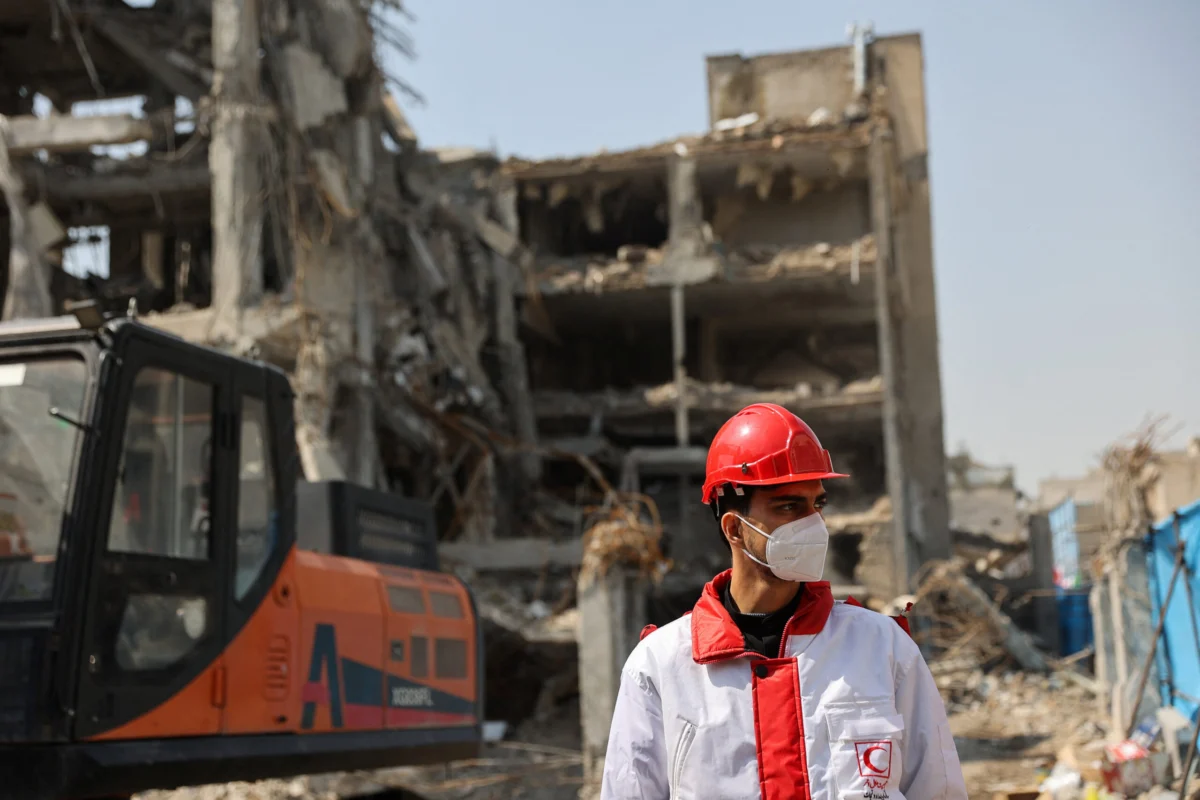
Rescue efforts are underway in Iran as emergency workers, including the nation’s Red Crescent, comb through rubble for survivors following a series of intensified US-Israeli strikes across the country. The attacks, which targeted major cities including the capital Tehran and the religious center of Qom, have resulted in significant casualties and widespread destruction, deepening the ongoing conflict in the region.
The latest wave of assaults commenced with air raids striking three residential houses in Qom on Friday, leaving at least six people dead, according to state-affiliated media. The full extent of injuries in Qom remains unclear, with local officials indicating the number of wounded is still being assessed. These attacks underscore a dangerous escalation in hostilities, with civilian areas bearing the brunt of the violence.
Explosions also rocked Tehran, with the Israeli military claiming responsibility for strikes aimed at what it described as Iranian leadership infrastructure located in the "heart" of the capital. Residents reported hearing the distinct sounds of air defense systems engaging threats since Thursday evening, followed by "massive blasts" overnight, as observed by Al Jazeera’s correspondent Tohid Asadi reporting from the capital. The targeting of the capital signifies a direct challenge to Iran’s command and control capabilities.
Adding to the grim tally, a residential complex in Urmia was hit in what is described as a direct missile attack during the overnight hours. Hamed Saffari, director-general of crisis management for West Azerbaijan province, confirmed that four residential buildings were completely destroyed. He stated that the strike resulted in an unspecified number of civilian deaths and injuries, further highlighting the indiscriminate nature of the attacks.
The escalating conflict has inflicted a devastating human toll. Iran’s Deputy Health Minister, Ali Jafarian, reported on Thursday that at least 1,937 people have been killed and nearly 25,000 injured since the war began. Among the fatalities, 240 women and 212 children have been identified, painting a stark picture of the civilian cost. Raids were also reported in Karaj and Isfahan’s industrial complex, indicating a broad strategic objective behind the sustained offensive.
Escalating Regional Tensions and Humanitarian Crisis
The intensifying military actions have intensified concerns about regional stability. Al Jazeera’s Asadi noted, "We are far from any point of de-escalation," reflecting the current grim outlook. The Norwegian Refugee Council issued a stark warning on Friday, describing the Iranian population as "exhausted and traumatized" by the prolonged conflict.
Jan Egeland, head of the Norwegian Refugee Council, highlighted the mass displacement occurring within Iran. Millions of Iranians have been forced to flee their homes in search of safety, while others remain in areas fearing that displacement itself could be more perilous, as "nowhere seems to be safe." Egeland underscored the immense suffering, stating that across the Middle East, 2,700 people have been killed by US, Israeli, and Iranian attacks, with more than half of those casualties occurring in Iran. "Civilians are paying the highest price for this war. It must end," he urged.
Egeland’s colleagues on the ground in Iran are reportedly operating under "extremely difficult and dangerous conditions" to provide aid to war-displaced families. He described their daily struggle, where "each night they lie awake, listening to the explosions and fearing for their lives, and each morning they return to work, doing all they can to support families in dire need." This firsthand account emphasizes the immense bravery and resilience of humanitarian workers amidst constant danger.

Uncertainty Clouds Ceasefire Negotiations Amidst Renewed Attacks
The latest series of strikes coincides with a period of significant uncertainty surrounding ongoing ceasefire negotiations. Iran laid out its conditions for de-escalation on Thursday, demanding an immediate cessation of "aggressive acts of assassination" that have decimated Iran’s leadership. Tehran also seeks "compensation and war reparations" and measures to ensure "war does not recur," along with an end to hostilities from "all resistance groups that took part in this battle throughout the region."
Furthermore, Iran has reasserted its "natural and legal right" over the Strait of Hormuz, a vital global shipping lane that Tehran has continued to effectively control, leading to significant worldwide fuel shortages. The assertion of control over this strategic waterway adds another layer of complexity to the regional power dynamics and international economic implications.
In response to the escalating tensions, the United Nations Security Council has scheduled closed consultations on the situation in Iran for Friday at 10 a.m. New York time (14:00 GMT). The United States, currently holding the rotating presidency of the Security Council, initiated the meeting, signaling the international community’s growing concern and the need for a coordinated diplomatic response.
Regional Spillover and Continued Military Operations
The repercussions of the war are extending beyond Iran’s borders, impacting neighboring Gulf states. Kuwait’s National Guard reported the successful interception of two drones as part of ongoing efforts to safeguard vital national assets, indicating a heightened state of alert across the region. Similarly, the United Arab Emirates’ Sharjah Media Office announced that its air defense systems were responding to a missile threat, underscoring the pervasive security concerns.
Meanwhile, Israel continues to pursue its military objectives beyond its immediate conflict with Iran, notably by pressing its ground invasion into Lebanon. On Friday, the Israeli military issued an evacuation order for residents of the village of Sajd in southern Lebanon, warning of imminent forceful action against the area.
Al Jazeera’s Nida Ibrahim, reporting from the occupied West Bank, commented on the potential ramifications of such operations. She noted that operations against Hezbollah could be "costly to the Israeli army without achieving certain goals, which are ending or disarming Hezbollah." Ibrahim added that even Israeli defense officials have acknowledged that disarming Hezbollah might not be achievable solely through a ground invasion, but rather would necessitate an agreement with the Lebanese government, a prospect that currently appears distant. This observation points to the complex and potentially protracted nature of the military engagements in the wider region.
The ongoing US-Israeli attacks on Iran, coupled with the wider regional military activities, have created a volatile environment with profound humanitarian consequences. The search for survivors in Iran continues amidst a backdrop of shattered infrastructure and immense loss, while diplomatic efforts to de-escalate the conflict face significant hurdles. The international community is closely monitoring the situation, with the UN Security Council poised to discuss the escalating crisis. The path toward peace remains fraught with challenges, as civilian populations continue to bear the brunt of the escalating hostilities.