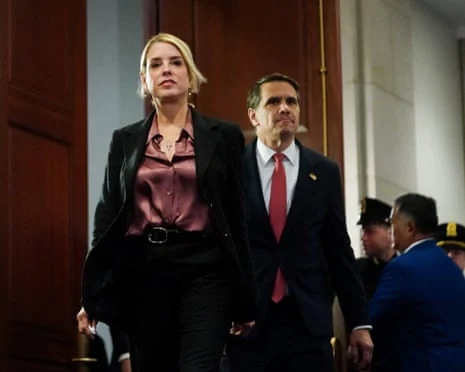
House Democrats formally introduced articles of impeachment against Attorney General Pam Bondi on Wednesday following a contentious closed-door briefing regarding the Department of Justice’s handling of Jeffrey Epstein’s investigative files. The move to impeach the nation’s top law enforcement officer comes after several high-profile lawmakers walked out of the session, labeling the proceedings an "outrageous fake hearing" designed to obstruct congressional oversight.
The escalation represents a significant rupture in the relationship between the executive branch and House oversight committees. Representative Summer Lee of Pennsylvania, who introduced the articles, stated that the action was necessary because Bondi has "already been obstructing justice" by refusing to provide transparent answers regarding the federal investigation into Epstein’s sex trafficking network. Lee is the second Democratic lawmaker to seek Bondi’s removal this month, following a similar effort by Representative Shri Thanedar of Michigan.
The briefing, which also included Deputy Attorney General Todd Blanche, was intended to address bipartisan concerns over the Justice Department’s failure to release millions of pages of documents related to the late financier. However, the meeting quickly devolved into a standoff when Bondi refused to commit to honoring a subpoena to testify under oath. The refusal prompted a mass exit by Democratic members of the House Oversight Committee less than an hour after the session began.
The Breakdown of the Epstein Briefing
The confrontation on Capitol Hill centered on the perceived evasiveness of the Attorney General regarding the "Epstein files," a trove of documents that lawmakers believe could implicate high-profile figures in the sex trafficking ring operated by the disgraced financier. Earlier this month, the Oversight Committee took the rare step of voting to subpoena Bondi, a measure that notably garnered the support of five Republicans who joined Democrats in demanding accountability.
Representative Robert Garcia of California was among the first to exit the room, branding the event a "fake hearing." Garcia and his colleagues argued that a private briefing without the requirement of an oath allowed the Attorney General to avoid legal accountability for her statements. "She is building a record," Representative Suhas Subramanyam told reporters, noting that the Attorney General appeared "evasive and combative" during the brief period the meeting remained in session.
Florida Congressman Maxwell Alejandro Frost echoed these frustrations, describing a cycle of "filibustering" by the Attorney General. Frost noted that despite multiple requests for Bondi to speak under oath, she repeatedly declined to provide a definitive "yes." The walkout served as a public signal that the minority party no longer views traditional briefings as a viable method for obtaining information from the current Justice Department leadership.
Democrats Move to Impeach Pam Bondi and Allegations of Obstruction
The articles of impeachment introduced by Representative Lee are co-sponsored by Representatives Yassamin Ansari and Rashida Tlaib, with Representative Lateefah Simon also indicating her support. The central premise of the impeachment effort is that the Attorney General has intentionally hindered the investigation into the Justice Department’s prior conduct. By defying subpoenas and offering what lawmakers call "guise briefings," Bondi is accused of undermining the constitutional authority of Congress to conduct oversight.

This legal battle is set against the backdrop of long-standing public interest in the Epstein case. For years, survivors and advocacy groups have called for the full disclosure of federal records to understand why a 2008 non-prosecution agreement was reached and which individuals may have been protected by federal authorities. The current administration’s perceived reluctance to facilitate this transparency has turned a legal issue into a volatile political crisis.
Legal experts suggest that while the impeachment effort faces significant hurdles in a politically divided Congress, the move serves to formalize the allegations of obstruction. If the House were to proceed, it would trigger a trial in the Senate, though such an outcome remains unlikely given the current partisan alignment. Nevertheless, the filing of articles ensures that the dispute over the Epstein files remains a central fixture of the national political discourse.
Broader Instability within the Administration
The move to impeach Pam Bondi occurs as the administration faces a cascade of internal and external challenges, ranging from controversial military operations to allegations of systemic policy violations. The tension in the Justice Department is mirrored in the intelligence community, where Democrats on the Senate Intelligence Committee are currently pressing Director of National Intelligence Tulsi Gabbard for answers regarding a high-level resignation.
Joe Kent, the top counter-terrorism official, resigned his post this week, citing fundamental disagreements over the ongoing war on Iran, referred to by the administration as "Operation Epic Fury." In his resignation letter, Kent claimed that Iran "posed no imminent threat" to the United States and suggested that the administration was pressured by foreign interests to launch military strikes in late February. The White House has denied these claims, asserting that Kent was under FBI investigation for national security leaks prior to his departure.
Simultaneously, the administration is defending its military strategy at the Pentagon. Defense Secretary Pete Hegseth recently touted the success of Operation Epic Fury, claiming that Iran’s naval infrastructure and air defenses have been "severely degraded." Hegseth has refused to provide a timeline for the end of the conflict, maintaining that military action will continue as long as the President deems it necessary. This bellicose stance has fueled a domestic debate over war powers, culminating in a 53-47 Senate vote on Wednesday that blocked a resolution intended to limit the President’s ability to prosecute the war.
Domestic Policy Crises and Human Rights Reports
While the Epstein files and the war in Iran dominate the headlines, a new report has highlighted potential legal violations within the administration’s immigration enforcement. The Women’s Refugee Commission (WRC) and Physicians for Human Rights (PHR) released findings alleging that the administration is deporting parents without inquiring if they have children in the United States or allowing them to arrange for their care.
The report details instances of "traumatic" family separations, including a case where a 22-year-old mother was deported to Honduras without her two-month-old baby. Researchers found that many parents were removed so quickly that they had no opportunity to contact family members or legal counsel. Staff at reception centers in Honduras reported "extremely high levels of emotional distress" among returnees, many of whom displayed symptoms of acute anxiety and panic.
These findings suggest a potential violation of the government’s own stated protocols regarding family unity during removal proceedings. The report has added another layer of scrutiny to the administration’s "Save America" initiatives, which critics like Senator Elizabeth Warren argue are designed to make it more difficult for vulnerable populations to navigate the legal system and for citizens to exercise their right to vote.
Surveillance and Civil Liberties Concerns
Further complicating the political landscape are recent admissions regarding the expansion of federal surveillance. FBI Director Kash Patel, testifying under oath at a Senate Intelligence Committee hearing on Wednesday, confirmed that the bureau has begun purchasing location data on American citizens. The practice of buying data from private brokers allows law enforcement to bypass the traditional requirement for a search warrant, a development that has alarmed civil liberties advocates on both sides of the aisle.
Patel’s testimony confirmed that the FBI is utilizing these commercial datasets to track movement patterns, a move he defended as necessary for national security. However, the revelation has intensified calls for legislative reform to protect digital privacy. Lawmakers have expressed concern that the Justice Department, under Bondi’s leadership, is moving toward a more aggressive surveillance posture while simultaneously resisting transparency in its own internal affairs.
Diplomatic Shifts and Congressional Hurdles
The atmosphere of domestic crisis has also begun to impact international diplomacy. A scheduled working lunch between the President and Japanese Prime Minister Sanae Takaichi was abruptly canceled on Thursday. While official sources cited a desire to extend the formal summit meeting at the White House, the cancellation comes at a time when the administration is struggling to manage multiple domestic and foreign policy fronts simultaneously.
In Congress, the confirmation hearing for Senator Markwayne Mullin to lead the Department of Homeland Security highlighted the deep partisan divide over the administration’s direction. Mullin faced intense questioning regarding his plans for border security and his stance on the family separation allegations raised in the WRC report.
As the House prepares to debate the merits of the impeachment articles against Pam Bondi, the nation remains fixated on the unresolved questions surrounding Jeffrey Epstein. The refusal of the Attorney General to testify under oath has transformed a document dispute into a constitutional showdown over the limits of executive privilege and the power of congressional subpoenas.
The path forward for the Bondi impeachment effort remains uncertain, but the walkout by Democratic lawmakers has set a new precedent for how the minority party intends to confront the administration’s legal leadership. With the Epstein files still largely shielded from public view and a war continuing in the Middle East, the political pressure on the Justice Department is unlikely to subside. The coming weeks will determine whether the House Oversight Committee can compel the transparency it seeks or if the administration will continue to successfully deflect legislative inquiry.