Dyson has officially launched its third attempt at capturing the high-end autonomous cleaning market with the introduction of the Dyson Spot+Scrub Ai, a machine designed to rectify the shortcomings of its predecessor, the 2024 360 Vis Nav. Priced at $1,199.99, the new unit represents a significant technological pivot for the British engineering firm, incorporating a integrated roller mop and advanced artificial intelligence to compete with established industry leaders like Roborock and Dreame. While the device introduces several first-to-brand features, initial evaluations suggest that the Spot+Scrub Ai faces a difficult path in proving it can outpace more affordable and agile competitors in an increasingly crowded 2026 marketplace.

The stakes for this release are exceptionally high following what industry analysts have characterized as a series of underwhelming entries into the robotics sector by Dyson. The previous 360 Vis Nav was criticized for its lack of mopping capabilities and a price tag that many consumers found prohibitive given its feature set. With the Spot+Scrub Ai, Dyson is attempting to leverage its reputation for high-performance stick vacuums by integrating its signature "green laser" technology and cyclonic suction into a fully autonomous platform. However, the transition from manual cleaning tools to sophisticated robotics has proven to be a complex engineering hurdle for the company.
Dyson’s Third Entry into the Autonomous Cleaning Market
The history of Dyson’s foray into robotics has been marked by a focus on suction power over navigational agility. The company’s earlier models, such as the 360 Eye and the 360 Heurist, were often noted for their height and inability to navigate under standard furniture, a trend that continues to some extent with the Spot+Scrub Ai. By maintaining the $1,199.99 price point of the Vis Nav while adding a comprehensive mopping system and a self-emptying dock, Dyson is signaling a realization that premium pricing must be matched by a "do-it-all" functionality.

Market conditions in 2026 have shifted significantly since Dyson’s first robot vacuum debut. Competitors have standardized features such as hot-water mop washing, AI-driven obstacle avoidance, and slim profiles that allow robots to clean under low-clearance cabinetry. The Spot+Scrub Ai enters this environment not as a pioneer, but as a challenger attempting to catch up to a baseline established by brands that specialize exclusively in autonomous floor care. The success of this unit will likely determine whether Dyson continues to invest heavily in the "stick vacuum to robot vacuum" pipeline or retreats to its core competency of handheld cleaning technology.
Technological Innovations: Green Lasers and AI Detection
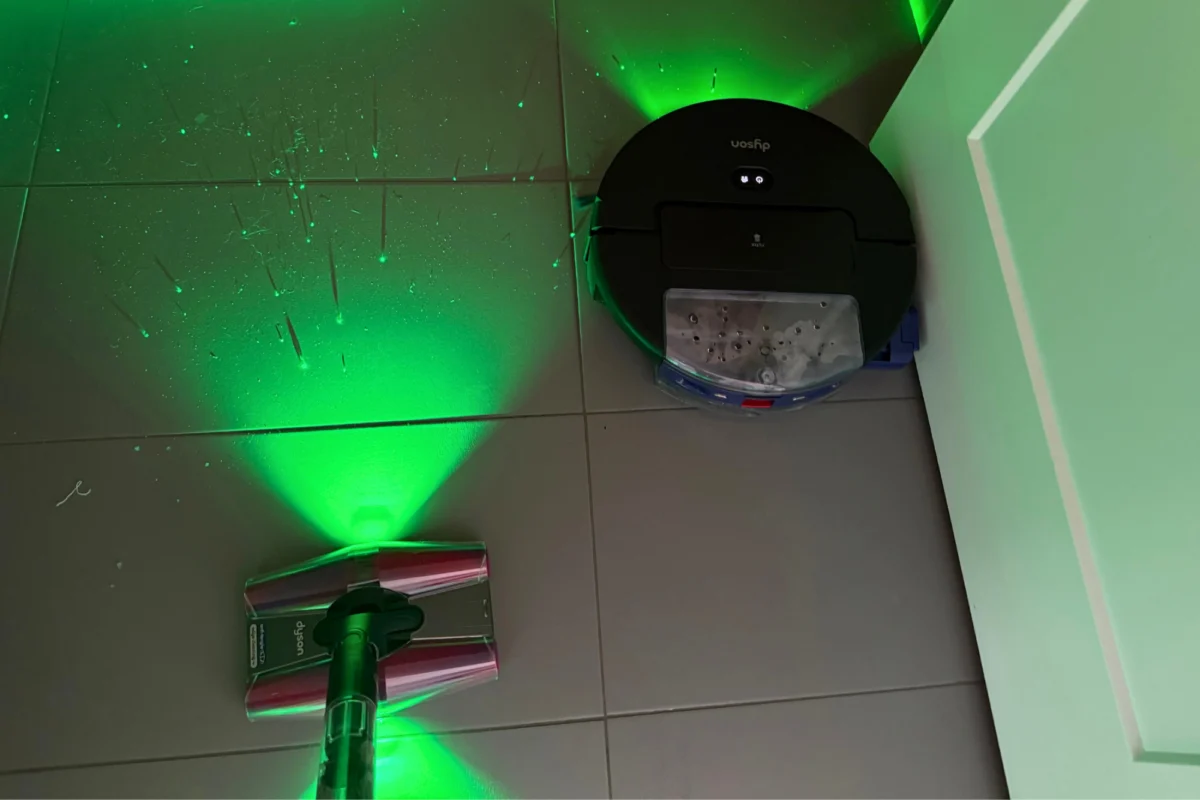
The most visible innovation on the Dyson Spot+Scrub Ai is the inclusion of the company’s iconic green laser, a feature originally popularized on the V15 Detect stick vacuum. This dust-illuminating light is synchronized with an AI-powered sensor array to identify microscopic debris and hidden stains that are often invisible to the naked eye. Unlike standard robot vacuums that follow a pre-determined pathing logic regardless of floor condition, the Spot+Scrub Ai uses this optical data to perform real-time cleaning adjustments.

According to technical specifications, the vacuum utilizes an HD camera and AI algorithms to distinguish between wet and dry messes. When the system detects a stubborn stain, it is programmed to perform multiple passes, "double-checking" the area before proceeding. This level of scrutiny is intended to mimic human cleaning patterns. Furthermore, the Spot+Scrub Ai is Dyson’s first model to feature a roller mop. This system utilizes a continuous freshwater rinse, ensuring the roller remains clean throughout the duration of the mopping cycle. In a departure from many competitors that only use hot water to clean the mop at the base station, the Dyson unit mops the floor with heated water to improve stain breakdown efficiency.
Operational Hurdles: Height and Liquid Management
Despite the advanced sensor suite, early field tests have highlighted significant mechanical and logic-based challenges. A primary concern is the physical dimensions of the unit. The Spot+Scrub Ai remains one of the tallest robot vacuums on the market, a design choice necessitated by Dyson’s powerful motor and filtration systems. This height limits the robot’s ability to clean under kitchen toe-kicks, certain furniture types, and specialized pet equipment like self-cleaning litter boxes. In comparative testing, slimmer models from rivals such as the Dreame X60 Max Ultra were able to navigate spaces where the Dyson unit became physically wedged.

Navigation logic regarding liquid spills has also emerged as a point of contention. While the AI is marketed as being highly intelligent, testing revealed a critical flaw in how the device handles large liquid puddles, such as spilled wine or juice. The Spot+Scrub Ai utilizes two spinning side brushes intended for dry debris. In several instances, the robot drove directly into liquid spills with the side brushes active, resulting in the liquid being splattered across a wider radius and onto the underside of the vacuum. This lack of "spill awareness"—the ability to retract or stop side brushes when a liquid is detected—can lead to cross-contamination of rugs and potential internal damage to the vacuum’s chassis.
Competitive Landscape and Price-to-Performance Ratios
The Dyson Spot+Scrub Ai enters a market where price-to-performance ratios are under intense scrutiny. At $1,199.99, the unit offers 18,000 Pa (Pascals) of suction power. While formidable, this figure is eclipsed by several lower-priced alternatives. For example, the Roborock Qrevo Curv 2 Flow, which often retails for under $1,000, provides 20,000 Pa of suction and features a more compact, maneuverable design. While the Roborock lacks Dyson’s proprietary laser illumination, its navigation and rug-handling capabilities have been noted as more consistent in multi-surface environments.

Furthermore, the industrial design of the Dyson docking station has drawn mixed reactions. The "three canister" layout is bulky and occupies a significant footprint in the home. While it features a convenient built-in detergent tank and a bagless dustbin—aligning with Dyson’s environmental stance against consumables—the noise levels during the self-emptying process are significantly higher than many competitors. For consumers in smaller living spaces, the physical and acoustic presence of the Spot+Scrub Ai base station may be a deterrent.
Impact on the Public and Industry Trends
The release of the Spot+Scrub Ai reflects a broader trend in the smart home industry toward "active" rather than "passive" cleaning. Consumers are increasingly demanding robots that do not just follow a map, but actually "see" and "react" to the environment. Dyson’s heavy investment in AI and optical sensors pushes the industry in this direction, even if the execution in this specific model remains imperfect. The inclusion of a privacy-focused HD camera that does not record or livestream images addresses growing public concern over domestic surveillance, a move that may force other manufacturers to adopt similar "local-processing only" AI architectures.

However, the "all-in-one" approach of the Spot+Scrub Ai also highlights the limitations of current robotics. The difficulty in balancing high-suction motors, large water tanks, and slim profiles remains the "holy grail" of vacuum engineering. Dyson’s insistence on maintaining its signature aesthetic and power levels has resulted in a machine that is undeniably powerful but occasionally lacks the finesse required for the complex, obstacle-filled environments of a modern family home.
Future Outlook and Consumer Considerations
As Dyson continues to refine the software for the Spot+Scrub Ai, there is potential for navigation and spill-handling to improve via over-the-air updates. The company has historically been proactive in tweaking its algorithms based on consumer feedback. Nevertheless, the hardware limitations—specifically the height and the behavior of the side brushes—are fixed elements that potential buyers must consider.

For enthusiasts of the Dyson brand who value the "laser-clean" aesthetic and the convenience of a bagless system, the Spot+Scrub Ai represents the most capable robot the company has produced to date. It is a massive leap forward from the 360 Vis Nav, successfully integrating mopping and self-emptying features that were long overdue. Yet, for the general consumer looking for the most efficient cleaning partner, the market offers several alternatives that provide more agility and smarter liquid management at a lower cost.
The Spot+Scrub Ai is a testament to Dyson’s engineering ambition, but it also serves as a reminder that the robotics market is governed by different rules than the stick vacuum market. In the world of autonomous cleaning, suction power and brand prestige are often secondary to navigation, height, and the ability to handle the unpredictable nature of a lived-in home. Whether this model can truly secure Dyson a permanent seat at the table of robotics leaders remains to be seen as more units reach consumer households throughout the year.