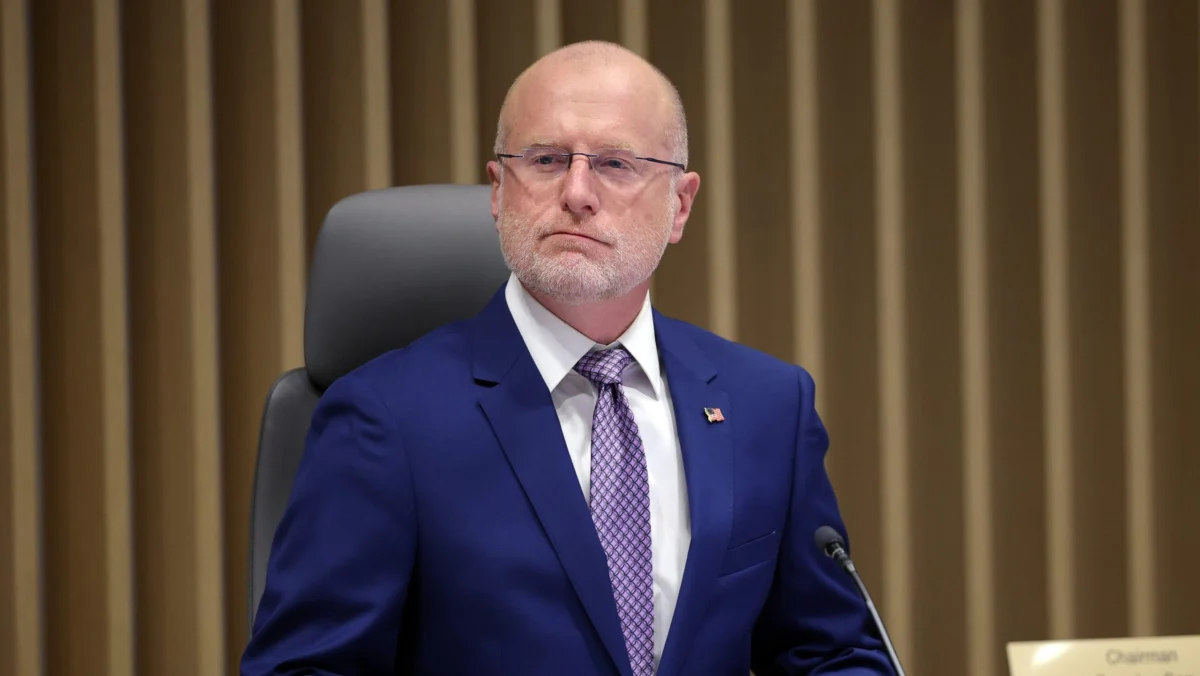
Federal Communications Commission (FCC) Chair Brendan Carr issued a stern warning to broadcasters, stating that outlets failing to “operate in the public interest” could face license revocation, echoing former President Donald Trump’s sharp critiques of media coverage concerning escalating tensions with Iran. Carr’s pronouncement, delivered via social media, specifically targeted what he termed "hoaxes and news distortions," giving broadcasters a window to rectify their reporting practices before upcoming license renewal cycles. The declaration underscores a deepening regulatory scrutiny on media content, raising significant questions about journalistic independence and the scope of government oversight in the American media landscape.
A Direct Warning from the FCC Chair
The FCC chair articulated his warning on X (formerly Twitter) on a recent Saturday, directly resharing a post by former President Trump from Truth Social. Carr’s statement was unequivocal: “Broadcasters that are running hoaxes and news distortions — also known as the fake news — have a chance now to correct course before their license renewals come up.” He emphasized the legal foundation for his position, asserting, “The law is clear. Broadcasters must operate in the public interest, and they will lose their licenses if they do not.” This firm stance from the head of the nation’s primary communications regulator signals a potential shift towards more aggressive enforcement of content standards for television and radio licensees.
Carr further elaborated on the practical and ethical dimensions of his admonition. He argued that a change in editorial direction was not only legally mandated but also in broadcasters’ own commercial interests. “And frankly, changing course is in their own business interests since trust in legacy media has now fallen to an all-time low of just 9% and are ratings disasters,” Carr wrote. He highlighted the significant public investment in broadcast infrastructure, stating, “The American people have subsidized broadcasters to the tune of billions of dollars by providing free access to the nation’s airwaves. It is very important to bring trust back into media, which has earned itself the label of fake news.” This framing suggests a dual imperative for broadcasters: fulfilling a public service obligation and rebuilding audience confidence to ensure long-term viability.
The "Public Interest" Mandate and FCC Authority
The FCC’s authority over broadcast licenses stems from the Communications Act of 1934, which mandates that broadcasters operate in the "public interest, convenience, and necessity." This statutory language has historically served as the cornerstone of broadcast regulation in the United States. Unlike print media, which enjoys broad First Amendment protections from government content intervention, broadcast media has traditionally been subject to a higher degree of regulation due to the scarcity of electromagnetic spectrum and the unique power of over-the-air signals.
Distinguishing Broadcast from Print Media
It is crucial to differentiate between the FCC’s regulatory purview over broadcast outlets (television and radio stations) and its lack of jurisdiction over print publications or digital-only news platforms. While former President Trump’s original criticism cited publications like The New York Times and The Wall Street Journal, the FCC, and by extension, Chair Carr, does not possess the legal authority to regulate the content of newspapers or websites. Carr’s warnings are strictly limited to entities holding FCC broadcast licenses. This distinction highlights the specific vulnerability of television and radio stations to regulatory pressure regarding content.
The "public interest" standard, while foundational, has been a subject of ongoing debate and interpretation. Historically, it has been invoked to ensure local programming, children’s educational content, and equal access for political candidates. However, its application to the subjective quality or accuracy of news reporting, particularly under the rubric of "fake news" or "hoaxes," represents a more contentious and potentially precedent-setting expansion of regulatory oversight. Critics argue that using this standard to police news content risks politicizing the FCC and infringing upon journalistic freedom.
Echoing Presidential Concerns on Iran War Coverage Criticism
The immediate catalyst for Carr’s warning was former President Trump’s recent criticism of media reports concerning an incident involving tanker planes in Saudi Arabia, amidst heightened tensions with Iran. Trump’s post specifically slammed what he called "an intentionally misleading headline by the Fake News Media about the five tanker planes that were supposedly struck down at an Airport in Saudi Arabia, and of no further use.” He asserted that “the planes were not ‘struck’ or ‘destroyed,’” clarifying, “None were destroyed, or close to that, as the Fake News said in headlines.”
Trump’s frustration with media narratives surrounding geopolitical events, particularly those involving military actions or international relations, was a consistent feature of his presidency. His repeated use of the term "fake news" became a hallmark of his administration’s adversarial relationship with many mainstream media organizations. The specific incident of the Saudi tanker planes, if inaccurately reported, served as a flashpoint for his broader critique that certain media outlets were not only biased but actively undermining national interests or misrepresenting facts. This consistent pressure from the executive branch on media veracity has created a challenging environment for journalists navigating complex international stories.
The Erosion of Media Trust and Business Implications
Chair Carr’s reference to trust in "legacy media" plummeting to an "all-time low of just 9%" underscores a pervasive and well-documented challenge facing the news industry. While the precise methodology behind this 9% figure would require further context, various polls and studies have indeed shown a significant decline in public confidence in media institutions over recent years, often exacerbated by political polarization and the proliferation of misinformation. This erosion of trust is not merely an abstract concern but has tangible business implications for broadcasters.
When public trust diminishes, audience engagement often follows, leading to reduced viewership and listenership—what Carr termed "ratings disasters." For commercial broadcasters, lower ratings directly translate into decreased advertising revenue, threatening their financial viability. Carr’s argument that "changing course is in their own business interests" suggests a belief that improved accuracy and a renewed focus on objective reporting could help reverse these trends, restoring both public confidence and economic stability to the industry. The FCC chair posited that broadcasters, having benefited from taxpayer-subsidized access to public airwaves, have a reciprocal obligation to deliver trustworthy information, arguing that this is paramount to the health of public discourse.
Broader Regulatory Scrutiny Under Carr
Brendan Carr’s latest warning is not an isolated incident but rather part of a broader pattern of increased regulatory scrutiny on broadcast content during his tenure at the FCC. In February, for instance, Carr announced that the FCC had initiated "enforcement proceedings" to investigate alleged violations of political equal time rules by The View, a prominent daytime talk show. This action concerned the show’s coverage of political figures and the potential for unequal airtime distribution among candidates.
These instances suggest a more active role for the FCC under Carr’s leadership in monitoring and potentially intervening in broadcast content, particularly when it touches upon political discourse or factual accuracy. While the "equal time" rule is a specific, well-established regulation, extending the "public interest" mandate to cover perceived "hoaxes" and "fake news" represents a more expansive interpretation of the commission’s powers. This approach signals a potential shift away from the FCC’s recent hands-off approach to content, towards a more interventionist stance that could have far-reaching implications for editorial decisions across the broadcast industry.
First Amendment Concerns and Legal Precedents
The FCC’s potential foray into regulating the factual accuracy of news content immediately raises significant First Amendment concerns regarding freedom of speech and freedom of the press. While the Supreme Court has acknowledged that broadcasters operate under a different regulatory framework than print media, any government action that chills speech or dictates content carries substantial constitutional weight. Legal scholars and media organizations are likely to scrutinize closely whether the FCC’s interpretation of "public interest" in this context oversteps constitutional boundaries.
Historically, the Supreme Court’s "Red Lion Broadcasting Co. v. FCC" (1969) decision affirmed the FCC’s power to enforce the Fairness Doctrine, which required broadcasters to cover controversial issues fairly. However, the Fairness Doctrine was abolished in 1987, largely due to concerns about its chilling effect on speech and the proliferation of media outlets that made the "scarcity" argument less compelling. Reintroducing content-based regulation under the guise of combating "fake news" could invite legal challenges centered on whether such actions constitute an impermissible infringement on journalistic independence. The potential for a politicized FCC to arbitrate truth in news reporting creates a challenging environment for a free and independent press.
Industry Reactions and the Path Forward
The FCC chair’s explicit threat of license revocation is likely to elicit strong reactions across the broadcast industry, from media advocacy groups, and among legal experts. Broadcasters, through their lobbying organizations such as the National Association of Broadcasters (NAB), typically advocate for minimal government interference in their content and operations, citing First Amendment protections and the need for editorial independence. Any concrete steps by the FCC to challenge license renewals based on content accuracy would almost certainly be met with legal challenges, setting up a potential showdown in federal courts.
Media ethicists and journalism organizations will likely voice concerns about the "chilling effect" such warnings could have on reporting, particularly on sensitive or politically charged topics. Journalists might feel pressured to self-censor or avoid certain stories to preempt regulatory scrutiny, potentially leading to a less robust and critical press. The politicization of the FCC, particularly through aligning with presidential criticism, could undermine its perceived impartiality and further erode public trust in regulatory institutions.
The Stakes for Free Press and Public Discourse
Carr concluded his Saturday post by reiterating the profound implications of declining media trust: “When a political candidate is able to win a landslide election victory after in the face of hoaxes and distortions, there is something very wrong. It means the public has lost faith and confidence in the media. And we can’t allow that to happen.” This statement positions the FCC’s potential intervention as a necessary measure to restore integrity to public discourse and ensure an informed citizenry. However, the method of intervention—threatening broadcast licenses—ignites a fundamental debate about who defines "hoaxes" and "distortions," and whether a government agency should wield such power over the news.
The unfolding situation places broadcasters at a critical juncture, balancing their statutory obligations under the "public interest" standard with their constitutional rights to a free press. The FCC’s move signals a heightened era of scrutiny, where the accuracy and perceived fairness of news reporting could become direct factors in the continuation of broadcast licenses. This development has profound implications for the future of journalism, media regulation, and the broader information environment in the United States. The consequences of this stance will likely reverberate through legal challenges, industry shifts, and a renewed national conversation about the role and responsibility of the media in a polarized society.