Director Taekyung Tanja Inwol, known for her earlier work A Colombian Family, delves into the complex and often painful realities of identity, family, and transnational adoption in her second feature documentary, Homesick (Hjemsøgt). The film offers a raw and unflinching look at Inwol’s personal journey as an adoptee from Korea, exposing the profound challenges of belonging and the systemic failures within international adoption practices, particularly as they intersected with a tumultuous family life in Denmark. It confronts fundamental questions about what constitutes a family and a home, and who holds the power to define these concepts for individuals whose origins have been severed.
A Deep Dive into Personal History and Systemic Flaws
Homesick charts a deeply personal odyssey, traversing the landscapes between Western Denmark and South Korea to unravel the director’s fragmented past. The documentary world-premiered in the NORDIC:DOX competition at the 23rd edition of CPH:DOX, the Copenhagen International Documentary Film Festival, immediately drawing attention for its candid portrayal of an adoptee’s struggle. The film’s synopsis describes it as a "raw family chronicle," highlighting a stark contrast between outward appearances and hidden turmoil within Inwol’s adoptive Danish family. Beneath a façade of perfection, the family grappled with domestic violence, breakups, divorce, suicide attempts, and profound loneliness. This unsettling backdrop amplifies the film’s central query: "When one’s origins have been erased in Korea, where does one turn when the family one has been placed in begins to crack?"
The narrative gains an additional layer of urgency with the revelation from June 2025 concerning Inwol’s adoption case. The Korean Truth and Reconciliation Commission concluded that her adoption was among 56 cases where human rights violations occurred, specifically finding that her documents were falsified. These falsifications were designed to portray her as a "foundling," thereby expediting her adoption for financial gain. Despite these official findings, Inwol has yet to gain access to substantive information about her birth parents or receive any concrete redress from either the Korean or Danish states, underscoring the enduring challenges faced by many international adoptees seeking their origins.
The Erasure of an Adoptee from Korea: A Global Reflection

Through a tapestry of interviews, evocative photographs, sweeping landscapes, and intimate voice-overs, Inwol meticulously reconstructs her experience. She navigates her unique position as the sole adoptee in her Danish family and reflects on the profound sense of being "erased from Korea her entire life." Press notes for the documentary emphasize that the film skillfully interweaves personal memories and imaginative reconstruction with the harsh political realities of a transnational adoption system that has, over decades, lost its initial sheen of humanitarianism. The film serves not only as a personal memoir but also as a powerful critique of a system that often prioritizes expediency and profit over the fundamental human rights of the child and their biological family.
Inwol’s motivation to create Homesick stems from a deeply personal space, articulated through her own lived experience: "I have, as a child, had more families than most, belonged to many and nowhere at all – but the premise for them all was that someone had the power to decide where and to whom I was allowed to belong." This statement encapsulates the core power imbalance inherent in many transnational adoptions. She poignantly questions the arbitrary parameters used to determine a "better" family, highlighting the disparity where "the childless couple in the West Danish town of Varde had more right to a child than the single mother in the Korean port city of Incheon." This systemic bias, she argues, allowed "a child born in Korea [to grow] up in Denmark," a circumstance she describes as "strange that the child grows up in a random family on the other side of the world – and no one talks about it." The film thus becomes a crucial act of breaking this silence, which Inwol suggests can be far more damaging than any spoken words.
Challenging the Narrative: Director as Subject
The impetus for Inwol to embark on this cinematic journey intensified after the deaths of her adoptive parents. She sought to process her complex emotions and the unanswered questions that had long haunted her. Challenging the societal expectation of "rest in peace" and the admonition "let’s not speak ill of the dead," Inwol felt an urgent need to discuss "all the stuff that we couldn’t talk about before." What began as an exploration of unspoken family secrets evolved into a profound self-examination. She initially aimed to "create a visual language for the things for which a language doesn’t exist," but as she interviewed family members, she realized her own centrality to these secrets. The film inevitably became a narrative "about me, or at least from my position in the family, as being one who we don’t talk about," transforming into a monumental project driven by an urge for self-healing.
This is not Inwol’s first foray into such emotionally charged territory. Homesick is a more intimate continuation of themes explored in her debut feature, A Colombian Family, which focused on a mother and daughter in Colombia seeking to mend their relationship. Inwol candidly admits, "You can see a trend here. I realized that the reason why I made that film was so that I could mirror myself in their relationship." This consistent thread reveals an artist deeply committed to exploring the intricacies of familial bonds, trauma, and the quest for connection across cultural and geographical divides.
Being both the director and the primary subject presented unique challenges. Inwol acknowledges that it was never her desire to be the protagonist, necessitating strict rules to maintain control over her portrayal. "Being the filmmaker and the protagonist gives me all the control, but I needed to make a whole bunch of rules for myself and how I wanted to be seen," she explained. Her objective was to "keep control of the narrative, and how do I present the world through my gaze?" She recognized the difficulty of conveying her experience when "there is just no language for difference," forcing her to invent that language. Furthermore, acutely aware that an audience might not inherently sympathize with a minority voice in such a story, she aimed to "turn the gaze around," creating a perspective that had previously been unseen by those observing her.

Visual Language and Cultural Reclamation for the Adoptee from Korea
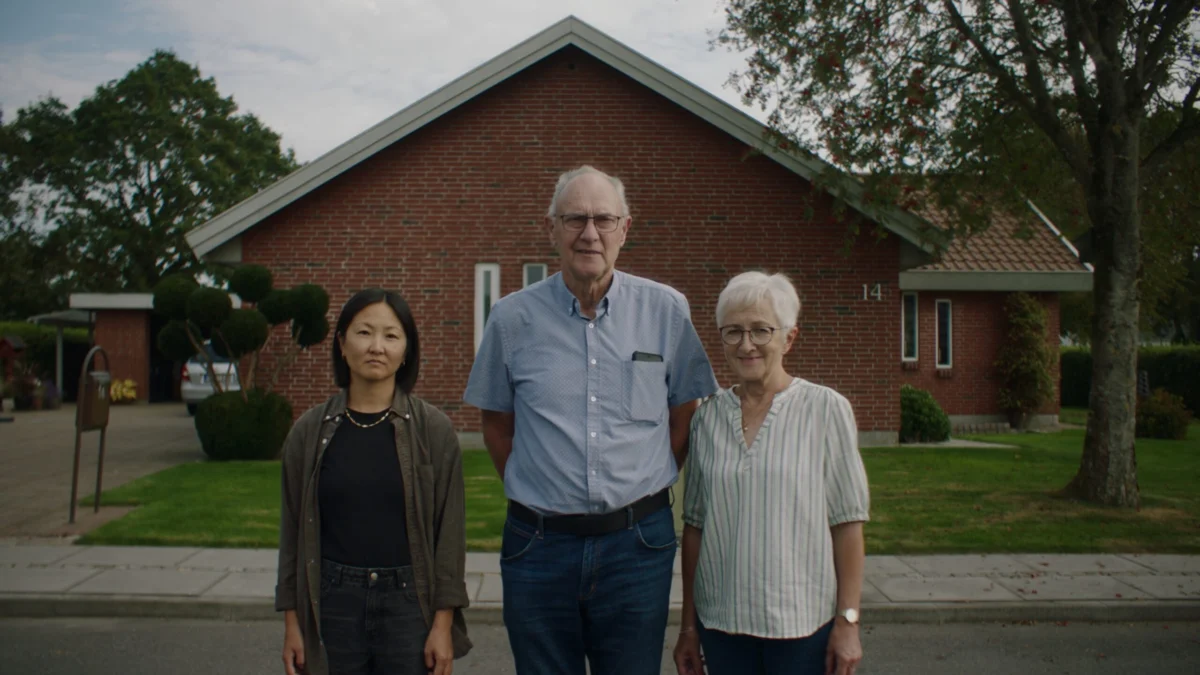
The visual aesthetics of Homesick are as deliberate and impactful as its narrative. One recurring element features Inwol standing alongside other individuals, whose identities are not immediately revealed, in a composition reminiscent of traditional family photographs. Inwol refers to these as "moving portraits," explaining, "Because it’s as if you take a portrait, but then just keep it going." This technique serves to introduce these figures—family members or others—and invites the viewer to scrutinize them. By placing herself next to them without immediate identification, the shots emphasize "the randomness of it all," subtly conveying the arbitrary nature of her own placement within her adoptive family.
Another powerful visual motif involves performative scenes filmed in Korea, where Inwol and three friends, all adopted from Korea to Denmark, wear traditional Korean hanbok. This imagery is crucial for several reasons. It counteracts the film’s pervasive sense of loneliness, creating "a sense of community" and demonstrating that Inwol is not alone in her experience. The hanbok itself becomes a potent symbol of resilience and resistance, even in the context of a nation that Inwol describes as "suffering." These scenes represent an act of cultural reclamation, an assertion of identity rooted in a heritage that was initially denied or erased.
Homesick was produced by Rikke Tambo Andersen, Sona Jo, and Virpi Suutari. Cinematography was handled by Catherine Pattinama Coleman and Mathias Døcker, with editing by Matilda Henningsson. Impronta Film is managing sales for the Tambo Film production. The film’s release is accompanied by a trailer that offers a glimpse into its poignant and thought-provoking content.
Looking ahead, Inwol’s artistic trajectory remains consistent. She identifies a "red thread" running through her work: "the theme of family divided by conflict or war or diaspora experiences." Her next project, currently in early development, will explore a Korean community in Mexico, one of the oldest such communities. This choice reflects her ongoing commitment to making films that resonate with her personal history and intellectual interests, constantly asking herself, "What films can I make? What films are for me?" Through Homesick and her evolving body of work, Taekyung Tanja Inwol continues to carve out a unique space for narratives that illuminate the profound human experience of seeking belonging, challenging silence, and redefining what it means to be family in a globalized, often fragmented, world.