The seizure of an Iranian-flagged container ship by the United States near the Strait of Hormuz on April 20, amid a U.S. blockade of Iranian ports, has drawn stark comparisons to the tumultuous "Tanker War" of the 1980s. During that conflict, Iran and Iraq repeatedly targeted each other’s oil tankers in the vital waterway, aiming to cripple their economies. While naval tensions are once again escalating in the Strait of Hormuz, this time primarily between Iran and the United States, the contemporary crisis exhibits significant differences in its origins, participants, and potential consequences compared to its historical predecessor.
Echoes of the Past: The 1980s Tanker War
The Iran-Iraq War, a brutal eight-year conflict that began in 1980 following Iraq’s invasion of Iran, spilled into the Persian Gulf in 1984. Iraq initiated attacks on Iranian oil tankers, seeking to starve Iran’s war-ravaged economy of its primary revenue source. Iran responded in kind, targeting Iraqi tankers and vessels belonging to nations supporting Baghdad. This tit-for-tat naval warfare severely disrupted shipping in the region.
A report from the University of Texas’s Robert Strauss Center for International Security and Law indicates that Iran, despite its economic dependence on oil exports through the Strait of Hormuz, also threatened to close the vital chokepoint. However, Iran’s own crippled economy necessitated continued oil exports, preventing a complete shutdown.
The conflict escalated in November 1986 when Iran struck Kuwaiti ships, prompting Kuwait to seek international assistance. The Soviet Union was the first to respond, providing escorts for Kuwaiti vessels. The United States, under President Ronald Reagan, launched Operation Earnest Will in July 1987 to counter Soviet influence and protect shipping. This operation involved reflagging Kuwaiti tankers with U.S. flags, granting them American protection.
A stark reminder of the dangers involved came during the U.S.’s inaugural escort mission in July 1987, when a reflagged tanker struck an Iranian mine. This incident signaled the United States’ entry into a covert naval war with Iran. Over the following fourteen months, dozens of U.S. warships were deployed to the region, escorting tankers and actively hunting Iranian mine-laying vessels through special operations and strikes against Iranian military assets. The extensive nature of this commitment saw as many as 30 U.S. Navy ships engaged simultaneously.

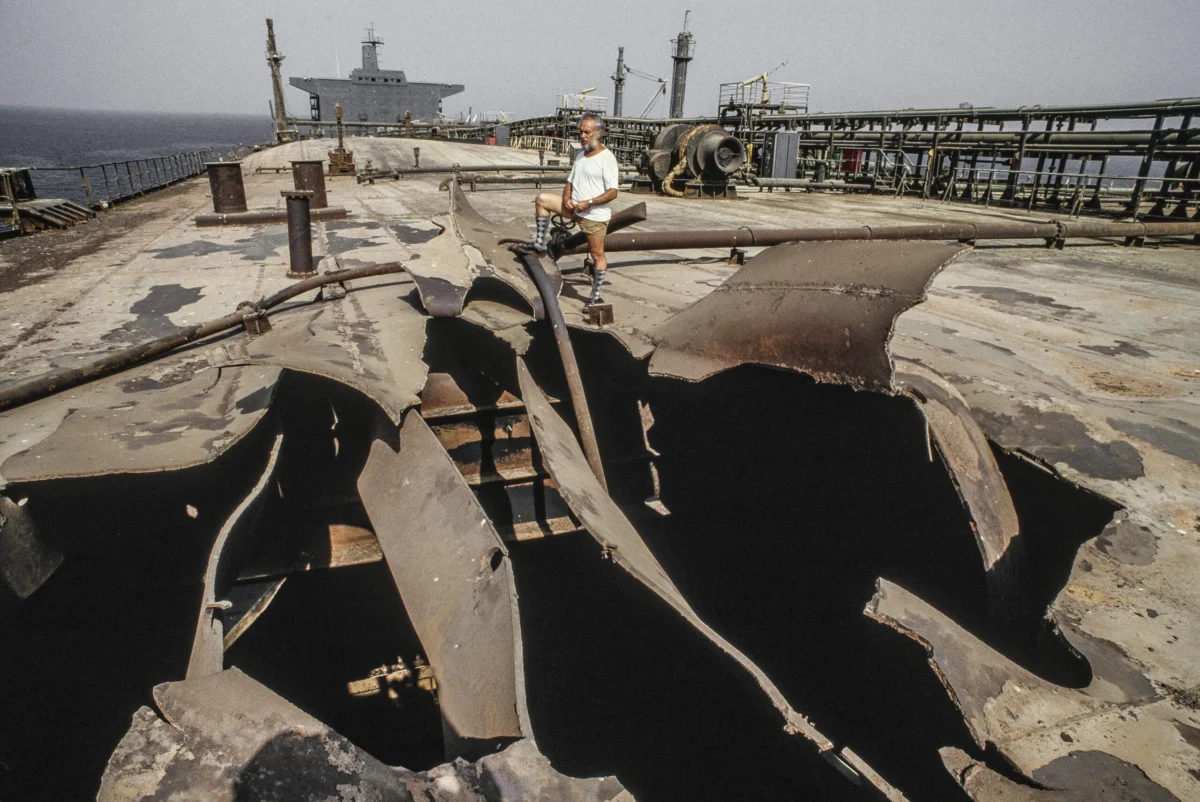
The tension culminated in April 1988 when the U.S. frigate USS Samuel B. Roberts sustained significant damage from an Iranian mine in the Strait of Hormuz. The severity of the damage, with the main deck being the sole remaining structural integrity, prompted the U.S. to launch Operation Praying Mantis, a retaliatory strike aimed at destroying Iranian naval forces.
The Tanker War officially concluded in August 1988 with a United Nations-brokered ceasefire between Iran and Iraq. During the conflict, Iraq launched 283 attacks on shipping, while Iran conducted 168. The human toll was significant, with 116 merchant sailors killed, 37 missing, and 167 wounded from various nationalities. Despite the devastating impact on maritime trade and the lives lost, the global demand for oil remained so high that the increased insurance rates and sailor casualties were deemed an acceptable price for maintaining the flow of vital energy resources.
The Contemporary Strait of Hormuz Crisis
The current maritime tensions in the Strait of Hormuz have a different genesis. Reports indicate that Iran began asserting control over passage through the strait in early March, following alleged U.S. and Israeli bombings. The Islamic Revolutionary Guard Corps (IRGC) declared full control of the strait, requiring clearance for all vessels. This move led to a dramatic 95 percent collapse in shipping traffic, causing oil prices to surge above $100 a barrel, a stark illustration of the strait’s critical role in global energy supply, with approximately 20 percent of the world’s oil passing through it.
For nearly eight weeks, Iran dictated which vessels could transit the Strait of Hormuz from the Persian Gulf to the Gulf of Oman. Initially, Tehran suggested that "friendly" ships could pass after paying a toll. Iranian Foreign Minister Abbas Araghchi stated on March 26 that the Strait was "not completely closed. It is closed only to enemies. There is no reason to allow the ships of our enemies and their allies to pass." Vessels from countries like Malaysia, China, Egypt, South Korea, India, and Pakistan were able to navigate the strait during much of March and early April.
The IRGC reportedly provided these vessels with alternative routes to avoid potential sea mines. U.S. officials, including President Donald Trump, have accused Iran of laying these mines, although Iran has neither confirmed nor denied the allegations.
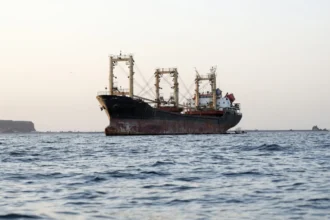
A significant shift occurred on April 13 when the U.S. imposed a naval blockade on all Iranian ports, reportedly alarmed by Iran’s continued oil exports. U.S. Central Command stated that its forces had directed 33 Iran-linked vessels to turn back or return to an Iranian port. The U.S. military subsequently fired upon and seized the Iranian-flagged container ship Touska near the Strait of Hormuz on April 20. The following day, another oil tanker, sanctioned for transporting Iranian crude oil, was detained in the Bay of Bengal.

The Pentagon, in a social media post following the seizure of the Touska, declared, "As we have made clear, we will pursue global maritime enforcement efforts to disrupt illicit networks and interdict sanctioned vessels providing material support to Iran—anywhere they operate. International waters are not a refuge for sanctioned vessels."
In response to the U.S. naval blockade, Iran further tightened its control over the Strait of Hormuz. On April 19, Iran’s First Vice President Mohammad Reza Aref justified the decision to halt foreign ship passage until the U.S. blockade was lifted, stating, "The security of the Strait of Hormuz is not free. One cannot restrict Iran’s oil exports while expecting free security for others."
Reports emerged last Saturday of Iran firing on two Indian-flagged merchant vessels in the strait, with the IRGC claiming the ships were operating without authorization. On April 22, Iran reportedly captured two container ships attempting to exit the Gulf via the Strait of Hormuz after firing upon them and another vessel.
Parallels Between the Two Strait of Hormuz Crises
The current situation in the Strait of Hormuz shares several striking parallels with the 1980s Tanker War. Most notably, shipping has been severely disrupted, leading to significant volatility in global oil and gas prices. The World Economic Forum reported on April 17 that the average price of crude oil from the mid-1980s to the turn of the millennium hovered around $20 per barrel. In contrast, on Friday, even with a ceasefire in effect, Brent crude, the international benchmark, surpassed $106 per barrel. During periods of open conflict between the U.S., Israel, and Iran in March and early April, oil prices reached as high as $119 per barrel.
The threat of naval mines also echoes across both eras. While vessels were directly damaged by mines during the 1980s Tanker War, no such incidents have been officially reported in the current conflict, the risk remains palpable. President Trump has pledged increased U.S. efforts to clear mines from the Strait of Hormuz, though these operations have yet to commence. Compounding concerns, CNN reported that the U.S. Navy has a limited number of minesweeping vessels in the Gulf, with four dedicated minesweepers having been decommissioned last year.
John Phillips, a British safety, security, and risk adviser and former military instructor, observed the clear parallels, stating, "In both cases, the basic idea is the same: pressure at sea can have effects far beyond the water itself. A relatively small amount of naval disruption… can create real strategic and economic consequences, especially in a chokepoint like the Strait of Hormuz." He further noted that the 1980s Tanker War serves as a potent reminder of the vulnerability of global trade when maritime domains become entangled in political or military confrontations.

Divergent Dynamics: Key Differences in the Current Standoff
Despite the historical resonance, crucial differences distinguish the current Strait of Hormuz crisis from the 1980s Tanker War. During the earlier conflict, the U.S. actively escorted ships and deployed naval assets for mine clearance, with significant support from NATO allies including the United Kingdom, Belgium, the Netherlands, France, and Italy.
However, in the present standoff, many U.S. allies, including the UK and other NATO members, have conspicuously refrained from joining Washington’s efforts to reopen the Strait of Hormuz or engage in minesweeping operations. These nations appear wary of being drawn into a broader conflict with Iran. President Trump, in early April posts on Truth Social, publicly criticized allies like the United Kingdom for their reluctance to intervene, urging them to "get your own oil" and emphasizing that "the U.S.A. won’t be there to help you anymore."
Experts also highlight a fundamental difference in the strategic framework of the conflicts. "In the 1980s, the Tanker War was part of the broader Iran-Iraq War, so the shipping attacks were tied to a much larger land conflict between two regional armies," Phillips explained. "Today, the situation is more about Iran’s standoff with the United States and its allies, and the maritime activity is less about asymmetrical war at sea and more about deterrence, signalling and the threat of escalation." He added that while Hormuz remains a critical chokepoint where limited actions yield significant effects, the modern environment is characterized by greater speed, technological advancement, and increased volatility.
Furthermore, analysts point to Iran’s enhanced capacity to withstand pressure and naval blockades compared to the 1980s. During the Tanker War, Iraq benefited from Western military support, while Iran operated under a U.S. arms embargo imposed after the 1979 revolution. This disparity granted Iraq a military advantage, but Iran’s IRGC effectively employed asymmetric warfare tactics against Iraq’s allies.
Evolving Iranian Military Doctrine and Resilience
Experts suggest that since the 12-day conflict between Iran and Israel last year, Tehran has transitioned its military doctrine. The shift is from a primarily defensive containment strategy to an explicitly offensive, asymmetric posture. "Iran today appears more structurally aggressive in doctrine where it is formally embracing earlier and more extensive use of regional missiles, drones, cyberattacks and energy coercion… but is operationally constrained by battle damage, sanctions and internal instability," Phillips noted in a March 2 interview.
Adam Ereli, a former U.S. ambassador to Bahrain, echoed this sentiment, describing Iran and the IRGC as possessing "revolutionary fervor," enabling them to "survive" and "tolerate pain for a lot longer than I think most American decision-makers and planners calculate." This inherent resilience, coupled with a more proactive military doctrine, suggests that Iran may be better positioned to endure prolonged pressure than in previous confrontations. The current Strait of Hormuz crisis, therefore, represents not merely a historical echo but a distinct and potentially more complex challenge in global maritime security.