The independent film "Kill Me," making its debut at the SXSW Film Festival, challenges conventional narratives around mental health and suicide by framing a man’s apparent attempt to end his life as a perplexing murder mystery. Starring Charlie Day as Jimmy, a man who insists someone tried to kill him despite overwhelming evidence pointing to self-harm, the film delves into the disorienting psychological landscape of depression with a darkly comedic and often unsettling tone. The initial critical reception suggests an intriguing premise and strong performances, particularly from Day and co-star Allison Williams, though its ambitious thematic exploration may leave audiences with a sense of unease rather than full resolution.
The Enigma of Jimmy: An Unconventional Crime Scene
The narrative thrust of "Kill Me" begins with Jimmy, portrayed by Charlie Day, making a frantic 911 call from his bathtub, reporting an attempted murder. His immediate panic, however, quickly shifts to a desperate plea to invoke the Fifth Amendment and demand a lawyer, driven by a profound fear that authorities will accuse him of "attempted self-murder." This unusual phrasing immediately alerts police, who clarify the standard term is "suicide" and, in most jurisdictions, not a crime for which one can be arrested. This linguistic distinction, central to director Peter Warren’s debut feature, sets the stage for a film that dissects the internal logic of a mind struggling to comprehend its own despair.
Jimmy’s insistence that he is a victim, not a perpetrator, forms the bedrock of the film’s central mystery. To the outside world, including law enforcement and his concerned family, the circumstances appear clear: Jimmy cut his own wrists. Yet, Jimmy remains steadfast in his belief that an external force, an unknown assailant, is responsible for the act. This internal conflict positions his own psychology as an unsolvable enigma, far more complex than any traditional criminal investigation.
Peter Warren’s Vision: Blending Genres and Challenging Perceptions
Written and directed by Peter Warren, "Kill Me" is an ambitious directorial debut that navigates the difficult terrain between dark comedy and profound drama. Warren’s script is lauded for its sharp, often morbid, sense of humor, finding levity in Jimmy’s frantic and increasingly bizarre attempts to prove his innocence. One memorable exchange sees Jimmy express concern to the 911 dispatcher, Margot (Allison Williams), about blood staining his bathtub, to which Margot deadpans, "Yeah, I think it might." Another moment highlights Jimmy’s assertion that his unkempt apartment is not a sign of neglect, but rather a repository of "evidence."
The film premiered as part of the Narrative Spotlight section at the SXSW Film Festival, a platform known for showcasing innovative and often challenging independent cinema. Warren’s choice to frame depression as a literal "assassin" and one’s inner turmoil as a "cold case" offers an intriguing conceptualization of mental illness, moving beyond conventional portrayals. This genre-bending approach aims to make a bleakly earnest subject more accessible, albeit through an unconventional lens.
A Deep Dive into Performance: Day and Williams Anchor the Narrative
Charlie Day, widely recognized for his high-energy comedic roles in productions like "It’s Always Sunny in Philadelphia," delivers a performance in "Kill Me" that showcases significant dramatic range. While the film benefits from his signature knack for playing characters in the midst of shrill, wide-eyed freakouts, Day also delves into the sadder, more serious aspects of Jimmy’s oscillating mental state. He convincingly portrays a man caught between an unshakeable certainty of external threat and an overwhelming fear that he is his own worst enemy.
Allison Williams, as the wan and numb 911 dispatcher Margot, provides a compelling foil to Day’s frantic energy. Her character, possessing her own unspoken reasons for her steadfast refusal to abandon Jimmy, develops an unexpectedly sweet, if fragile, romantic spark with him. Their connection is depicted as a lifeline, a shared desperation akin to "shipwreck survivors clinging to driftwood," underscoring the film’s underlying themes of isolation and the search for connection amidst despair. The supporting cast further enriches the narrative, with Giancarlo Esposito appearing as Dr. Singer, Jimmy’s therapist, and Aya Cash as Alice, Jimmy’s skeptical sister. Jessica Harper plays his mother, and David Krumholtz contributes a poignant cameo as a suicide victim’s son.
The Unraveling Mystery: Delusion or a Deeper Truth?
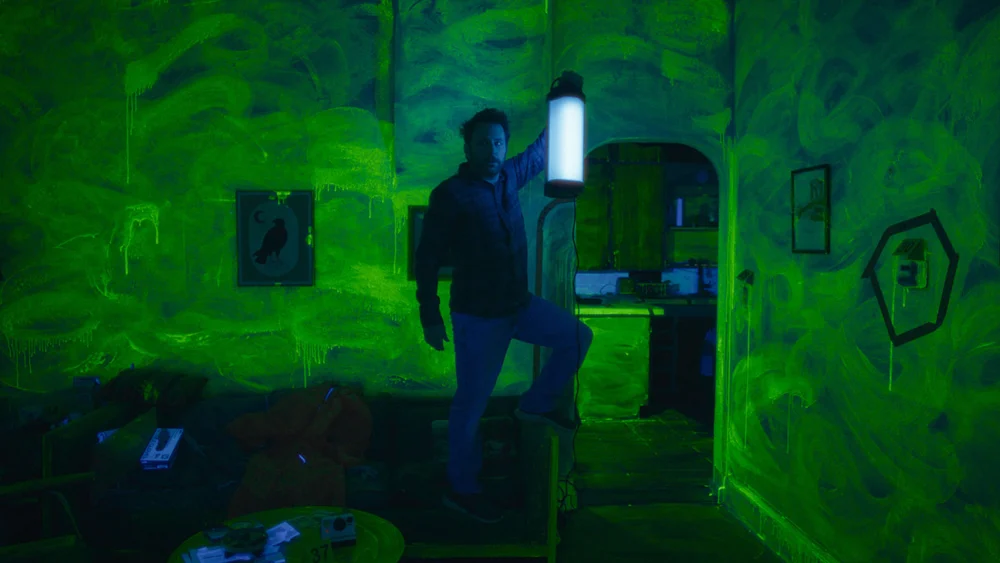
From the outset, the evidence against Jimmy appears conclusive. The film opens with him in a bathtub, his last vestiges of energy dedicated to dialing 911. The production design, credited to Ashley Cook, masterfully enhances the mood, creating a dingy bathroom setting reminiscent of a "Saw" film, subtly hinting at the horror of Jimmy’s situation. His family, including his sister Alice and mother, confirm a long history of mental illness, noting a strikingly similar incident four years prior. Police find no signs of forced entry, and the apartment’s locks are engaged from the inside. Even Jimmy’s frantic search for forensic evidence yields nothing to support his claims.
Despite the overwhelming circumstantial evidence, Jimmy remains resolute in his lack of memory regarding the incident. He struggles to conceive of any reason he would harm himself, even as his family points out his recent downturn, and he admits to Dr. Singer that he has stopped taking his medication. In a poignant display of his skewed perception, Jimmy conjures heartbreakingly mundane justifications for why others might wish him dead, including his ex-girlfriend Sarah, for reasons as trivial as not jogging enough or embarrassing himself at a work party. The film skillfully keeps the audience guessing whether Jimmy is genuinely onto something, particularly as he uncovers minor clues that could support his theories, or if he is, as his sister Alice cynically suggests, "living in a Sherlock Holmes fantasy where you just sail on an ocean of delusion."
Mental Health as a Central Character: Challenging Stigma
"Kill Me" endeavors to explore mental health, specifically depression and suicidal ideation, through a unique and often provocative lens. By personifying depression as an external "assassin," the film attempts to externalize the internal struggle, making the invisible torment of mental illness tangible. This approach, while conceptually intriguing, also carries the risk of simplifying a deeply complex condition. The film’s dark humor serves not to trivialize the subject matter but rather to highlight the absurdities and profound isolation that can accompany severe mental illness.
The interactions between Jimmy and other characters further underscore the societal stigma and often brutal honesty surrounding suicide. A poignant scene features a suicide victim’s son, played by David Krumholtz, who bitterly asserts that "The most selfless act [my dad] ever did was killing himself so my mom and I could move on." Another character, a father who lost his daughter to suicide, speaks of her finally having "found peace," a state Jimmy desperately yearns for. These harsh reflections, while potentially difficult for audiences, offer a raw portrayal of the complicated emotions and sometimes cruel realities faced by those impacted by suicide, both directly and indirectly.
Critical Reception and Thematic Impact: A Bruising Experience
While "Kill Me" is praised for its innovative framing and strong performances, particularly Charlie Day’s nuanced portrayal, critical reception suggests that its exploration of these complex ideas is ultimately too incomplete to feel fully satisfying. The film’s unflinching portrayal of Jimmy’s pain, while bone-deep, occasionally borders on cruelty, reflecting perhaps Jimmy’s own self-perception and the harshness of the world around him. This lack of a clear emotional resolution or a turn toward sentimentality, while perhaps true to the film’s prickly nature, leaves the audience with a sense of lingering unease.
The conclusion of "Kill Me" does not offer tidy answers or a cathartic release. Instead, it mirrors the ongoing, often unresolved, struggle with mental illness. The film’s thematic ambition, coupled with its refusal to offer easy solace, contributes to its "bruising" rather than satisfying impact. It leaves the audience contemplating the profound questions it raises about the nature of reality, self-perception, and the often-invisible battles waged within the human mind, solidifying its place as a thought-provoking, albeit challenging, entry into the burgeoning landscape of mental health cinema.