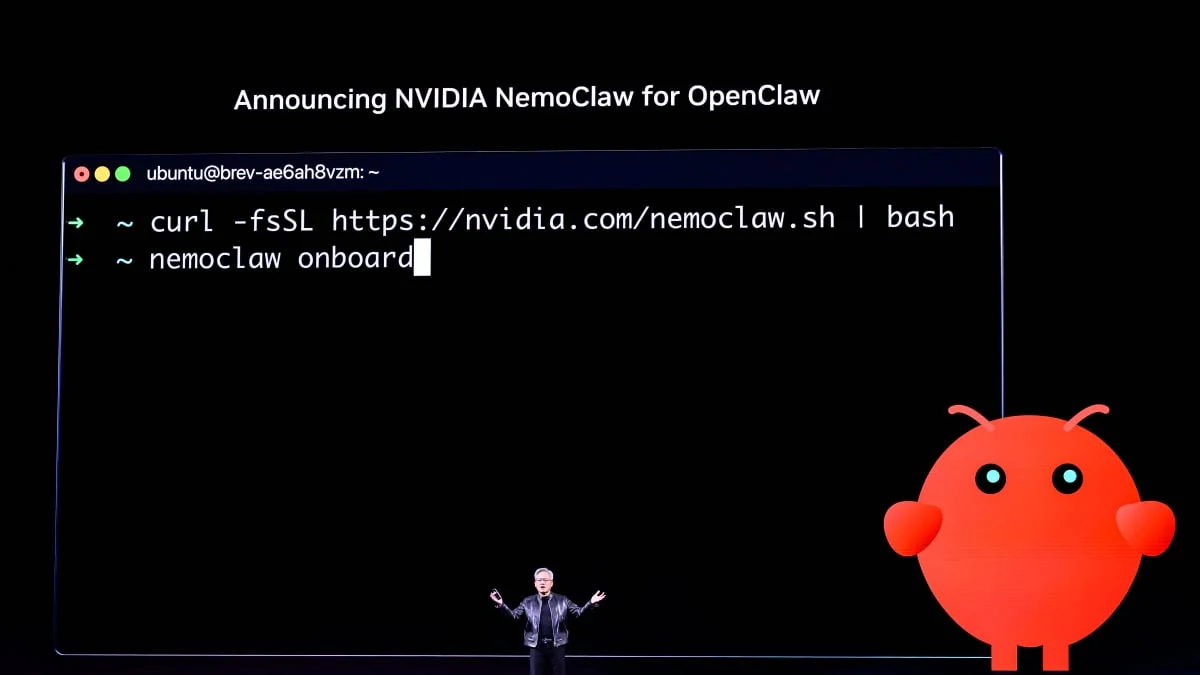
Nvidia CEO Jensen Huang introduced Nvidia NemoClaw during his keynote address at the 2026 GTC conference, unveiling a comprehensive open-source stack designed to secure and standardize the rapidly growing ecosystem of autonomous AI agents. The announcement follows Nvidia’s strategic move to align its hardware dominance with the software requirements of OpenClaw, the popular open-source agent platform recently acquired by OpenAI. Huang characterized the shift toward agentic systems as a fundamental evolution in computing, asserting that every modern enterprise must now develop a dedicated strategy for deploying these autonomous digital entities.
The release of Nvidia NemoClaw arrives at a pivotal moment for the artificial intelligence industry, as the focus shifts from generative models that merely answer questions to "agents" that can execute complex tasks across multiple applications. During the keynote, Huang compared the emergence of OpenClaw to the launch of the Windows operating system for personal computers in the 1980s. By providing the underlying infrastructure through NemoClaw, Nvidia aims to ensure that these new "digital employees" operate within a secure, manageable framework that prevents the data leaks and security breaches that have plagued early agentic deployments.
The Strategic Vision Behind Nvidia NemoClaw
The core mission of Nvidia NemoClaw is to provide a bridge between raw agentic capabilities and the rigorous security requirements of the enterprise world. While OpenClaw has gained significant traction among developers for its flexibility and power, it has faced mounting criticism regarding its safety protocols. Industry analysts have frequently described personal AI agents as potential security risks due to their ability to access sensitive user data and execute actions across third-party platforms without sufficient oversight.
Nvidia’s response to these vulnerabilities is a stack that adds essential privacy and security controls to the OpenClaw platform. By integrating the Nvidia Agent Toolkit with specialized guardrails, the company is attempting to standardize how agents interact with both internal corporate data and the public internet. This move solidifies Nvidia’s role not just as a provider of the H100 and Blackwell chips that train these models, but as the architect of the software environment in which they live.
According to technical specifications released alongside the announcement, Nvidia NemoClaw is designed to be a "plug-and-play" solution for developers who are already building on OpenClaw. It addresses the "black box" nature of many AI agents by providing a transparent layer where administrators can set specific policies regarding what an agent can and cannot do. This level of granular control is seen as a prerequisite for the mass adoption of AI agents in regulated industries such as finance, healthcare, and law.
Technical Architecture of Nvidia NemoClaw and OpenShell
Central to the functionality of Nvidia NemoClaw is a new open-source runtime called Nvidia OpenShell. This component acts as an enforcement engine for policy-based privacy and security guardrails. While traditional AI models operate in a stateless manner—processing one request at a time—agents are persistent and adaptive. Nvidia OpenShell allows these agents to operate with higher velocity while remaining within the safety parameters defined by the user or the organization.
The Nvidia Agent Toolkit, which forms the foundation of the NemoClaw stack, provides developers with the necessary libraries to build and deploy agents that are optimized for Nvidia’s accelerated computing platforms. By using OpenShell, developers can monitor agent behavior in real-time, ensuring that the AI does not deviate from its intended task or access unauthorized directories. This is particularly relevant in "human-in-the-loop" scenarios, where an agent might be tasked with managing a user’s email or financial accounts.
Nvidia has emphasized that OpenShell is designed to be "runtime-agnostic," meaning it can adapt to different environments while maintaining a consistent security posture. This flexibility is intended to prevent vendor lock-in, though the performance benefits are most pronounced when running on Nvidia’s proprietary hardware. The company claims that this new runtime allows agents to "operate and adapt faster and more safely" than previous iterations of agentic software.
Addressing the Security Nightmare of Autonomous Agents
The decision to develop Nvidia NemoClaw was largely driven by the growing chorus of warnings from cybersecurity experts. As AI agents gain the ability to use tools—such as web browsers, terminal commands, and API integrations—the surface area for potential attacks expands exponentially. A malicious prompt could, in theory, trick an agent into deleting files or exfiltrating corporate secrets.
Nvidia NemoClaw seeks to mitigate these risks by implementing "hard" guardrails that cannot be bypassed by the agent’s underlying logic. This involves a zero-trust architecture where every action requested by the agent must be validated against a set of predefined permissions. For example, if an agent built on OpenClaw attempts to access a restricted database, NemoClaw’s security layer would intercept the request and block it before the command is executed.
Furthermore, Nvidia NemoClaw addresses the issue of data residency and privacy. Many enterprises have been hesitant to use AI agents because of the risk that proprietary data might be used to train future iterations of public models. Nvidia’s stack includes features that allow for local processing and data masking, ensuring that sensitive information remains within the organization’s controlled environment.
Industry Impact and the Race for Agentic Dominance
The launch of Nvidia NemoClaw places the company in direct competition with other tech giants vying for control of the AI agent layer. Microsoft, Google, and Meta have all teased their own versions of agentic frameworks, but Nvidia’s deep integration with the hardware layer gives it a unique advantage. By optimizing the software stack specifically for its own GPUs, Nvidia can offer lower latency and higher throughput for complex agentic workflows.
The acquisition of OpenClaw by OpenAI earlier this year set the stage for this development. As OpenAI moves toward a more agent-centric model with its "Operator" projects, the need for a standardized infrastructure has become apparent. Nvidia’s decision to back OpenClaw with its own NemoClaw stack suggests a strong partnership or alignment between the hardware giant and the leading AI research firm.
Market analysts suggest that the success of Nvidia NemoClaw could determine the trajectory of the AI industry over the next decade. If Nvidia can establish NemoClaw as the industry standard for secure agent deployment, it will effectively control the "operating system" of the AI era. This would mirror the dominance the company currently enjoys in the data center market, creating a virtuous cycle where software and hardware are inextricably linked.
How to Access and Try Nvidia NemoClaw
For developers and researchers eager to test the new platform, Nvidia has made a preview version of Nvidia NemoClaw available through its official build portal. The company has focused heavily on ease of use, aiming to lower the barrier to entry for smaller firms and individual developers who may not have extensive cybersecurity resources.
To try Nvidia NemoClaw, users must first have a compatible environment capable of running the Nvidia Agent Toolkit. The installation process has been streamlined to a single command in the terminal, which pulls the necessary containers and sets up the OpenShell runtime. This "one-command" philosophy is part of Nvidia’s broader effort to democratize high-end AI tools.
The preview version allows users to experiment with creating custom guardrails and testing how agents behave under different security policies. Nvidia has also provided a suite of sample applications, including a secure document assistant and a protected coding agent, to demonstrate how NemoClaw functions in real-world scenarios. Access to the documentation and the download package can be found on the Nvidia Build website, where the company is actively soliciting feedback from the developer community.
Future Outlook for the Nvidia NemoClaw Ecosystem
Looking ahead, the evolution of Nvidia NemoClaw is expected to include deeper integration with edge computing and robotics. As AI agents move from digital environments into the physical world—powering autonomous vehicles and factory robots—the security requirements will become even more stringent. Nvidia’s long-term roadmap suggests that NemoClaw will eventually serve as the safety layer for the "Omniverse," the company’s platform for industrial digital twins.
The company has also hinted at future updates that will incorporate federated learning and blockchain-based audit trails into the NemoClaw stack. These features would provide an immutable record of every action taken by an AI agent, offering a new level of accountability for autonomous systems. Such developments would be critical for gaining the trust of government regulators and the general public.
As the 2026 GTC conference concludes, the industry’s attention is firmly fixed on how quickly enterprises will adopt this new framework. While the potential of AI agents is vast, their success hinges on the very issues of security and privacy that Nvidia NemoClaw aims to solve. By providing a robust, open-source solution, Nvidia is positioning itself as the indispensable guardian of the next generation of artificial intelligence.
Implications for Enterprise AI Strategy
The introduction of Nvidia NemoClaw signals a shift in how corporations must approach their internal IT infrastructure. Jensen Huang’s assertion that every company needs an "agentic system strategy" implies that the era of simple chatbots is over. Organizations must now consider how to orchestrate dozens or even hundreds of autonomous agents working in concert across different departments.
Nvidia NemoClaw provides the governance framework necessary for this orchestration. Without such a system, the deployment of multiple agents could lead to "agent sprawl," where unmonitored AI entities interact in unpredictable ways, potentially creating systemic risks. By centralizing security and policy enforcement through the NemoClaw stack, IT departments can maintain visibility and control over their AI workforce.
The move also highlights the importance of the open-source community in the AI space. By making Nvidia NemoClaw and OpenShell open-source, Nvidia is encouraging a collaborative approach to security. This allows independent researchers to audit the code and contribute improvements, which is often seen as a more effective way to secure complex software than the "security through obscurity" model used by some proprietary platforms.
Conclusion of the GTC 2026 Announcement
The GTC 2026 keynote will likely be remembered as the moment the AI industry moved beyond the model and toward the system. Nvidia NemoClaw represents the first major attempt by a hardware provider to solve the systemic challenges of autonomous agents at scale. With its focus on privacy, security, and ease of deployment, the stack addresses the primary barriers to enterprise adoption.
As developers begin to download and implement the preview version of Nvidia NemoClaw, the feedback loop will begin to shape the future of the platform. The coming months will reveal whether NemoClaw can indeed become the "Windows of AI agents" or if competing frameworks will fragment the market. Regardless of the outcome, Nvidia has clearly stated its intention: to be the foundation upon which the future of autonomous computing is built.