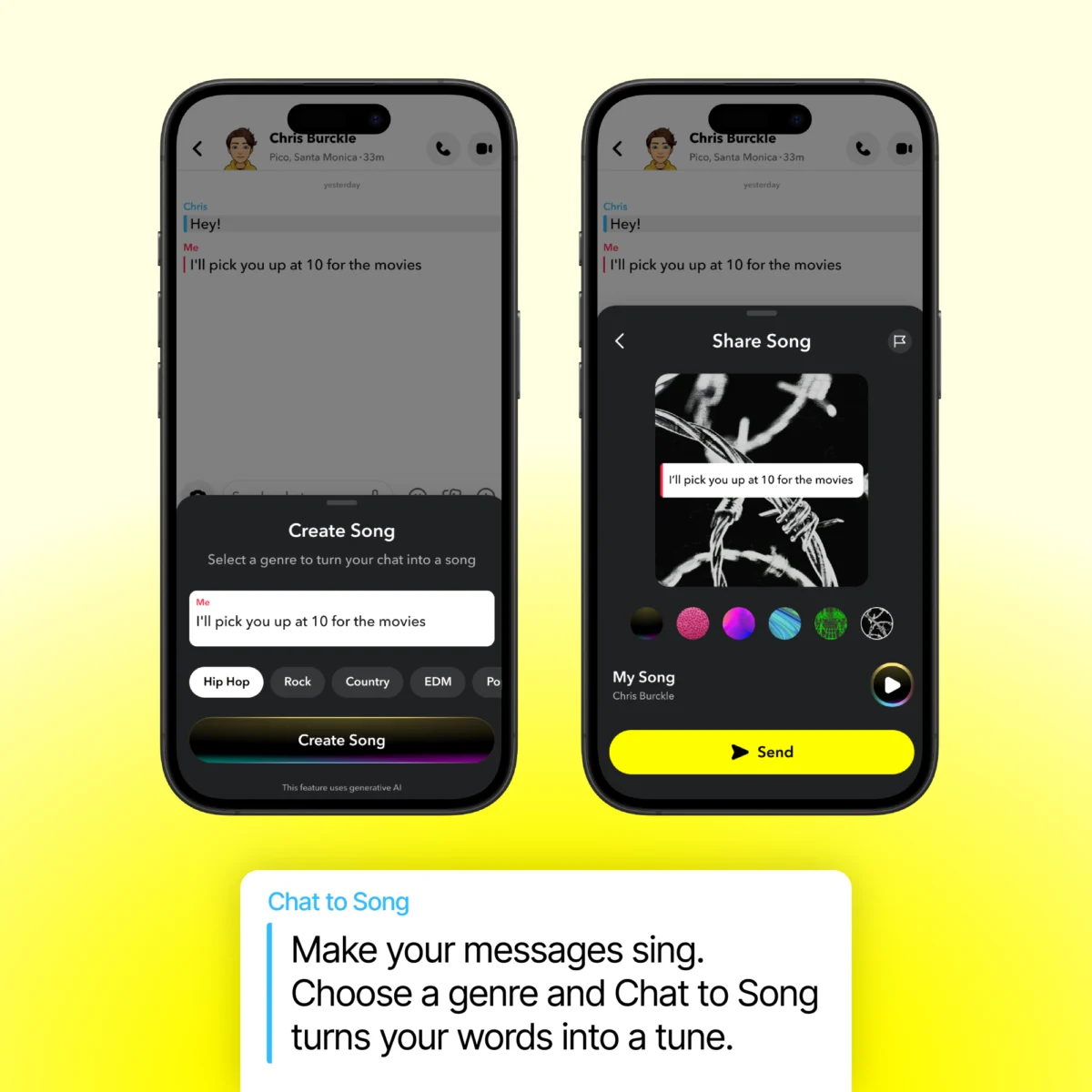
Snap Inc. has officially expanded the capabilities of its premium subscription tier, introducing a suite of generative artificial intelligence tools designed to transform how users interact within private messages. The cornerstone of this update is a feature titled "Create Song," which allows subscribers to convert standard text messages into original musical compositions across various genres. This development marks a significant escalation in Snap’s efforts to monetize its massive user base through advanced, compute-heavy AI features that remain exclusive to its highest-paying customers.
The "Create Song" feature functions through a simple interface integrated directly into the chat window. Users can press and hold any sent or received message to trigger a menu that includes the new musical option. Once selected, the platform prompts the user to choose from a list of musical styles, including pop, rock, country, and hip-hop. The underlying AI then analyzes the text and generates a short, unique audio track that incorporates the message’s content into the lyrics or melody. Before sharing the creation with a group or individual, users are provided with a preview to ensure the tone matches the intended sentiment of the conversation.

This move is part of a broader strategy to differentiate Snapchat’s Lens+ from the standard Snapchat+ subscription. While the basic paid tier offers various aesthetic and functional perks, Lens+ is positioned as the home for Snap’s most sophisticated augmented reality and generative AI experiments. By turning text-based communication into a multimedia experience, Snap is betting that its younger demographic will value novel ways to express humor and emotion within their inner circles.
Expanding the Generative Capabilities of Snapchat’s Lens+
Beyond the musical integration, the latest update introduces several visual AI tools aimed at "rescuing" imperfect media and reimagining shared content. One of the most prominent additions is AI Photoshoot, a tool designed to correct common photography errors that often lead to discarded Snaps. Utilizing machine learning models trained on vast datasets of human portraiture, AI Photoshoot can digitally adjust images where a subject may have blinked, looked away from the lens, or been obscured by unfavorable lighting conditions.
The tool operates by identifying the flaws in a captured frame and offering "Retouch" or "Flash" styles to intelligently fill in missing data. For example, if a user captures a group photo where one individual has their eyes closed, the AI can synthesize a natural-looking open-eyed version based on the subject’s facial structure. This feature brings professional-grade photo editing capabilities to the mobile interface, reducing the friction between capturing a moment and sharing it.

Another significant addition is AI Remix, which encourages interactive engagement with received content. When a friend sends a Snap, Lens+ subscribers can now use the Remix tool to transform that image into an entirely new artistic style. The interface allows users to input descriptive prompts—such as "make this look like a 1990s cartoon" or "add a dozen cats to the background"—to generate a stylistic reply. This creates a feedback loop of generative content that keeps users engaged within the app’s messaging ecosystem rather than exported to third-party editing suites.
The Evolution of the Snapchat’s Lens+ Subscription Model
The introduction of these tools comes as Snap Inc. reports a milestone of over 25 million subscribers for its paid services. The company launched Lens+ last year as an elite sub-tier within the existing Snapchat+ framework, priced at $7.99 per month. This pricing strategy reflects the high operational costs associated with running generative AI models, which require substantial server-side processing power compared to traditional social media features.
To manage these costs, Snap utilizes a "generation allowance" system for its Lens+ subscribers. Each account is granted a specific number of AI "credits" per month, which are consumed whenever a user generates a song, restyles a photo, or uses the "Imagine" lens for text-to-image creation. This model allows Snap to provide high-end features while maintaining a sustainable balance against the cloud computing expenses incurred by heavy users.

The growth of Snapchat’s Lens+ highlights a shift in the social media industry away from a total reliance on advertising revenue. As privacy regulations and changes in mobile operating systems have made targeted advertising more challenging, platforms are looking toward direct consumer monetization. By bundling exclusive AI tools into a monthly subscription, Snap is creating a predictable revenue stream that is less sensitive to the fluctuations of the digital ad market.
Strategic Differentiation and the "Private AI" Philosophy
Snap’s approach to AI implementation differs fundamentally from its competitors, such as Meta or TikTok. While other platforms have focused heavily on integrating AI into their public-facing discovery algorithms or using AI to generate content for broad distribution, Snap is focusing its most advanced tools on private communication. The company has maintained a strict policy that fully AI-generated video content will not be recommended in "Spotlight," Snapchat’s public content platform where users can go viral.
This "Private AI" philosophy is intended to protect the platform’s social fabric. By keeping generative tools within chats, Snap positions AI as a social lubricant—a way for friends to joke, create, and communicate—rather than a tool for mass misinformation or algorithm-gaming. This distinction is crucial for maintaining the trust of a user base that has historically used Snapchat as a "safe space" for ephemeral, unpolished interactions.

Furthermore, the company recently launched "Snapchat Plans," an event-coordination feature that allows users to organize real-world meetups. When viewed alongside the new AI features in Snapchat’s Lens+, a clear roadmap emerges: Snap is attempting to become the central operating system for a user’s social life, handling everything from the initial "vibe" of a chat (via AI songs) to the logistical planning of an in-person event.
Industry Impact and the Competitive Landscape
The launch of these features places Snap in direct competition with specialized AI startups and established tech giants alike. The "Create Song" feature, for instance, enters a space currently occupied by AI music generators like Suno and Udio, though Snap’s version is optimized for short-form, conversational snippets rather than full-length tracks. By integrating this technology directly into a messaging app, Snap removes the "app-switching" friction that often prevents mainstream adoption of new AI tools.
In the realm of photo editing, AI Photoshoot competes with Google’s "Magic Editor" and Apple’s "Intelligence" features. However, Snap’s advantage lies in its social context. While a Google user might fix a photo for their personal archive, a Snapchat user fixes a photo specifically to send it to a friend in real-time. This emphasis on "social utility" has been a hallmark of Snap’s survival in an industry dominated by larger players.

Market analysts suggest that the success of Snapchat’s Lens+ will serve as a bellwether for the broader social media landscape. If users prove willing to pay a premium for AI-integrated messaging, other platforms will likely follow suit with similar tiered subscription models. Meta has already experimented with "Meta One" in certain regions, and the industry is closely watching to see if the "AI-as-a-service" model can offset the rising costs of infrastructure.
Future Implications for Digital Culture and Expression
As generative AI becomes a standard component of interpersonal communication, the nature of "authentic" digital interaction is likely to evolve. The ability of Snapchat’s Lens+ to instantly turn a joke into a song or a blurry selfie into a studio-quality portrait blurs the line between reality and digital enhancement. Critics of the technology argue that such tools may lead to a "homogenized" social experience where every interaction is filtered through a machine-learning lens.
However, proponents argue that these tools represent a new form of digital literacy. For a generation raised on memes and remixes, the ability to manipulate media as easily as typing a sentence is seen as an extension of creativity. Snap’s focus on playful, small-scale AI tools suggests that the company views the technology not as a replacement for human connection, but as a new medium for it.

The rollout of these features will continue across global markets where Lens+ is available over the coming weeks. As the novelty of AI-generated songs and photoshoots wears off, the true test for Snap Inc. will be whether these tools become essential parts of the user experience or remain as ephemeral as the Snaps they are designed to enhance. For now, the company remains committed to its path of aggressive AI integration, betting that the future of social media is not just what we say to each other, but how we use technology to sing it.