Austin Abrams, the breakout star of Zach Cregger’s critically acclaimed Resident Evil reboot, recently delved into the film’s audacious and emotionally devastating conclusion, characterizing it as "risky and gutsy." The horror film, which has shattered box office records for the franchise, concludes with Abrams’ character, Bryan, succumbing to the t-virus and transforming into one of the very monsters he fought, rather than finding a cure or heroic redemption. This unconventional ending has sparked considerable discussion among critics and audiences alike.
Abrams’ recent ascent in Hollywood has been closely tied to filmmaker Zach Cregger. After their successful collaboration on the Oscar-winning film Weapons (where Amy Madigan secured a Best Supporting Actress award), Abrams chose to stick with Cregger, even navigating strike-related scheduling conflicts that saw an initial cast change for Weapons. This loyalty paid off, as Cregger, celebrated for his innovative approach to horror demonstrated in 2022’s Barbarian, cast Abrams as the lead in the Resident Evil reboot. The film has since achieved the franchise’s best reviews and highest-grossing opening weekend, taking in $60 million in its first three days.
A New Chapter for Resident Evil

Cregger’s Resident Evil marks a significant departure from previous adaptations, focusing on a more grounded and character-driven horror experience. Abrams’ portrayal of Bryan, a medical courier caught in the initial stages of the t-virus outbreak in Raccoon City, anchors the narrative. The film’s critical and commercial success has solidified Cregger’s position as a leading genre filmmaker and propelled Abrams into the spotlight as a sought-after leading man, with his survival thriller Whalefall also slated for an October 16 release. Directed by Cregger collaborator Brian Duffield, Whalefall similarly puts Abrams’ character through an intense, isolated ordeal, this time as a scuba diver swallowed by a sperm whale.
Reflecting on the physically demanding nature of these back-to-back lead roles, Abrams, who began acting at 13, expressed the difficulty of singling out which project was more arduous. "Honestly, in certain ways, they’re one and the same," Abrams told The Hollywood Reporter. "With Whalefall, I don’t know if you’ve ever worn a wetsuit all day long, but the incessant tightening on your skin is somewhat uncomfortable. With Resident Evil, the amount of running, mixed with the exactness needed to get the shot right, and night shoots — makes it a hard competition." He noted that Resident Evil offered more comedic relief, which helped "lighten the load" during challenging production.
Bryan’s Tragic Arc in Raccoon City
Cregger’s Resident Evil opens by establishing Bryan’s character, a medical courier grappling with an impending life change. He’s tasked with delivering an organ while simultaneously having a difficult phone conversation with his girlfriend, Michelle, who has just revealed her pregnancy. Bryan, apprehensive about fatherhood, postpones the conversation by taking a last-minute job to Raccoon City General Hospital. His attempts to avoid the discussion further alienate Michelle, who decides to stay with a friend, giving him space to reflect.

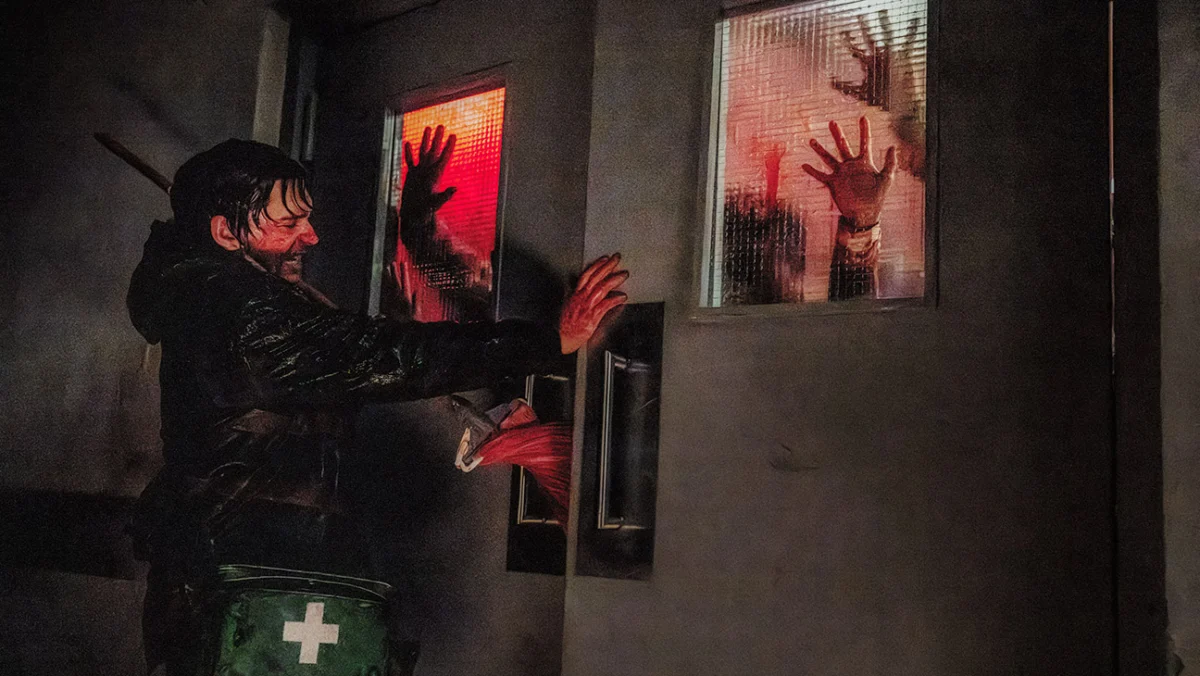
The unfolding t-virus outbreak quickly overtakes Bryan’s personal drama. His journey is marked by a series of escalating horrors: striking an infected pedestrian, witnessing a police officer’s demise, and encountering mutated creatures. Seeking refuge in a farmhouse, he kills an infected farmer and his reanimated wife, only to witness their bodies fuse into a grotesque, relentless amalgamation monster. This horrifying visual sets the stage for his own eventual transformation.
Bryan’s perilous trek continues into a tunnel filled with abandoned vehicles, where he attempts to rescue a little girl, only for her to turn on him and bite his arm, sealing his fate. He later learns from Umbrella Corporation agents that he is carrying the "neutralizing base" crucial for an antidote. Despite his rapidly spreading infection and numerous near-death experiences, Bryan heroically reaches the hospital’s 28th-floor lab. However, the Umbrella scientists fail to complete the cure in time, and Bryan, consumed by the virus, tragically kills them, becoming an amalgamation monster himself.
The Unconventional Climax of Resident Evil
The film’s final reveal recontextualizes the entire narrative as an origin story for a Resident Evil monster, a poignant twist that challenges audience expectations. This thematic choice underscores Cregger’s message that change is an inevitable force, regardless of one’s readiness. Abrams found this ending to be profoundly impactful. "I thought it was crazy and shocking when I first read it," he stated. "You follow this one guy the whole time, so hopefully you’re enjoying watching him and rooting for him. Then to have him not make it is really risky and gutsy, which is what I love about all of Zach’s work."

In an industry often driven by test screenings and CinemaScore metrics that favor more palatable conclusions, Cregger’s decision to embrace a "downer ending" stands out. Abrams commended this artistic courage, noting, "With a lot of movies nowadays, they’re a little too afraid to do something like that — to kill off a character you really like. And if they do, the blow is softened in some way so it doesn’t hurt too much." He contrasted this with older films that "just rip your heart out," expressing appreciation for Cregger’s willingness to take such a significant creative risk with Resident Evil.
The Unsent Message and Enduring Tragedy
A particularly heartbreaking aspect of the ending is Bryan’s final act: recording an audio message for Michelle, expressing his regret over his initial reaction to her pregnancy and his desire to build a family. Critically, this message is never sent, leaving Michelle to believe his monstrous initial response was his true sentiment. Abrams acknowledged the profound tragedy inherent in this lack of closure. "She thinks he doesn’t want to have this baby, when he actually does," Abrams explained. "He realizes, ‘No, I love her. Having a kid isn’t as scary as I thought, and I want to do it with her.’ So the fact that she’ll never know that is pretty damn tragic. He changed and got better, but no one will ever know about it. There’s something really beautiful and tragic about that."
Abrams’ portrayal of Bryan consciously subverted traditional action hero archetypes. Instead of a stoic, unflappable protagonist, Bryan reacts to the zombie apocalypse with genuine fear and vulnerability, often letting out what Abrams described as a "feminine scream." This choice aimed for realism, showing how an ordinary person might truly react to such unimaginable horrors. "I wanted to look like the antithesis of the ‘cool action hero’ as much as I possibly could because that feels the most interesting," Abrams said, noting that such a realistic approach makes the character’s journey more compelling.

Behind the Scenes: Humor and Hazards on the Resident Evil Set
The film also subtly touches on societal perceptions of video games. At one point, Bryan triumphantly exclaims, "Video games!" after successfully firing his last bullet, attributing his survival instincts to his gaming experience. This moment playfully challenges the long-standing critique that video games promote violence, suggesting they might instead hone problem-solving and vigilance. Abrams suggested the deeper meaning would be for Cregger to confirm, but appreciated the humorous element.
Despite the film’s intense horror, the set of Resident Evil was not without its lighter moments and physical challenges. Cregger had initially cut many jokes from the script after test audiences found the movie "too funny," though Abrams noted that many hilarious situational moments remained, and some "SNL version" jokes were never even filmed. Abrams also recounted a tense moment during filming when a 150-pound blood bag nearly crushed him during a "jumper street" sequence. He admitted he was so immersed in the scene that he barely registered the danger at the time, only realizing how close it was later during promotional interviews.
As Abrams continues to navigate his career, now frequently atop the call sheet, he remains grounded. He dismissed the idea of becoming a "boogeyman" for other actors in auditions, emphasizing his continued drive to push himself creatively. Having spent the last few years in physically demanding, survival-focused roles, Abrams lightheartedly expressed a desire for a "lullaby" movie, a calmer project that would offer a different kind of challenge. Ultimately, his future roles, he stated, would depend on the filmmaker and the opportunities that come his way, indicating a continued pursuit of compelling storytelling over genre constraints.

Resident Evil is currently playing in movie theaters nationwide.