Spotify announced robust second-quarter financial results, surpassing expectations for new premium subscribers and demonstrating strong revenue growth, while its co-CEOs highlighted the significant progress and strategic control over key initiatives like its AI remixing tool and other technological investments. The music streaming giant revealed it added one million more new premium subscribers than anticipated, a crucial factor that helped buffer a slight miss in total monthly user growth and ensured the company met its revenue targets.
The company reported that its total user base of 777 million monthly average users generated 14% revenue growth, reaching 4.777 million euros, a figure that aligned with prior guidance. Spotify also outperformed expectations regarding its gross margin, which saw an expansion of 193 basis points to 33.4%, and operating income, which climbed to 655 million euros. These figures underscore a period of solid financial performance for the audio streaming platform.
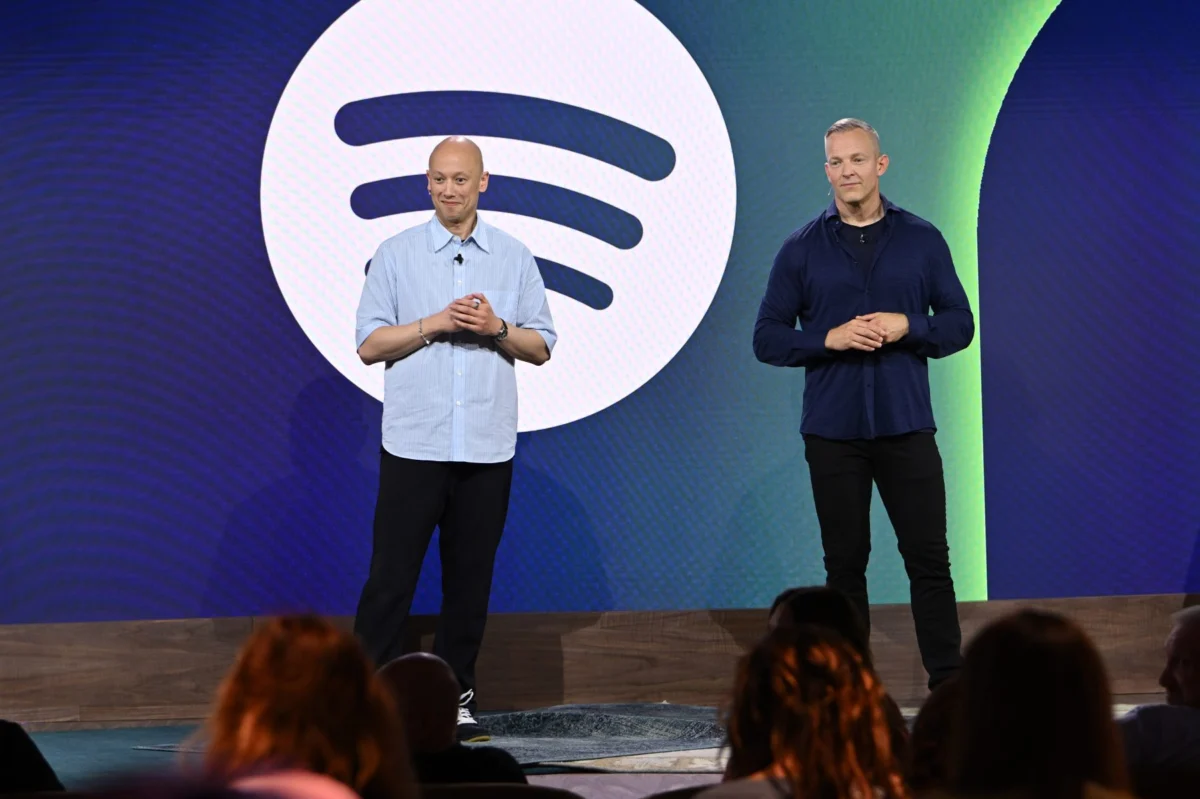
This marks the first public investor and analyst discussion involving co-CEOs Alex Norström and Gustav Söderström since the company’s investor presentation day in May. During the call, they articulated that new product developments, including a ticket reservation system, AI-powered playlisting, and the much-discussed AI remixing tools, are exhibiting "strong momentum." Crucially, they emphasized that the company’s investments in artificial intelligence and marketing remain "entirely in our control," aiming to allay investor concerns about escalating tech expenditures.
Operating expenses saw a modest increase of 3% from the previous year, totaling 941 million euros. This rise was attributed to strategic investments in technology, particularly in AI development, and expanded marketing efforts. Despite the financial updates, Spotify’s stock experienced a slight dip, trading down 1.5% to $479 per share in afternoon trading on the New York market.
Artist Adoption Fuels Momentum for Spotify’s AI Remix Tool
A significant development highlighted by Spotify is the growing traction of its AI remixing tool, with key industry players signaling their participation. The independent label collective Merlin has officially joined Universal Music Group (UMG) in licensing the music of artists and creators who opt-in to have their work remixed by select Spotify premium subscribers using AI. This move is crucial for the widespread adoption and ethical deployment of the technology, ensuring that artists have agency over their creations.

Under the agreements with Merlin and UMG, artists, songwriters, and other rights holders must explicitly consent to their music being used for remixing. Spotify has committed to compensating and crediting these participating artists through the upcoming tool, addressing a critical aspect of artist rights in the age of AI. This framework aims to build trust and transparency within the creative community.
When questioned by analysts about the pace of artist consent, Söderström acknowledged the prevailing skepticism surrounding AI in music but expressed optimism about the "strong momentum" observed for the remixing initiative. He articulated Spotify’s distinct approach, stating, "What we’re doing is something different, and artists see that our products are about real artists, not fake artists, and in the case of remixes, real artists with real voices."
Söderström further elaborated on the unique value proposition, noting, "This thing doesn’t exist, and artists remain excited about that, and consumers remain excited about that." This suggests that Spotify is positioning its AI tools as enhancements that empower existing artists rather than replace them, a key differentiator in the evolving music landscape.
Preview of AI Remix Model and Scalable User Feedback
Spotify plans to roll out a preview of its AI Remix model to a select group of users, allowing them to test the product before its full catalog integration. This phased approach is designed to gather valuable user feedback and refine the technology. "What we will do is allow fans of a certain artist to start making remixes with songs from that artist," Söderström explained, emphasizing the iterative development process.
The company intends to leverage its massive user base of 777 million music fans for reinforcement learning, a critical component in improving the AI model. "We have now 777 million people and music fans to do reinforcement learning with, which is why we think we’re very well positioned in this business," Söderström stated. He anticipates the product will launch when it is deemed ready, possessing the necessary appeal for consumers.
Addressing licensing complexities, Söderström indicated that Spotify does not require agreements with every major music company at launch. He drew a parallel to the platform’s early days, when it streamed music from artists like The Beatles and Metallica without initial permissions. "We would like to have as many artists as possible, obviously, but we don’t expect to have all artists," he concluded, signaling a pragmatic approach to licensing.

Reserved Ticketing Initiative Exceeds Expectations
Spotify’s innovative "Reserved" ticketing initiative, launched on June 23, has already seen significant uptake, with nearly 100,000 tickets reserved. This program identifies an artist’s most dedicated fans and holds a pair of concert tickets for them, fostering a direct connection between artists and their core audience. In partnership with Live Nation and Ticketmaster, eligible premium subscribers receive notifications when they can reserve tickets for shows by artists such as ROLE MODEL.
Norström reported that for certain tours, the allocation of reserved tickets was completely sold out, prompting Live Nation to increase the number of available seats mid-run. He described Reserved as "one of the most wonderful improvements… in our history," highlighting its benefits for both fans and artists. "The biggest fans get first access. Artists get their most dedicated audience in the room, and every seat we fill makes a Spotify subscription more valuable," Norström stated, underscoring the symbiotic relationship the program fosters.
Strategic Control Over AI Investments and Operating Expenses
In response to growing investor apprehension regarding substantial investments in AI by major technology companies, Spotify’s leadership sought to reassure stakeholders about their financial prudence. While operating expenses increased by 3% year-over-year, executives emphasized that these expenditures are well within their control. "The operating expense growth is not coming from people; it’s coming from compute and marketing," Söderström clarified.
He further elaborated that both compute and marketing are variable costs that can be managed effectively. "Both of these are variable and entirely in our control, and we will continue to invest in AI on our terms," Söderström asserted, reinforcing the company’s strategic autonomy. This approach aims to mitigate the risks associated with unbridled AI spending.
Spotify’s vendor-agnostic strategy for AI, utilizing models from companies like Anthropic, and its strict oversight of platform and consumer usage, contributes to cost control. "Which means that the cost curve is also under our control," Söderström added, providing a clear picture of their financial management in this area.

Monetization Strategies in Emerging Markets
Spotify is implementing strategic changes to its ad-supported tier in emerging markets, including India and Indonesia, with the goal of converting more free users into premium subscribers. The company has observed faster-than-expected growth in its ad-supported tier in these regions. To drive monetization, Spotify is introducing "friction" into the user experience for free accounts.
Norström detailed these adjustments, stating, "We’ve made changes like, you know, tweaking the sign-up to get higher quality MAU throughput." This includes deprecating support for lower-end Android devices to streamline operations and enhance efficiency. Furthermore, "We’ve carefully introduced some friction in both ad load and some limitations in our free tier. All of these things are positioning us for more monetization."
While acknowledging that these changes might impact monthly active users (MAUs) in the third quarter, Norström expressed confidence in their long-term benefits. He believes these measures will ultimately boost subscription penetration in emerging markets, mirroring the success seen in Latin America. "We do not expect it to come at the expense of our subscriber growth," Norström concluded, indicating a balanced approach to user acquisition and monetization.