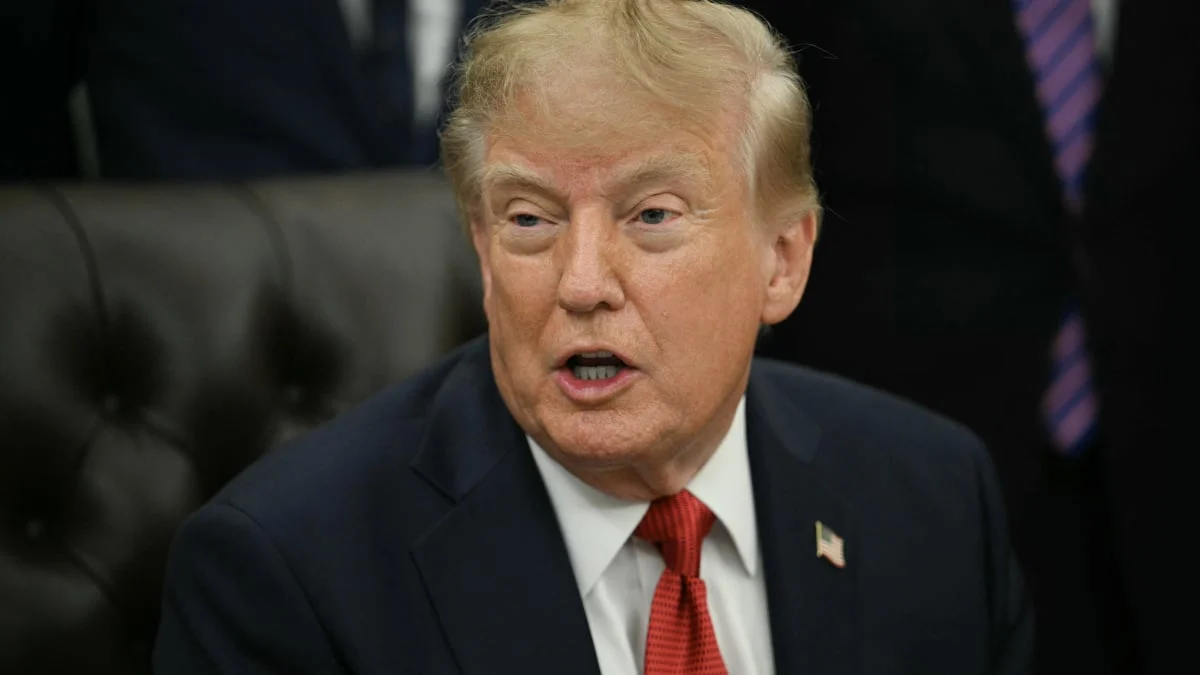
President Donald Trump announced on Saturday his intention to establish a dedicated "AI Force," a new initiative designed to centralize the federal government’s rapidly expanding artificial intelligence capabilities under a single administrative and military framework. The proposal, which mirrors the creation of the Space Force during his first term, aims to consolidate various technological programs that are currently fragmented across multiple agencies and military branches. Trump further revealed that his administration would soon appoint a high-level official, often referred to as an AI "czar," to lead the new entity and oversee the nation’s strategic direction in emerging technologies.
The announcement was made through a detailed statement on Truth Social, where Trump framed the "AI Force" as a necessary evolution of American national security. In the post, the former president dismissed widespread concerns regarding the existential risks of artificial intelligence, categorizing such warnings as manufactured "hoaxes" designed to slow American progress. Instead, he emphasized a policy of aggressive growth, promising that the federal government would actively support the industry while utilizing the existing legal system to prosecute "BAD" actors who misuse the technology for criminal or unethical purposes.
According to the administration’s outline, the primary mission of the "AI Force" would be to provide a unified structure for the development and deployment of machine learning and automated systems. Trump emphasized that the United States must maintain its competitive edge against global adversaries, particularly China, by ensuring that domestic innovation is not hampered by what he described as excessive regulatory overreach. "We will not in any way hinder or stifle the Growth of this incredible Industry," Trump wrote, signaling a pivot toward a more laissez-faire approach to Silicon Valley’s most potent technological advancements.
The Blueprint: Modeling the AI Force After the Space Force
The comparison to the Space Force is central to understanding the proposed structure of the new organization. When the Space Force was established in 2019, it was not initially designed as a combat-heavy infantry unit but rather as a specialized branch focused on coordinating satellite operations, missile warning systems, and orbital communications. Prior to its inception, these responsibilities were scattered across the Air Force, Army, and Navy, leading to bureaucratic redundancies and a lack of unified strategic vision.
An "AI Force" would likely function in a similar capacity. Currently, the Department of Defense (DoD) operates hundreds of separate AI-related projects, ranging from autonomous drone swarms to predictive logistics and cyber-defense algorithms. Many of these programs operate in silos, with little data sharing or cross-branch collaboration. By establishing a centralized "AI Force," the administration seeks to bring these disparate programs under one roof, streamlining procurement, improving interoperability, and creating a specialized career path for data scientists and software engineers within the military hierarchy.
The proposal also addresses the need for a specialized workforce. Trump noted that the administration is looking for "High I.Q. individuals" to fill the role of the AI czar and other leadership positions within the organization. This focus on elite technical talent suggests a departure from traditional military recruitment, focusing instead on attracting experts from the private sector who might otherwise be recruited by major tech firms like Google, Meta, or OpenAI.
Leadership Vacancies and the Role of the AI Czar
The search for a new AI czar follows the recent departure of David Sacks, a prominent venture capitalist and tech executive who previously served as Trump’s advisor on artificial intelligence and cryptocurrency. Sacks stepped down from his formal role in March after his term as a special government employee concluded, though he continues to serve in an unofficial advisory capacity. His exit left a significant void in the administration’s technology policy wing, which the "AI Force" and its new leadership are intended to fill.
The role of the AI czar will be pivotal in defining the boundaries of the "AI Force." This individual will be tasked with navigating the complex relationship between the White House, the Pentagon, and Silicon Valley. Beyond military applications, the czar will likely oversee the integration of AI into federal infrastructure, including energy grids, border security, and economic forecasting. The administration has indicated that the ideal candidate must possess both deep technical knowledge and a commitment to the president’s deregulation agenda.
In a move that reflects his penchant for branding, Trump also suggested that the term "Artificial Intelligence" might be replaced with something more prestigious. He floated several alternatives, including "Supreme Intelligence," "Superior Intelligence," and "Extreme Intelligence." While these suggestions were met with various reactions from the tech community, they underscore a desire to reframe the conversation around AI from one of caution and risk to one of national dominance and technological superiority.
Addressing Recent Intelligence Failures and Operational Risks
The push for a centralized "AI Force" comes at a time when the Department of Defense is facing intense scrutiny over its current use of automated systems. Several high-profile failures have highlighted the dangers of an uncoordinated approach to military AI. Earlier this year, Pentagon investigators launched a probe into a February military strike in Iran that resulted in the deaths of dozens of individuals at a girls’ school. Initial findings suggested that an "overreliance on AI" and automated targeting systems may have led to the tragic error, sparking a debate over the lack of human oversight in lethal autonomous operations.
More recently, a significant intelligence lapse nearly escalated into a major international conflict. In September, reports surfaced that a U.S. military analyst had utilized an AI chatbot to generate a report claiming a Chinese vessel was transporting nuclear weapons components. Based on this AI-generated intelligence, armed U.S. service members were reportedly prepared to board the ship. The operation was only halted at the last minute when senior officials discovered the source of the data was a hallucinating AI model rather than verified human intelligence.
Sources familiar with the incident described the situation as a near-miss that "almost started a war" with China. These events have bolstered the argument for an "AI Force" that can implement rigorous standards and protocols for the use of machine learning in intelligence gathering. Proponents argue that a centralized command would prevent individual analysts from using unvetted consumer-grade AI tools and would instead provide secure, military-grade alternatives with built-in safeguards.
Economic Impact and the Stance on Innovation
From an economic perspective, the creation of an "AI Force" represents a significant commitment to the domestic technology sector. Trump’s promise to "cherish it, help it, and watch over it" suggests that the federal government may increase subsidies and contracts for American AI companies. By framing AI as a national security priority, the administration can justify large-scale investments that bypass traditional budgetary hurdles.
The administration’s stance on regulation remains a focal point for industry leaders. While some tech CEOs have called for federal guardrails to prevent the misuse of AI, Trump’s "AI Force" initiative leans heavily toward deregulation. The administration’s philosophy is rooted in the belief that the primary threat to the U.S. is not the technology itself, but the possibility of being overtaken by foreign competitors who do not adhere to the same ethical constraints.
However, the promise to go after "BAD" actors indicates that the administration does not intend to allow a total vacuum of oversight. The "AI Force" would likely work alongside the Department of Justice to monitor for the use of AI in cybercrime, financial fraud, and foreign interference. This dual approach—unfettered growth for "patriot" companies and strict enforcement against "bad" actors—forms the backbone of the proposed "AI Force" policy.
Geopolitical Stakes and the Global AI Arms Race
The international community is watching the development of the "AI Force" closely. The United States and China are currently locked in what many analysts describe as a "Global AI Arms Race," where the winner will likely dictate the future of global economics and warfare. China has already integrated AI into its "Great Firewall" and its domestic surveillance apparatus, and it has made no secret of its goal to become the world’s primary AI innovation center by 2030.
The establishment of a dedicated military branch for AI signals to the world that the U.S. views this technology as more than just a tool; it views it as a domain of warfare, similar to land, sea, air, and space. This move could prompt other nations to accelerate their own military AI programs, potentially leading to a new era of algorithmic deterrence. Critics warn that such a move could lower the threshold for conflict, as automated systems might react to perceived threats faster than human diplomats can intervene.
The "AI Force" would also be tasked with protecting American intellectual property. As AI models become increasingly valuable, they have become prime targets for state-sponsored espionage. Centralizing the defense of these assets under a single command could provide a more robust shield against the theft of trade secrets and the reverse-engineering of sensitive American algorithms.
Legislative Path and Future Implementation
While the president has the authority to initiate the planning of a new military branch, the full establishment of an "AI Force" will require Congressional approval and funding. The Space Force faced similar hurdles before eventually receiving bipartisan support, and it is expected that the "AI Force" will spark a vigorous debate on Capitol Hill. Concerns regarding the cost of a new military branch, the potential for "killer robots," and the ethics of automated decision-making will likely be central to the upcoming legislative sessions.
In the coming months, the administration is expected to release more specific details regarding the "AI Force" budget and its organizational chart. The appointment of the AI czar will be the first major milestone in this process. As the White House vets candidates for the role, the tech industry and the military establishment are bracing for a fundamental shift in how the United States approaches the most transformative technology of the 21st century.
The "AI Force" represents a bold attempt to modernize the American state for a digital age. By consolidating power, prioritizing "High I.Q." leadership, and rejecting the narrative of AI-induced catastrophe, the administration is betting that centralized control and rapid innovation will ensure American dominance for decades to come. Whether this new branch can successfully navigate the technical failures of the past and the geopolitical tensions of the future remains the defining question of this new technological era.