International travelers navigating the logistical fallout of the escalating Middle East crisis are facing a secondary threat from sophisticated cybercriminals utilizing scam airline accounts to drain bank accounts. As missile strikes and airspace closures disrupt hundreds of flights across the region, fraudsters have flooded social media platforms, particularly X, to impersonate major carriers and intercept passengers seeking urgent assistance. These bad actors monitor public posts for keywords related to delays and cancellations, then pose as customer service representatives to lure victims into private conversations.
The surge in fraudulent activity coincides with significant military escalations involving Iran, which have forced airlines like Emirates, Etihad, and Qatar Airways to reroute or cancel flights on short notice. This atmosphere of uncertainty provides the ideal cover for scammers, who exploit the desperation of passengers stranded in foreign airports or facing high-rebooking fees. Financial institutions, including Santander UK, have issued high-level alerts after observing a spike in customers reporting unauthorized debits initiated through these fake social media profiles.
The Mechanics of Scam Airline Accounts During Global Crises
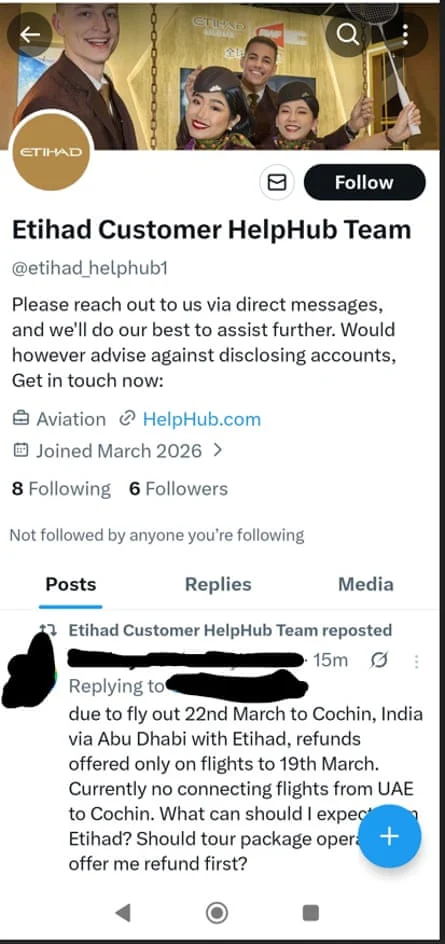
The operation typically begins when a frustrated passenger tags a legitimate airline in a post seeking information about a delayed flight. Within minutes, a scam airline account—often featuring the official logo and a convincing bio—replies to the post. These accounts frequently use handles that mimic official terminology, such as "Support Team," "Quick Response Care," or "Guest Services," often adding a series of numbers or underscores to bypass platform filters.
Once a traveler engages with the fraudulent account, the scammer moves the conversation to a direct message (DM) to avoid public scrutiny. The perpetrator then requests the passenger’s phone number and booking reference under the guise of processing a priority refund or rebooking. In many cases, the scammer will claim that the traveler is entitled to "crisis compensation" due to the Iran-related disruptions, a tactic designed to lower the victim’s defenses with the promise of unexpected financial recovery.
After establishing a rapport, the fraudster sends a link to a third-party money transfer application or a phishing site designed to look like an official airline portal. Victims are instructed to link their digital wallets or enter their banking credentials to "receive" the payment. Instead of a credit appearing in the account, the scammers use the provided information to authorize outgoing payments, effectively emptying the traveler’s account before the victim realizes the deception.

Geopolitical Instability as a Catalyst for Cybercrime
The conflict in the Middle East has created a "perfect storm" for digital fraud, as the rapid closure of Jordanian, Iraqi, and Lebanese airspaces in response to Iranian military maneuvers has left tens of thousands of passengers in a state of flux. Security analysts note that cybercriminals are increasingly agile, shifting their focus to whatever global event is currently causing the most consumer anxiety. The high ticket prices and complex refund policies associated with long-haul carriers like Qatar Airways and Emirates make them particularly lucrative targets for these campaigns.
Chris Ainsley, the head of fraud risk management at Santander UK, noted that the speed at which these criminals adapt to current events is a hallmark of modern social engineering. According to Ainsley, the travel disruption caused by the conflict in the Middle East is being exploited with clinical efficiency. He emphasized that criminals are targeting those seeking refunds for high-value holiday bookings, using the chaos of the war as a distraction to facilitate account takeovers and unauthorized charges.
The disruption is not limited to the immediate vicinity of the conflict. Because the Middle East serves as a primary transit hub for flights between Europe, Asia, and Australia, a closure of Iranian airspace has a ripple effect on global aviation. This expanded pool of potential victims allows scammers to operate on a massive scale, targeting travelers who may not even be flying to the Middle East but are affected by the resulting logistical bottlenecks.
Identifying Red Flags in Scam Airline Accounts
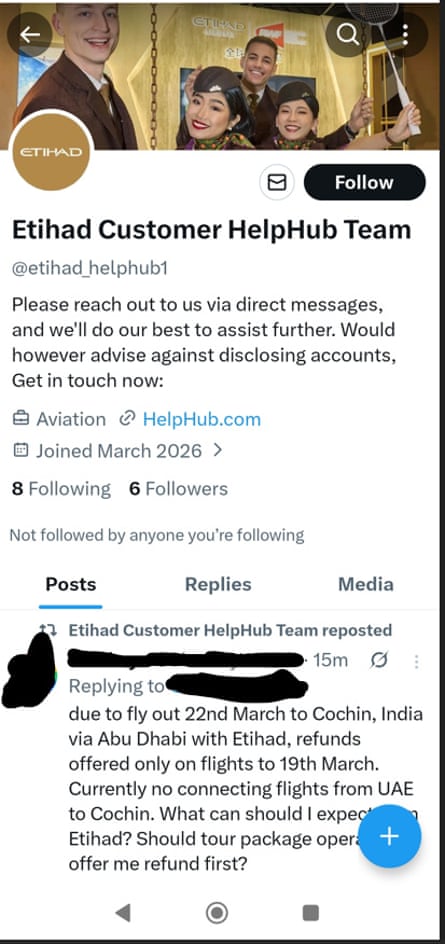
Despite the visual sophistication of these fraudulent profiles, there are several indicators that can help travelers distinguish between a legitimate customer service representative and a criminal. One of the most prominent red flags is the follower count. While official airline accounts possess hundreds of thousands or millions of followers, scam airline accounts typically have very low numbers, often in the single digits. These accounts are frequently created just days or even hours before they begin targeting victims.
Another key indicator is the nature of the information requested. Legitimate airlines will never ask for sensitive data such as account passwords, one-time passcodes (OTPs), or full credit card details through a social media message. Etihad Airways recently issued a public clarification stating that they do not request sensitive information or payment details via DMs. Furthermore, official accounts on platforms like X are usually verified with specific badges or are linked directly from the airline’s primary, high-traffic website.
The language used by scammers also tends to create a false sense of urgency. Phrases like "immediate action required" or "temporary refund window" are used to pressure travelers into making hasty decisions. In the context of the Iran conflict, scammers may claim that the "emergency nature" of the situation requires bypassing standard security protocols, a common tactic used to convince victims to share digital wallet access.
The Role of Social Media Platforms in Fraud Prevention
The rise of scam airline accounts has reignited the debate over the responsibility of social media platforms to protect users from financial harm. Since the overhaul of the verification system on X, which allows users to purchase a "blue checkmark," it has become increasingly difficult for the average consumer to verify the authenticity of a brand. Scammers have been known to purchase these checkmarks to add a layer of perceived legitimacy to their fraudulent operations.
Consumer advocacy groups have called for more robust automated monitoring to detect and ban accounts that impersonate major corporations during times of crisis. However, the sheer volume of posts generated during a major event like the Iran-Israel conflict makes manual moderation difficult. As a result, the burden of detection often falls on the consumer and their financial institution.
Airlines are responding by consolidating their social media presence. Many carriers now include a list of their official handles on their primary websites and warn customers to ignore any outreach from accounts not listed there. Some have even moved away from using social media for sensitive customer service interactions entirely, directing passengers to secure, encrypted chat functions within their proprietary mobile apps.
Broader Implications for the Travel and Banking Sectors
The persistence of these scams has broader implications for consumer trust in both the travel and financial industries. For airlines, the impersonation of their brands can lead to significant reputational damage, even if the company itself was not responsible for the security breach. For banks, the rise in "authorized push payment" (APP) fraud—where a customer is tricked into sending money themselves—presents a complex legal and financial challenge regarding reimbursement.
In many jurisdictions, banks are becoming more proactive in flagging suspicious transfers to money-messaging apps, but the speed of digital wallet transactions often means the money is gone before a freeze can be implemented. The psychological impact on travelers is also significant; losing thousands of dollars while already dealing with the stress of a war-disrupted journey can lead to long-term travel anxiety and a withdrawal from digital commerce.
The travel industry is currently exploring new ways to verify communications. Some experts suggest that the future of airline-to-customer interaction may involve blockchain-verified credentials or more integrated communication hubs that bypass third-party social media platforms altogether. Until such systems are universal, the reliance on public platforms remains a significant vulnerability.
Preventive Measures and Best Practices for Travelers
To mitigate the risk of falling victim to scam airline accounts, security experts recommend several layers of caution. Travelers are advised to never initiate contact with an airline by searching for their name on social media. Instead, they should navigate to the airline’s official website and click on the social media icons provided there to ensure they are being directed to the genuine profile.
If a passenger receives a reply from an account they did not explicitly tag, they should treat it with immediate suspicion. It is also recommended to use the airline’s official app or phone-based customer service lines, even if wait times are longer during a crisis. While the convenience of a quick reply on X is tempting, the risk of financial loss outweighs the time saved.
Financial institutions also suggest that travelers enable multi-factor authentication (MFA) on all banking and travel apps and set up real-time transaction alerts. If a traveler suspects they have engaged with a scammer, they should immediately contact their bank to freeze their accounts and report the fraudulent profile to the social media platform.
Conclusion of Current Crisis Management
As the geopolitical situation in the Middle East remains volatile, the aviation industry continues to brace for further disruptions. The "DM your details" scam is a stark reminder that cybercriminals are permanent fixtures in the ecosystem of global conflict, waiting to capitalize on every new wave of chaos. For the modern traveler, the price of mobility now includes a requirement for heightened digital literacy and a skeptical approach to unsolicited "help" in the digital sphere.
The ongoing coordination between airlines, banks, and government agencies like the Foreign Office is essential to curbing the success of these fraudulent campaigns. By staying informed through official channels and recognizing the patterns of social engineering, passengers can protect their finances while navigating the complexities of international travel during times of war. The focus remains on direct, verified communication as the only safe path for those caught in the crosswinds of global instability.