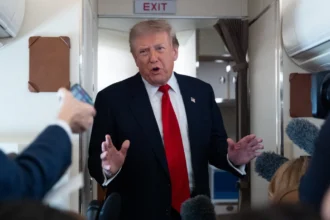
President Donald Trump declared Monday that any Iranian naval vessels venturing into a newly established U.S. naval blockade zone in the Persian Gulf would be "immediately eliminated," escalating tensions in a critical global energy artery. The stern warning signals a significant hardening of U.S. policy toward Iran, potentially imperiling a fragile ceasefire brokered just last week.
The U.S. naval blockade, officially commencing Monday at 10 a.m. Washington time (2 p.m. GMT), encompasses Iran’s coastline, including its ports and vital energy infrastructure. The United Kingdom Maritime Trade Operations (UKMTO) center confirmed it had been notified of the blockade, which it stated would apply "without distinction" to ships interacting with Iranian ports and oil terminals. This move, announced by President Trump on Sunday following the breakdown of U.S.-Iran negotiations in Pakistan, marks a dramatic departure from previous diplomatic efforts.
Escalation in the Persian Gulf
The declaration of a naval blockade represents a sharp escalation in the ongoing confrontation between the United States and Iran. This action directly challenges Iran’s maritime operations and its ability to export oil, a critical component of its economy. The broader implications for regional stability and global energy markets are significant, with analysts closely monitoring potential repercussions.
President Trump’s forceful rhetoric underscores the administration’s intent to enforce the blockade rigorously. "Iran’s Navy is laying at the bottom of the sea, completely obliterated – 158 ships," Trump stated in a social media post, referencing past naval engagements. He then issued a direct threat: "Warning: If any of these ships come anywhere close to our BLOCKADE, they will be immediately ELIMINATED." This aggressive posture indicates a willingness to use significant military force to achieve U.S. objectives in the region.
Background to the Blockade
The imposition of the U.S. naval blockade follows a period of intense diplomatic maneuvering and a recent, albeit fragile, ceasefire. Talks between U.S. and Iranian negotiators in Pakistan concluded without a comprehensive agreement, leading to the renewed adversarial stance. The ceasefire, intended to de-escalate tensions and facilitate dialogue, had stipulated that Iran would reopen the Strait of Hormuz, a crucial chokepoint for global oil shipments. However, vessel traffic in the strait has reportedly not increased since the truce was announced, suggesting underlying issues remain unresolved.
Iranian officials have publicly accused the United States of violating the ceasefire by permitting Israeli airstrikes in Lebanon. Pakistan, which played a pivotal role in mediating the truce, had asserted that the agreement encompassed all regional fronts, including Lebanon. This divergence in interpretation of the ceasefire terms highlights the deep-seated mistrust between the parties and the challenges of maintaining peace in the volatile region.
Economic and Geopolitical Ramifications
The U.S. naval blockade is poised to inflict further damage on Iran’s already strained economy. By restricting access to its ports and energy infrastructure, Washington aims to curtail Tehran’s revenue streams. However, the blockade’s effectiveness in dismantling Iran’s influence over the Strait of Hormuz or in stabilizing global energy prices remains a subject of debate.
Mohammad Bagher Ghalibaf, the speaker of the Iranian parliament and a key member of Tehran’s negotiating team, issued a stark warning regarding the potential impact on American consumers. He predicted that the U.S. blockade would inevitably lead to higher gasoline prices for Americans. "Enjoy the current pump figures," Ghalibaf posted on X. "With the so-called ‘blockade’, Soon you’ll be nostalgic for $4-$5 gas." Current reports indicate the average price of gasoline in the U.S. has already surpassed $4.12 per gallon, a significant increase from pre-conflict levels.
Iran has vehemently condemned the U.S. action, with officials labeling the naval siege as an act of "piracy" and vowing to defend its territorial waters. The disputes over control of the Strait of Hormuz and Iran’s pursuit of a domestic nuclear program were identified as the primary obstacles during the recent talks in Islamabad.
Pakistan’s Continued Mediation Efforts
Despite the heightened tensions, Pakistan has reiterated its commitment to facilitating a peaceful resolution. Prime Minister Shehbaz Sharif affirmed Pakistan’s dedication to sustaining the momentum for peace and stability in the region. This commitment underscores Pakistan’s ongoing role as a mediator, seeking to de-escalate the conflict and prevent further deterioration of the security situation.
The Strategic Importance of the Strait of Hormuz
The Strait of Hormuz is a narrow waterway situated between the Persian Gulf and the Gulf of Oman. It is one of the world’s most vital oil transit points, with approximately 30% of the world’s seaborne oil passing through it daily. Any disruption to shipping in this strait has immediate and significant consequences for global energy supplies and prices.
The U.S. naval blockade directly impacts Iran’s ability to export its oil, a critical source of income for the government. It also raises concerns about the potential for miscalculation and accidental escalation, given the high concentration of naval forces operating in close proximity. The U.S. maintains a significant naval presence in the Persian Gulf, tasked with ensuring freedom of navigation and deterring aggression.
Broader Geopolitical Context
The current standoff between the U.S. and Iran is part of a broader geopolitical landscape marked by regional rivalries and proxy conflicts. Iran’s nuclear program has been a persistent source of international concern, with the U.S. and its allies seeking to prevent Tehran from developing nuclear weapons. The U.S. withdrawal from the Joint Comprehensive Plan of Action (JCPOA) in 2018 and the subsequent reimposition of sanctions have further exacerbated tensions.
The conflict also involves complex relationships with regional powers, including Saudi Arabia and Israel, who view Iran as a significant threat. The ongoing proxy conflicts in Yemen, Syria, and elsewhere further complicate the security dynamics of the Middle East.
Potential for Wider Conflict
The imposition of a naval blockade and the threat of military engagement raise the specter of a wider regional conflict. A direct confrontation between the U.S. and Iran could draw in other regional actors and potentially disrupt global trade routes. The economic impact of such a conflict would be devastating, not only for the countries directly involved but also for the global economy.
The involvement of international actors, such as the United Kingdom and other maritime nations, highlights the global implications of any escalation in the Persian Gulf. Ensuring the safety of shipping lanes and preventing a full-blown conflict remains a paramount concern for the international community.
The Path Forward
The immediate future hinges on the adherence to and interpretation of the U.S. naval blockade. The U.S. military’s readiness to enforce the blockade with force, as stated by President Trump, signals a low tolerance for any perceived Iranian provocations. Conversely, Iran’s defiance and vows to defend its territorial waters suggest a willingness to challenge the U.S. presence.
The role of international diplomacy, particularly the continued mediation efforts by Pakistan, will be crucial in de-escalating the situation. Any misstep or miscalculation could lead to unintended consequences, rapidly escalating the crisis. The global community will be watching closely to see if diplomatic channels can be leveraged to avert further conflict and restore stability to this critical region. The economic fallout, particularly on energy prices, is already a palpable concern for consumers worldwide, adding another layer of urgency to finding a peaceful resolution.