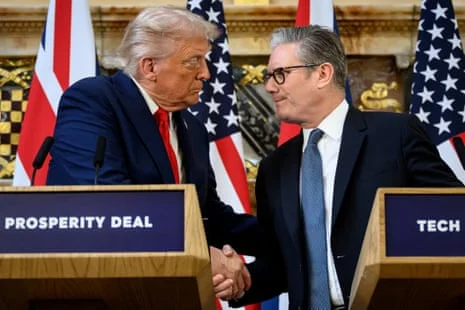
President Donald Trump expressed sharp disappointment Monday evening regarding the current state of the U.S.-UK alliance, stating the "special relationship is obviously not what it was" following Prime Minister Keir Starmer’s initial refusal to authorize British airbases for offensive operations against Iran. Speaking from the White House in a telephone interview, Trump criticized the British leader for what he described as a significant delay in supporting American military objectives in the Middle East. The tension marks one of the most visible fractures in the historic partnership between Washington and London in recent decades.
The president’s remarks come as the United States and Israel intensify a military campaign against Iranian targets following a series of escalations across the region. While other allies, including France and NATO Secretary General Mark Rutte, have signaled strong support for the U.S.-led strikes, Starmer initially resisted the request to use British sovereign bases for the opening wave of attacks. This hesitation prompted Trump to tell reporters that the relationship has shifted into a "different world" than the one previously shared by the two nations.
Trump Questions the Future of the Special Relationship After Starmer’s Refusal
During a conversation with the political editor of The Sun, Trump characterized the lack of immediate cooperation from Downing Street as a departure from the traditional expectations of the transatlantic alliance. "It’s very sad to see that the relationship is obviously not what it was," Trump said, adding that he "never thought" he would see such a lack of helpfulness from the United Kingdom. The president emphasized his affection for the British people but made it clear that the current administration in London was not meeting the moment as he defined it.
Trump specifically compared Starmer’s stance unfavorably to that of French President Emmanuel Macron. Historically, France has been more prone to independent foreign policy maneuvers that diverge from Washington, whereas the UK has traditionally been the most reliable U.S. partner in military interventions. Trump’s assertion that France had been more supportive than Britain underscores the depth of his frustration with Starmer’s tactical and legal reservations regarding the strikes on Tehran.
The president’s critique centers on the use of strategic military installations. The U.S. had requested the use of RAF Fairford in Gloucestershire and the strategically vital base at Diego Garcia in the Chagos Islands. These locations are critical for deploying long-range bombers and conducting sustained aerial campaigns. The delay in securing these permissions for the "initial wave" of attacks on Iran’s "missile cities"—fortified underground sites housing ballistic weaponry—was viewed by the White House as a hindrance to the immediate security of the region.
The Shadow of Iraq and Starmer’s Legal Defense
Prime Minister Keir Starmer defended his position in the House of Commons on Monday, framing his caution as a necessary lesson learned from previous Middle Eastern conflicts. In a direct reference to the 2003 invasion of Iraq, Starmer told lawmakers, "We all remember the mistakes of Iraq, and we have learned those lessons." He insisted that any UK military action must be grounded in a "lawful basis" and a "viable, thought-through plan."

The Prime Minister explicitly rejected the concept of "regime change from the skies," a phrase that signaled a significant policy break from the more aggressive posture adopted by the Trump administration. Starmer’s emphasis on the legality of the strikes reflects a broader concern within the British government regarding international law and the potential for long-term entanglement in a regional war. He noted that while the UK remains a committed ally, it would not participate in offensive strikes aimed solely at destabilizing the Iranian government without a clear defensive justification.
However, Starmer’s position evolved rapidly by Sunday evening. The Prime Minister told the Commons that the situation changed when Iran’s actions became a direct threat to British personnel and regional allies. Following reports of Iranian drone strikes targeting coalition bases in Iraq and the British base at RAF Akrotiri in Cyprus, Starmer authorized the use of UK bases for what he termed "defensive" strikes. These operations are intended to intercept and destroy Iranian missile sites that pose an immediate risk to British and allied forces.
Domestic Backlash and the Special Relationship Is Obviously Not What It Was
The friction between Trump and Starmer has provided fresh ammunition for the UK’s domestic opposition. Conservative Leader Kemi Badenoch accused the Starmer government of being "too scared" to project strength on the global stage. Badenoch argued that the Prime Minister’s hesitation was motivated by domestic political considerations rather than the national interest. She claimed that some sectors of the Labour Party’s base are "swayed by conflicts in the Middle East" and that Starmer was pandering to these voters at the expense of the UK’s most important security alliance.
The Conservative critique suggests that Starmer’s delay has damaged Britain’s standing in Washington, potentially leading to long-term consequences for intelligence sharing and trade negotiations. For many in the UK’s political establishment, the phrase "the special relationship is obviously not what it was" is a haunting assessment that could signal a pivot in U.S. foreign policy away from London.
The military reality on the ground has further complicated the political narrative. Before Starmer’s Sunday night authorization, two drones were fired at RAF Akrotiri in Cyprus. While these attacks were unsuccessful, they highlighted the vulnerability of British assets in the region. The RAF has also been active in intercepting Iranian drones over Iraq. These "defensive" actions have been used by Downing Street to justify their eventual cooperation with the U.S., even as they maintain a rhetorical distance from the "offensive" nature of the broader American campaign.
Regional Escalation and Global Market Impact
The diplomatic row is unfolding against the backdrop of a rapidly expanding war. Israeli military forces have launched new strikes on Tehran and Beirut, while Iran has responded by expanding retaliatory attacks on American targets in the Gulf region. This cycle of violence has sent shockwaves through global energy markets. Oil and gas prices have surged as investors weigh the risk of a total shutdown of shipping lanes in the Strait of Hormuz.
Market analysts are closely watching the "special relationship is obviously not what it was" rhetoric, as any prolonged tension between the U.S. and UK could affect coordinated efforts to stabilize the global economy. The UK government is currently preparing for a spring forecast and economic plan, but the rising cost of energy driven by the Middle East conflict threatens to undermine domestic financial stability. The interconnectedness of military policy and economic health has put immense pressure on Starmer to find a middle ground that satisfies both the White House and his own legal advisors.
In the United States, the Trump administration has signaled that it will continue its "maximum pressure" campaign against Iran regardless of the level of support from European allies. The White House has made it clear that it views the neutralization of Iran’s ballistic missile capabilities as a non-negotiable security priority. The use of RAF Fairford and Diego Garcia remains central to this strategy, and U.S. military planners are expected to push for even greater access to British facilities as the conflict progresses.
The Strategic Importance of Diego Garcia and RAF Fairford
The specific military assets at the heart of this dispute are among the most valuable in the world. Diego Garcia, located in the Indian Ocean, serves as a vital hub for long-range B-52 and B-2 Spirit bombers. Its remote location allows the U.S. to project power across the Middle East and Asia with minimal risk of ground-based retaliation. Similarly, RAF Fairford in the United Kingdom is the only European airfield capable of supporting large-scale heavy bomber operations.
When Starmer initially hesitated to grant access for offensive strikes, he was essentially placing a temporary "no-fly" zone on some of the most potent weapons in the U.S. arsenal. While the authorization for defensive strikes has eased some of the immediate operational friction, the "offensive" versus "defensive" distinction remains a point of contention. Trump’s administration views any strike on an Iranian missile site as a necessary preemptive measure, whereas Starmer’s legal team continues to scrutinize the definitions of "imminent threat" under international law.
The deployment of British aircraft to intercept drones heading for coalition bases in Iraq indicates that the UK is willing to engage in combat, but only under a strictly defined framework. This nuanced approach has clearly failed to impress President Trump, who values loyalty and decisive action above legalistic precision. The clash of styles—Trump’s transactional and aggressive posture versus Starmer’s cautious and legalistic framework—suggests that the "special relationship" will remain under significant strain for the foreseeable future.
Future Implications for the Transatlantic Alliance
As the conflict with Iran continues to spiral, the long-term health of the UK-US alliance remains uncertain. The "special relationship is obviously not what it was" comment may be remembered as a turning point where the two nations began to drift toward different strategic priorities. While the UK is still deeply integrated into the U.S. security architecture through the Five Eyes intelligence-sharing network and NATO, the current political leadership in both countries appears to be operating on different wavelengths.
The coming weeks will be a critical test for Starmer’s diplomacy. He must find a way to repair the damage with the White House while maintaining his commitment to a "lawful basis" for military action. For Trump, the priority remains a swift and overwhelming victory over Iranian forces, and he has shown little patience for allies who do not fully align with his vision. The world is watching to see if the historic bond between these two nations can survive the pressures of a new and volatile era of Middle Eastern warfare.
The immediate focus remains on the "missile cities" of Iran and the potential for further strikes. As the U.S. military utilizes the newly authorized access to British bases, the effectiveness of these defensive strikes will be closely monitored. Whether this cooperation leads to a warming of relations or if the "special relationship" continues to erode will depend on the next phase of this rapidly evolving international crisis.