Five years after Tunisian President Kais Saied suspended parliament and consolidated sweeping executive powers, the North African nation remains deeply fractured, facing a severe economic recession and an entrenched political stalemate. The anniversary of Saied’s July 25, 2021, actions, which saw the dismissal of Prime Minister Hichem Mechichi and the freezing of legislative functions, is marked by widespread discontent and a grim economic outlook.
Saied’s supporters maintain that his extraordinary measures were a necessary "correction" to rescue Tunisia from a paralyzed political system and economic stagnation. They argue that his intervention was essential to combat corruption and inefficiency that had plagued the country since the 2011 revolution. However, critics contend that these actions have led to the collapse of state institutions, the unfulfilled promise of reform, and an unprecedented concentration of power in the hands of a single individual.
Political and economic analysts have extensively debated the legacy of President Saied’s nearly half-decade in power. Their assessments frequently highlight an economy hobbled by a deteriorating business climate, populist economic policies, and a conspicuous absence of a coherent, long-term vision. This period has been characterized by a significant decline in key economic indicators and a deepening sense of uncertainty among the populace.
An Economy in Free Fall Under Saied’s Rule
Since President Kais Saied assumed near-absolute control of Tunisia’s governance, the country’s economic performance has shown a marked and sustained downturn. This period of heightened presidential authority has coincided with a significant contraction in investment and a surge in inflation, eroding the purchasing power of ordinary Tunisians.
According to Ridha Chkoundali, an economics professor at the University of Tunisia, the nation’s investment rate has plummeted from an average of 20 percent of gross domestic product (GDP) between 2015 and 2019 to a mere 8 percent in 2023. This dramatic decline is largely attributed to an increasingly hostile investment environment, compounded by a substantial increase in tax burdens, which have risen by five percentage points since 2015.
Chkoundali argues that taxation has shifted from a tool to stimulate economic growth to a mechanism primarily focused on revenue collection, inadvertently stifling investment and expansion. This fiscal approach, coupled with other economic policies, has contributed to a challenging operational landscape for businesses within Tunisia.
The Human Cost of Economic Woes
The economic crisis has had a profound and direct impact on the daily lives of Tunisians. Food inflation has surged to levels nearly three times the general inflation rate, severely diminishing household budgets and forcing many to cut back on essential goods. Simultaneously, unemployment rates have escalated, particularly among university graduates, prompting a significant wave of emigration as skilled workers seek better economic prospects abroad.
This economic hardship has fueled widespread public frustration and is a central theme in the ongoing protests against the government. The perception of a nation adrift economically contributes to the broader political discontent that has characterized the Saied era.
Governance Style and Erosion of Rule of Law
Mohamed Abbou, a former minister of state and ex-secretary-general of the Democratic Current party, asserts that the current crisis is intrinsically linked to Saied’s governance style. He contends that the principles of the rule of law have been supplanted by an atmosphere of intimidation and political pressure, creating an environment of fear and uncertainty.
"Tunisia has lost all credibility," Abbou stated in recent remarks. "Everyone fears the situation in Tunisia because there is no rationality… there is no stability in laws, taxes, or anything else." This sentiment reflects a broader concern about the predictability and fairness of the legal and administrative framework in the country.
Abbou has been particularly critical of Saied’s handling of international financial relations, specifically the president’s rejection of a deal with the International Monetary Fund (IMF). He suggests this move was primarily aimed at maintaining a populist image, while simultaneously implementing austerity measures that mirror IMF demands, such as halting public sector hiring and restricting imports. This apparent contradiction in policy has drawn criticism from various political factions.
Alternative Perspectives on Economic Blame
Conversely, supporters of the current administration argue that it is unfair to assign sole responsibility for the economic crisis to Saied’s government. They point out that many of the underlying economic challenges predate his assumption of power and were inherited from previous administrations.
Political analyst Souhaib Mezrigui suggests that the current economic predicament is the cumulative result of a decade-long absence of a clear economic or social strategy following the 2011 revolution. He places significant blame on the broader political class that has governed Tunisia in the post-revolutionary period for the nation’s persistent economic difficulties.
Protests Erupt Amidst Political Repression
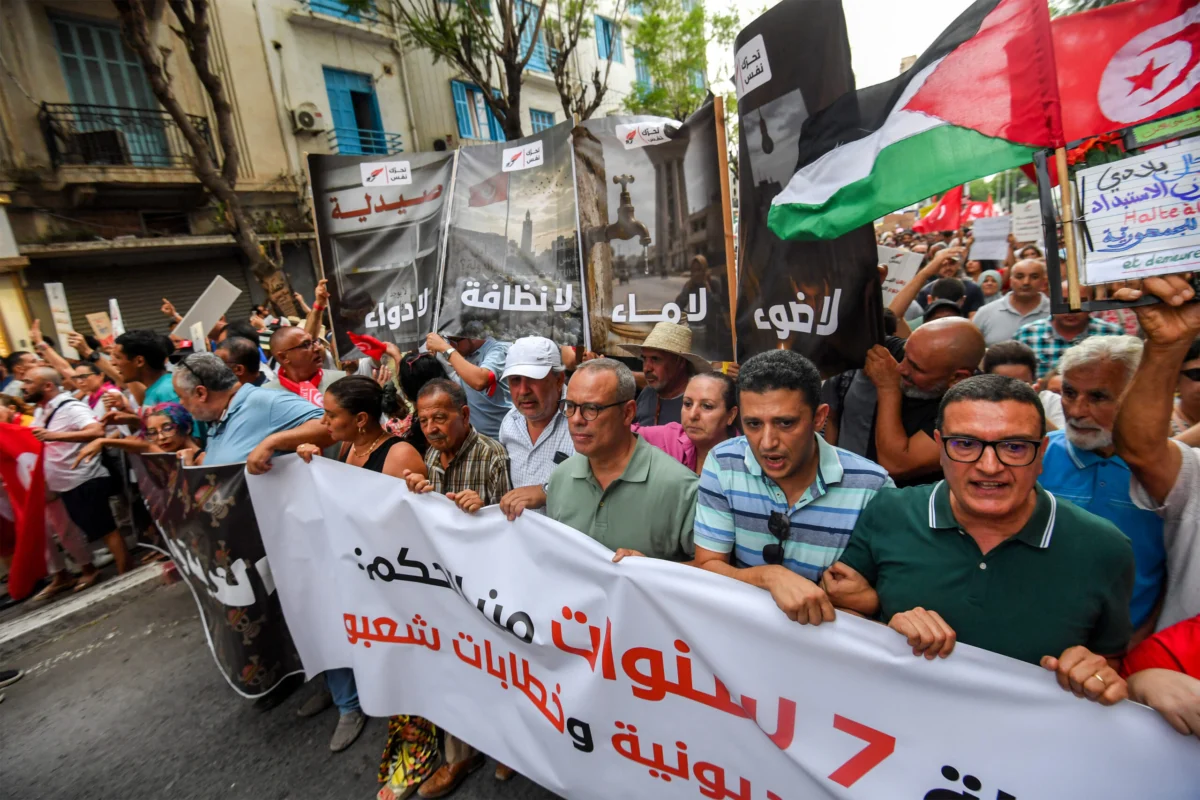
Tunisia’s protracted economic stagnation has translated into tangible public anger manifested in widespread street protests. Commemorating the fifth anniversary of Saied’s consolidation of power, thousands of Tunisians gathered in the capital’s Habib Bourguiba Avenue, voicing their dissent against deteriorating living conditions, recurrent water and electricity outages, and what they describe as a significant rollback of democratic freedoms.
Organized by a coalition of opposition parties and the "Nafas" civil initiative, the demonstrators chanted calls for Saied to step down, echoing the 2011 democratic revolution’s slogan: "The people want the fall of the regime." These protests underscore a deep-seated desire for political change and a restoration of democratic norms.
The Plight of Political Prisoners
A central demand of the ongoing protests is the immediate release of political prisoners, whose numbers have swelled in Tunisia’s jails since President Saied initiated a crackdown on dissent. Among the most prominent detainees is Rached Ghannouchi, the 85-year-old former parliament speaker and leader of the Ennahdha party, who was recently sentenced to life imprisonment.
Ghannouchi’s health has reportedly deteriorated significantly during his detention. He recently collapsed in Mornaguia prison, where temperatures are said to have reached extreme levels. Human rights organizations and the families of detainees, including opposition politician Ahmed Nejib Chebbi, have repeatedly raised alarms about the dire conditions within detention facilities and the severe toll they are taking on elderly inmates.
Imed al-Khamiri, a spokesperson for the Ennahdha party, characterized the continued detention of political figures and opposition leaders as a "disgrace to the Tunisian state," highlighting the gravity of the human rights concerns.
International Scrutiny and Calls for Sanctions
President Saied’s consolidation of power has also drawn significant international condemnation and scrutiny. On the anniversary of his power grab, US Representative Joe Wilson issued a strong statement, accusing Saied of transforming the Arab world’s sole constitutional democracy into a "one-man dictatorship."
Wilson alleged that the Tunisian regime has seen a dramatic increase in corruption, has stifled opportunities for its youth, and has shifted its foreign policy alignments to foster close ties with Russian President Vladimir Putin, Iran, and Hezbollah. This geopolitical shift has raised concerns among international observers about Tunisia’s regional role and its commitment to democratic values.
Citing reports of the Tunisian government detaining US citizens, Wilson urged the US State Department to issue a "Level 4: Do Not Travel" advisory for Tunisia. He further announced his intention to continue efforts to pass the "Tunisia Democracy Restoration Act," which proposes sanctions against President Saied and his close associates. "Democracy in Tunisia will win in the end," Wilson stated on the social media platform X. "Madmen tyrants will not last." This call for sanctions signals growing international pressure on the Saied government.