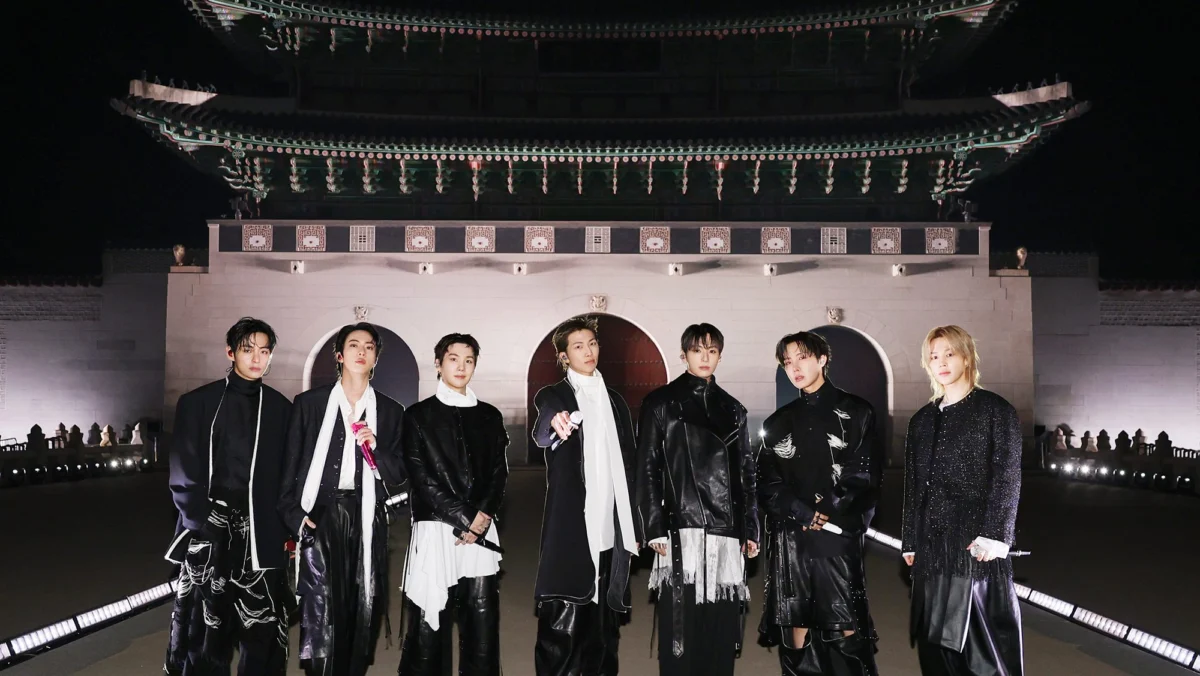
Global K-pop sensation BTS marked their highly anticipated return to the stage with their first full group live performance in over three years, broadcasting globally on Netflix from Seoul’s historic Gwanghwamun Square on Saturday night. The concert, titled BTS The Comeback Live | Arirang, celebrated the release of their fifth studio album, Arirang, and reunited the seven members—RM, Jin, Suga, J-hope, Jimin, V, and Jungkook—before a massive crowd and millions of streaming viewers worldwide. The event was a significant cultural moment, signifying the end of the group’s hiatus during which members pursued solo projects and completed mandatory military service in South Korea.
A Historic Return on Sacred Ground
The monumental comeback performance unfolded against the breathtaking backdrop of Seoul’s Joseon-era Gyeongbokgung Palace, with the stage prominently positioned in Gwanghwamun Square. The live stream commenced with a sweeping visual introduction to the South Korean capital, culminating in the seven members appearing before the iconic palace. "Hello, Seoul," declared group leader RM to the fervent crowd. "We’re back." This declarative statement resonated deeply with the millions of fans, collectively known as ARMY, who had eagerly awaited this reunion.
The choice of Gwanghwamun Square for this unprecedented pop concert was deeply symbolic and underscored the album’s thematic focus on Korean identity. Historically, the square holds immense cultural and political significance, making it an unconventional, yet powerful, venue for such a large-scale musical event. No pop concert of this magnitude had ever been staged there, reflecting the unique cultural weight and influence of BTS. Netflix and Hybe, the group’s label, distributed 22,000 tickets for a cordoned-off seating area, but an estimated 260,000 people were expected to gather in the square and surrounding streets to witness the historic occasion.
An Album Rooted in Korean Heritage
The new album, Arirang, serves as a profound reflection on the group’s roots and a tribute to South Korea’s cultural heritage. Its title directly references "Arirang," the beloved Korean folk song, which holds the distinction of being the first Korean song recorded by Korean men with American ethnologist Alice Fletcher in the U.S. in 1896. This deep connection to tradition was evident from the concert’s opening. The show immediately launched into "Body to Body," the album’s first track, which prominently features motifs from the traditional "Arirang" folk song. The performance of this track concluded with a poignant moment where performers in traditional Korean hanbok played the "Arirang" melody, seamlessly blending contemporary K-pop with centuries-old musical heritage.
Further emphasizing their national pride, the album includes "No. 29," a minute-and-38-second recording of the resonant tolling of the Divine Bell of King Seongdeok. This ancient artifact is designated as South Korea’s National Treasure No. 29, reinforcing Arirang‘s message that BTS, despite their global reach, remains firmly anchored in their Korean identity. The album, their first in nearly four years, effectively reintroduces the group to the global stage following their individual pursuits and military service.
The Performance: A Blend of New and Classic Hits
Following "Body to Body," the group transitioned into new tracks from Arirang, including "Hooligan" and "2.0." After introducing themselves individually to the roaring crowd, Jimin, 30, expressed the group’s overwhelming emotion. "We are finally here, and we are seeing you again," he shared. "The fact that I’m speaking here, I am so moved." The setlist strategically combined new material with beloved fan favorites, ensuring a dynamic experience for both long-time ARMY and new listeners.
The concert continued with popular non-Arirang hits like "Butter" and "MIC Drop," showcasing the breadth of their discography. The latter part of the show featured more new tracks from the album, such as "Aliens," "FYA," their new single "Swim," "Like Animals," and "Normal." As the performance neared its climax, J-hope, 32, energized the audience, proclaiming, "BTS 2.0 is just getting started." Jin, the eldest member at 33, added a heartfelt "Thank you for waiting, ARMY," acknowledging the unwavering patience of their global fanbase during their hiatus.
RM’s Resilient Participation Amidst Injury
Despite the celebratory atmosphere, group leader RM faced a challenge, participating with limitations due to an ankle injury sustained during rehearsals. BigHit Music, the band’s label, announced the injury on Friday, noting RM suffered a serious-sounding ankle injury during practice. Despite this, RM remained a central figure on stage, frequently using a stool as a base but also standing and engaging with his bandmates and the audience.
"Although there will be limitations to his performance, RM will participate on stage to the extent possible and hopes to connect with ARMY and the audience," a statement from BigHit Music confirmed. "As many have waited a long time for this performance, he will do his utmost to deliver his best." His determination to perform, even with an injury, underscored the group’s commitment to their fans and the significance of this comeback.
Netflix’s Ambitious Live Stream and Production Masterpiece
BTS The Comeback Live | Arirang marked a significant milestone for Netflix, being the streaming giant’s first-ever live stream of a standalone concert. This venture highlighted Netflix’s growing ambition in live events, aiming to create singular, globally unifying experiences. Brandon Riegg, Netflix’s vice president of nonfiction sports and series, emphasized the strategic importance of the event. "It was very clear from the start that this opportunity was one we could not pass up," Riegg stated at a pre-show briefing. "We view these live events as an opportunity to reach fans and members around the world in a way that is becoming increasingly tough to find: singular events that really pull people together." He added that "it just doesn’t get any bigger than BTS," venturing to guess it "might be the biggest thing this year that we see on Netflix in terms of our live ambition."
The scale of the production was staggering, employing a jaw-dropping 23-camera setup to capture every angle of the live experience for a global audience. Directing this complex spectacle was Hamish Hamilton, a veteran live television performance professional renowned for directing multiple Super Bowl halftime shows, including the most recent one featuring Bad Bunny. Hamilton expressed his honor, stating, "BTS is the greatest band in the world, so it’s a huge honor to be asked to direct this live show in such an iconic location."
Hamilton detailed the meticulous planning behind the visual experience: "Every decision we have made in terms of camera approach, stage design and production has been built around one question: how do we make the person watching at home feel like they are standing in that square?" He promised both grand, sweeping shots to convey the scale of Seoul and intimate moments to connect viewers directly with the band, ensuring that "The millions watching around the world are every bit as much a part of this night as the people on the ground in Seoul."
Logistical Challenges and City-Wide Collaboration
Staging such a massive arena-style concert in a bustling public square presented immense logistical challenges, far exceeding those of a typical stadium show. Jonathan Mussman, Netflix’s vice president of production for nonfiction and live programming, likened the undertaking to a "military takeover" rather than a conventional concert setup. "When you do this in a stadium, you can completely control the environment and you can take your time setting up," Mussman explained during a press walkthrough. "We’re really pushing the boundaries of what’s possible in the live concert broadcast world."
While a typical arena show, such as Harry Styles’ recent Netflix concert, might require a few hundred crew members, BTS The Comeback Live | Arirang mobilized over 1,000 local and international production professionals, excluding security personnel. "It really takes an army of production veterans — plus BTS Army, of course — to make this happen," Mussman quipped, acknowledging both the crew and the dedicated fanbase.
The city of Seoul provided full support for the return of its national pop heroes. A remarkable aspect of the production was the integration of the enormous, skyscraper-sized video billboards encircling Gwanghwamun Square. In most cities, securing control over such privately held screens would be nearly impossible. However, Hybe and city officials successfully arranged for these massive LED panels to become an integral part of the concert experience. With 50.6 million pixels worth of LED screens illuminating original content during the show, the visual impact was unparalleled. "If we were in Times Square, that’s totally impossible," Mussman commented. "We’ve been secretly testing the billboards late at night with tears coming into our eyes, because of how unique and impressive it is."
Looking Ahead: U.S. Engagements and Continued Global Impact
The Gwanghwamun performance marks the beginning of a busy period for BTS. The group is slated to make their first U.S. appearance in nearly four years in the coming week. Their schedule includes a performance at a Spotify event on Monday, followed by a return to U.S. television. The members are scheduled to appear on two consecutive nights of The Tonight Show with Jimmy Fallon, further solidifying their presence in the American market and engaging with their vast U.S. fanbase.
The BTS The Comeback Live | Arirang concert was more than just a musical event; it was a powerful statement on cultural identity, technological innovation, and the enduring global phenomenon of BTS. As the group embarks on this new chapter, their influence continues to reshape the landscape of music, entertainment, and international cultural exchange.