The death of Abderrahim Fakir, a 42-year-old Moroccan-born man who had resided in Bologna for over three decades, has once again ignited a contentious debate in Italy surrounding police accountability and the use of force. A harrowing six-minute and 56-second video, filmed from a balcony, captured Fakir’s final moments on a Sunday afternoon, showing him restrained on the ground by two Italian police officers and a civilian as he repeatedly pleaded for help. The footage has amplified existing concerns about the conduct of law enforcement and the mechanisms in place to ensure their accountability.
The distressing video, recorded shortly after 12:30 p.m. local time, depicts Fakir being held down while four Italian Red Cross volunteers stand nearby with an ambulance. For more than four minutes, Fakir’s cries for assistance are audible before he falls silent. His ankles are secured with a black plastic zip tie, and it is only after the restraint is removed that paramedics recognize he has lost consciousness. This stark visual evidence has become a focal point for activists and legal experts demanding greater scrutiny of police actions.
Fabio Anselmo, the lawyer representing Fakir’s family, urged the public to listen intently to the video during a press conference held on July 21 in the Italian Senate. The event was hosted by Senator Ilaria Cucchi, whose brother, Stefano, died in police custody in 2009. Anselmo, who also represented the Cucchi family, has become a prominent voice in Italy’s struggle for police accountability, with the Stefano Cucchi case serving as a watershed moment.

Anselmo highlighted a critical observation from the video: "When the officers stand up, Fakir may still be alive. Yet no one attempts to help him. No one removes the restraints." His statement underscores a central concern of the family and their supporters – the perceived lack of immediate medical intervention and the prolonged restraint.
With nearly three decades of experience handling similar cases, Anselmo pointed to broader European legal context, noting that the European Court of Human Rights has previously condemned Italy. He specifically referenced a January 2026 ruling concerning the death of Riccardo Magherini in Florence in 2014, who also died after being restrained by police. The European court found Italy in violation of Article 2 of the European Convention on Human Rights, citing the authorities’ failure to demonstrate that Magherini’s prolonged face-down restraint was "absolutely necessary."
Following Fakir’s death, Bologna police issued a statement indicating that officers had responded to a report of "a person behaving violently." They asserted that emergency services were summoned promptly and that Fakir passed away after "restraint procedures" were administered in the presence of medical personnel. Prosecutors have initiated a post-mortem examination, and Bologna’s local health authority has launched an internal inquiry into the incident.
The graphic video quickly circulated across social media platforms, galvanizing public attention and prompting immediate reactions. Within hours, dozens of individuals gathered at the site where Fakir died, expressing their grief and outrage. During a spontaneous vigil, Fakir’s sister, holding a photograph of her brother, tearfully addressed reporters. "My brother wasn’t an animal. He was a father, a worker, a good man. Why did they do this to him?" she implored, her voice thick with emotion. "I want everyone to see his face. I want people to know who he was. We don’t want revenge. We want justice." Her plea for justice, rather than retribution, resonated deeply with many.

Friends and legal representatives familiar with Fakir’s situation revealed that his final months were overshadowed by significant fear and financial strain. Barbara Spinelli, who had represented Fakir on immigration matters for several years, informed Al Jazeera that he had been grappling with severe financial difficulties. She explained that Fakir had launched a small removals and logistics business, but a series of unpaid invoices from clients led to layoffs and mounting debt.
Adding to his distress, Spinelli noted that Fakir had become increasingly anxious about Italy’s evolving migration policies. Discussions around deportations and the implementation of the European Union’s Pact on Migration and Asylum, adopted in 2024 and set for full implementation in 2026, heightened his concerns. The pact introduces new regulations concerning migration management, asylum procedures, and the return of individuals lacking legal status.
Fakir reportedly feared he could be expelled from Italy, despite Spinelli’s assurances that there were no current legal grounds for such action. While it remains unclear if these anxieties directly contributed to the encounter with the police on July 19, Spinelli emphasized the persistent nature of his fear. "I kept reassuring him there were no legal grounds for that to happen," she stated, "But that fear never left him."
In the wake of Fakir’s death, Bologna Mayor Matteo Lepore called for a solidarity rally in Piazza Maggiore to support his family. The event drew thousands of participants, including trade unionists, students, and civil rights organizations. However, what began as a peaceful demonstration took a turn towards confrontation when a segment of the crowd marched towards the Prefecture, the local government representative office, and the city’s police headquarters.

Protests Erupt Amidst Tensions Over Police Brutality
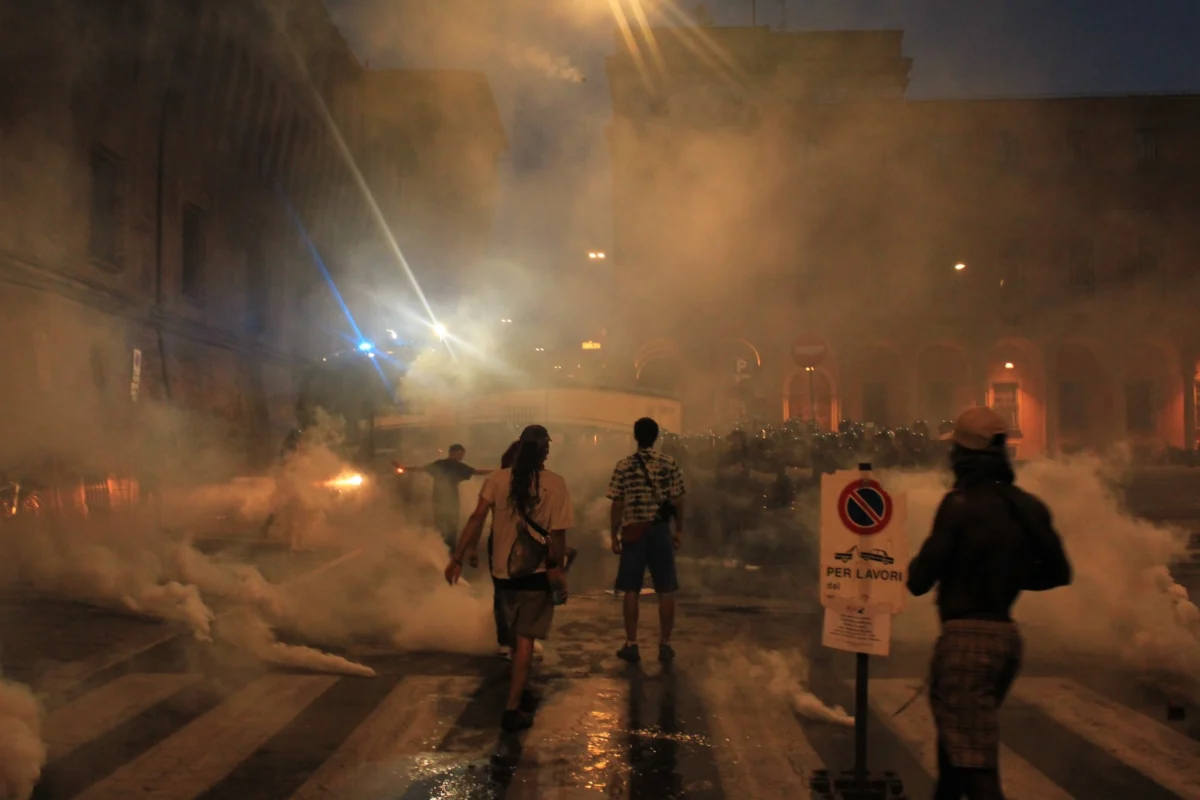
Clashes erupted between protesters and law enforcement as demonstrators reached a police line. The situation escalated when protesters began throwing bottles and fireworks, vandalizing shop windows and cash machines, and setting two cars ablaze. Police responded with baton charges, water cannon, and tear gas, creating a scene of significant unrest in the historic city center.
Several demonstrators later accused the police of employing excessive force during the confrontations. Jacopo, who requested to be identified only by his first name, recounted to Al Jazeera how officers allegedly tackled him from behind and threw him to the ground. He described being hit with batons and punched while shielding his face and attempting to comply with instructions. "I covered my face with my hands, and they started hitting me with batons and punching me," he said, adding that he repeatedly told officers they were hurting him. He alleged an officer responded with, "I don’t care. Shut up," as the assault continued. Jacopo was subsequently taken to the hospital, where he was diagnosed with multiple bruises and an eye injury.
A freelance journalist working for the Italian weekly news magazine L’Espresso also reported being beaten by officers while retreating from the clashes. Video evidence published by the magazine appeared to show him shouting, "I’m a journalist! I’m a journalist!" as an officer repeatedly struck him with a baton before he managed to escape. Police officials reported that 64 officers sustained injuries during the unrest, and significant damage was inflicted upon Bologna’s historic center.
Political Reckoning and Scrutiny of New Legislation
Prime Minister Giorgia Meloni swiftly condemned the violence, labeling the clashes as "unacceptable." She stated that Fakir’s death "must be fully established, without prejudice and without discounts for anyone," while also emphasizing that "nothing can justify violence against law enforcement officers." In response to the growing public outcry, opposition parties called for Interior Minister Matteo Piantedosi to address parliament regarding the circumstances of Fakir’s death and to release any body-camera footage recorded by the officers involved.

A Test of Italy’s Police Accountability Framework
The ongoing investigation into Abderrahim Fakir’s death will be conducted under Italy’s new Article 45-bis procedure. This procedure was introduced by the Meloni government’s Security Decree, which took effect in February 2026. Under this new regulation, police officers are not automatically registered as criminal suspects when alleged offenses occur during their duties. Critics, including opposition parties, legal scholars, and human rights organizations, argue that this change could potentially impede efforts to hold officers accountable for their actions.
Fabio Anselmo, the family’s lawyer, has vehemently criticized the reform, terming it "a legal monstrosity." He asserted that the legislation was not intended to strengthen the rule of law but rather "to satisfy part of public opinion." This legal challenge marks a significant test for Italy’s commitment to transparency and accountability in law enforcement practices, particularly in light of previous condemnations by European human rights bodies.
The tragic events surrounding Abderrahim Fakir’s death have underscored persistent systemic issues within Italian law enforcement, fueling demands for reform and a comprehensive re-evaluation of police conduct and oversight. The outcome of the investigation and the application of the new legal procedures will be closely watched both domestically and internationally as Italy grapples with its ongoing struggle for effective police accountability.