The song "Golden" from the animated musical "KPop Demon Hunters" secured the Oscar for Best Original Song at the 98th Academy Awards on March 15, 2026, but the acceptance speech was notably cut short for one of its seven credited writers. The victory marked a historic moment for K-pop in Hollywood, as it became the first song from the genre to achieve this prestigious award. The win also set a new record for the most writers on a song to ever win in the category.
A Historic Win for K-Pop and "Golden"
The triumphant moment for "Golden" was a culmination of a remarkable awards season for the track and its accompanying film. The song, performed by the fictional K-pop group HUNTR/X, had already garnered significant critical acclaim, securing wins at the Grammy Awards for Best Song Written for Visual Media, as well as top honors at the Critics Choice Awards and the Golden Globes. This Oscar win solidified its status as a groundbreaking achievement in popular music and film.
The seven individuals credited as writers for "Golden" are EJAE, Mark Sonnenblick, Joong Gyu Kwak, Yu-Han Lee, Hee Dong Nam, Jeong Hoon Seo, and Teddy Park. This large number of collaborators presented a unique situation for the Academy Awards, which has specific rules regarding the number of statuettes awarded in the Best Original Song category.
Navigating Academy Rules for Multiple Songwriters
The Academy’s rules stipulate that typically no more than two statuettes are awarded for Best Original Song. A third may be granted for three essentially equal writers, and a fourth in rare, extraordinary circumstances determined by the Music Branch Executive Committee. However, for songs with five or more credited collaborators, the Academy allows for a single statuette to be awarded to the group, provided all writers agree to this arrangement in advance. This policy aims to acknowledge the collaborative nature of songwriting while maintaining a manageable number of awards.
In the case of "Golden," all seven writers had agreed to the "group statuette" option, meaning they would share one Oscar award. This decision was crucial for their eligibility in the category, allowing them to be recognized collectively for their work. While they will all be officially recognized as Oscar winners, they will not each receive an individual trophy.
The Acceptance Speech and an Abrupt Interruption
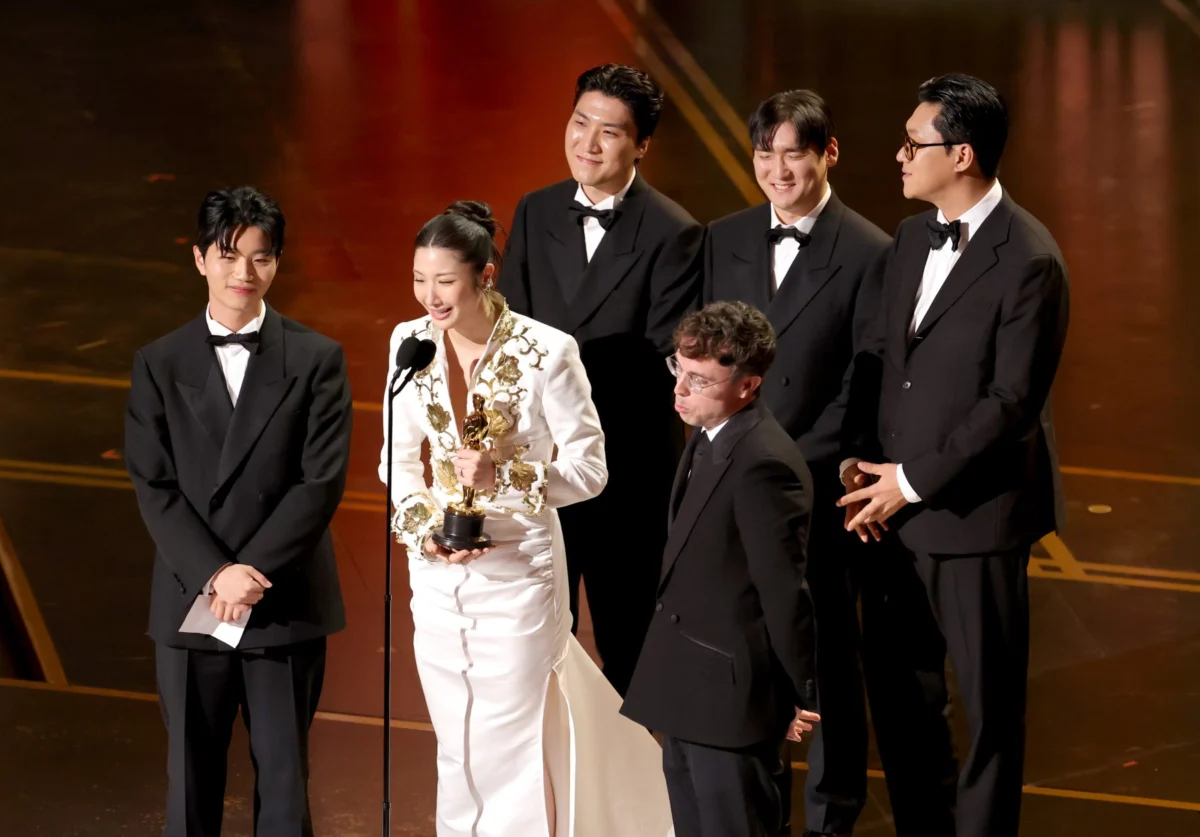
During the acceptance speech, EJAE, who is also one of the lead vocalists for HUNTR/X alongside AUDREY NUNA and REI AMI, took the podium to express her gratitude. She spoke passionately about the song’s message of resilience, highlighting the personal journey of overcoming doubts and prejudices.
"Growing up, people made fun of me for liking K-pop, but now everyone’s singing our song and all the Korean lyrics. I’m so proud," EJAE stated, her voice filled with emotion. She emphasized that the award was a testament to resilience rather than just success. She extended her thanks to her family, fiancé, manager, and the entire cast and crew of "KPop Demon Hunters," including directors Maggie Kang and Chris Appelhans, and producer Michelle Wang. She also acknowledged the support from Netflix and Sony Animation.
As EJAE concluded her remarks and began to introduce her fellow collaborators, Yu-Han Lee, also known as Yuhan, stepped forward to add his own words of thanks. However, his attempt to speak was abruptly cut short as the orchestral music swelled, drowning out his voice. The broadcast then transitioned to a commercial break, leaving the audience and viewers with a sense of an unfinished moment.
The Impact of "Golden" on the Music Industry
The success of "Golden" extends beyond its Oscar win, marking a significant milestone for K-pop on the global stage. The song’s popularity and critical acclaim demonstrate the increasing influence of South Korean popular music on mainstream entertainment. Its chart performance, including an extended run at No. 1 on the Billboard Hot 100, further underscores its broad appeal and cultural impact.
"Golden" is now among an elite group of songs to have spent eight or more weeks at the top of the Billboard Hot 100 and subsequently win an Oscar for Best Original Song. This distinction places it alongside iconic tracks like Debby Boone’s "You Light Up My Life" (1977) and Eminem’s "Lose Yourself" (2002-03). Notably, "Golden" is the first song to achieve this feat since "Lose Yourself," highlighting its exceptional commercial and critical success prior to the Academy Awards.
Cultural Significance and Broader Implications
The win for "Golden" also carries significant cultural weight for South Korea. Six of the seven credited writers – EJAE, Joong Gyu Kwak, Yu-Han Lee, Hee Dong Nam, Jeong Hoon Seo, and Teddy Park – are South Korean nationals. This makes them the first South Koreans to win an Oscar in the Best Original Song category. While Karen O, a South Korean-born artist, was previously nominated for co-writing "The Moon Song" from "Her," the award went to another song. This new victory opens doors and provides inspiration for aspiring artists from South Korea and beyond.
The film "KPop Demon Hunters" also achieved success at the 98th Academy Awards, taking home the Oscar for Best Animated Feature Film. This dual win further cements the film’s impact and the growing recognition of K-pop-inspired narratives in Hollywood.
A Competitive Field in Best Original Song
"Golden" triumphed over a strong field of nominees in the Best Original Song category. Other contenders included "Dear Me" from Diane Warren: Relentless, with music and lyrics by Diane Warren; "I Lied to You" from Sinners, with music and lyrics by Raphael Saadiq and Ludwig Goransson; "Sweet Dreams of Joy" from Viva Verdi!, with music and lyrics by Nicholas Pike; and "Train Dreams" from Train Dreams, with music by Nick Cave and Bryce Dessner, and lyrics by Nick Cave. The diverse range of nominated songs reflected the rich and varied musical landscape contributing to cinematic storytelling.
The incident with the interrupted acceptance speech, while a minor hiccup in an otherwise momentous occasion, has sparked conversations about the pacing and production of the Oscars telecast. Nevertheless, the historic win for "Golden" and its talented team signifies a new era for K-pop in Hollywood, paving the way for greater diversity and inclusion in the film and music industries.