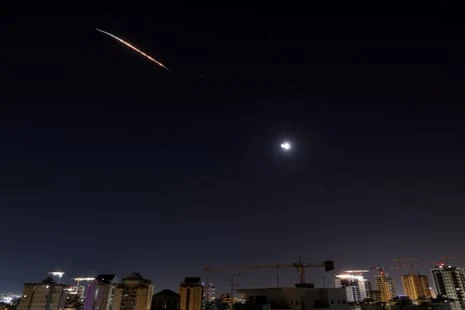
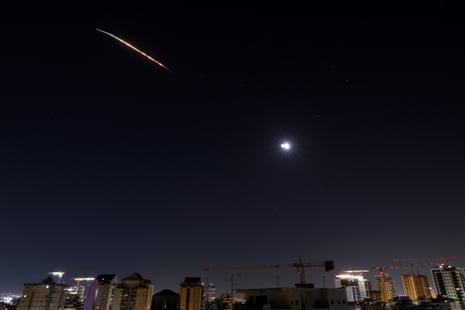
The Middle East remains on a knife-edge as the Israeli military confirmed Wednesday that Iran has launched a fresh barrage of missiles toward major population centers, while U.S. forces engaged and neutralized several Iranian mine-laying vessels near the Strait of Hormuz. These developments mark a significant escalation in the 11-day-old conflict, which has now expanded to include direct naval confrontations and a widening internal crackdown within the Islamic Republic.
In a series of statements released via state media, Iran’s Revolutionary Guards claimed responsibility for targeting a satellite communications center in Haifa, along with multiple Israeli military bases. The barrage was not limited to Israel; Tehran also asserted that it successfully struck U.S. assets across the region, including targets in Iraqi Kurdistan and the U.S. Fifth Fleet naval base in Bahrain. "We will continue our sustained attacks with purpose and power," the Guards stated on their official Sepah News website. "In this war, we contemplate nothing but the enemy’s complete surrender."
Naval Confrontation and the Battle for the Strait of Hormuz
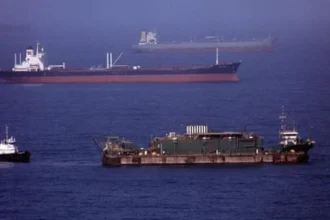
The maritime theater saw the most kinetic activity on Tuesday and early Wednesday. U.S. Central Command (CENTCOM) announced it had "eliminated" 16 Iranian mine-laying vessels operating near the Strait of Hormuz. This strategic waterway serves as the world’s most important oil chokepoint, through which approximately one-fifth of global oil consumption passes daily. The U.S. military’s intervention follows intelligence reports suggesting that Tehran was attempting to seed the channel with explosives to halt international shipping.
The naval engagement followed a series of conflicting statements from the White House. President Donald Trump initially stated there were "no reports" of active mining but warned that any such action would be met with military consequences "at a level never seen before." Hours later, the President confirmed that U.S. forces had "completely destroyed" at least 10 inactive mine-laying vessels, a figure later updated by CENTCOM to 16.
According to reports from CNN and CBS News, several dozen mines have already been deployed in recent days. U.S. officials are currently assessing whether these mines are tethered or drifting, the latter of which would pose a catastrophic risk to commercial tankers. White House Press Secretary Karoline Leavitt clarified that while the U.S. Navy has not yet begun escorting individual oil tankers through the strait, the military is "drawing up additional options" to ensure the passage remains open to global trade.
Internal Unrest and the Regime’s Warning to Protesters
As the external war intensifies, the Iranian government is facing a domestic crisis of unprecedented proportions. Police Chief Ahmad-Reza Radan appeared on state television to issue a chilling ultimatum to the Iranian public. He warned that anyone participating in anti-war or anti-government demonstrations would no longer be viewed as a civilian dissenter but as a combatant.

"We will do to them what we do to enemies," Radan said, noting that security forces are stationed throughout the country "day and night." He emphasized that the military and police have their "fingers on the trigger," ready to suppress any perceived internal threat to the revolution. This rhetoric comes as the U.S.-based Human Rights Activists News Agency (HRANA) reported a confirmed death toll of at least 7,000 people since a wave of anti-establishment protests began in late December.
The internal pressure is being fueled by external calls for regime change. Both President Trump and Israeli Prime Minister Benjamin Netanyahu have recently urged the Iranian people to take to the streets and overthrow the clerical leadership. This has placed ordinary Iranians in a precarious position, caught between a brutal state apparatus and a foreign-led military campaign that is increasingly targeting domestic infrastructure.
U.S. Public Opinion and the "Rally Around the Flag" Effect
Despite the rapid military advances, the Trump administration is facing significant headwinds at home. Data analyzed by the New York Times suggests that, unlike previous American conflicts, the current war in Iran is opposed by a majority of the U.S. population. Public support for the strikes is significantly lower than the levels recorded during the initial phases of the wars in Iraq or Afghanistan.
Sociologists and political scientists point to a diminishing "rally around the flag" effect, a phenomenon where public support typically surges for a commander-in-chief during the onset of hostilities. Experts suggest that deep political polarization is the primary cause. While the President’s base generally supports his "America First" posture, many are wary of another protracted Middle Eastern conflict. Conversely, the Democratic opposition has largely remained critical of the administration’s rush to war without a clear exit strategy.
Sarah Maxey, an associate professor of international relations at Loyola University of Chicago, noted that previous administrations spent months "selling" a war to the public before the first shot was fired. In contrast, the current conflict escalated within a matter of days, leaving many Americans skeptical of the long-term objectives and the potential for a regional conflagration.
Nuclear Stockpiles and the Risk of Special Operations
One of the most concerning aspects of the current escalation involves Iran’s nuclear capabilities. The Trump administration is reportedly weighing the deployment of special operations forces into Iranian territory to secure stockpiles of highly enriched uranium (HEU). Experts estimate that Tehran possesses enough material to produce at least 10 nuclear warheads, a reality that has accelerated the timeline for military intervention.
U.S. Secretary of State Marco Rubio recently told Congress that diplomatic options have been exhausted, stating, "People are going to have to go and get it." The prospect of ground troops entering Iran to seize nuclear assets represents a massive shift in the war’s scope. Such an operation would likely trigger a full-scale ground war, a scenario the administration has publicly sought to avoid while simultaneously demanding "complete and unconditional surrender."
Regional Instability and Diplomatic Fallout
The conflict’s reach is expanding into neighboring Iraq, where a drone struck a major U.S. diplomatic facility near Baghdad International Airport on Tuesday. The Diplomatic Support Center, a critical logistical hub, was hit in what is believed to be a retaliatory strike by the Islamic Resistance in Iraq, an umbrella group of Iran-backed militias. While U.S. personnel were ordered to "duck and cover," it remains unclear if there were any casualties. Five other drones were reportedly intercepted by defense systems.
In Lebanon, the humanitarian cost continues to mount. Israeli raids on the southern town of Qana resulted in the deaths of five people on Wednesday, according to Lebanese health authorities. The Israeli military maintains that it is targeting command centers and missile production infrastructure, but Iran’s UN ambassador, Amir Saeid Iravani, has accused the U.S. and Israel of deliberately hitting civilian sites. Iravani claimed that over 8,000 residential homes have been destroyed and the civilian death toll has exceeded 1,300.
Adding to the complexity is the role of Russia. The Kremlin has denied reports that it is sharing intelligence with Tehran regarding the movement of U.S. warships and aircraft. Steve Witkoff, Trump’s special envoy, stated that Moscow gave its word that no such sharing is taking place. However, Western intelligence agencies remain skeptical, given the deepening military ties between Moscow and Tehran in recent years.
Economic and Environmental Consequences
The financial burden of the war is also becoming apparent. Israel is set to expand its defense budget by approximately 40 billion shekels ($13 billion) to fund continued operations. This includes 28 billion shekels in direct military spending and an additional 10 billion held in reserve.
On the ground in Iran, the environmental impact of the bombing campaign has been devastating. Strikes on fuel storage facilities over the weekend blanketed Tehran in toxic black smoke. The resulting acid rain has created a public health emergency for the city’s 10 million residents. In response, the U.S. reportedly asked Israel to halt strikes on energy infrastructure for the first time since the war began, fearing that the total collapse of the Iranian economy could lead to a massive refugee crisis that would destabilize Europe and the broader region.
Amidst the chaos, small stories of escape have emerged. Australia’s Home Affairs Minister Tony Burke confirmed Wednesday that seven members of the Iranian women’s football team have been granted humanitarian visas. Several players sought asylum while in Sydney for a tournament, citing fears of persecution upon their return to a country now in the throes of total war.
The Pentagon reports that approximately 140 U.S. service members have been wounded since the start of "Operation Epic Fury," with eight in severe condition. As the U.S. military moves to dismantle Iran’s missile production capabilities, the international community remains watchful, hoping for a de-escalation that currently seems nowhere in sight.