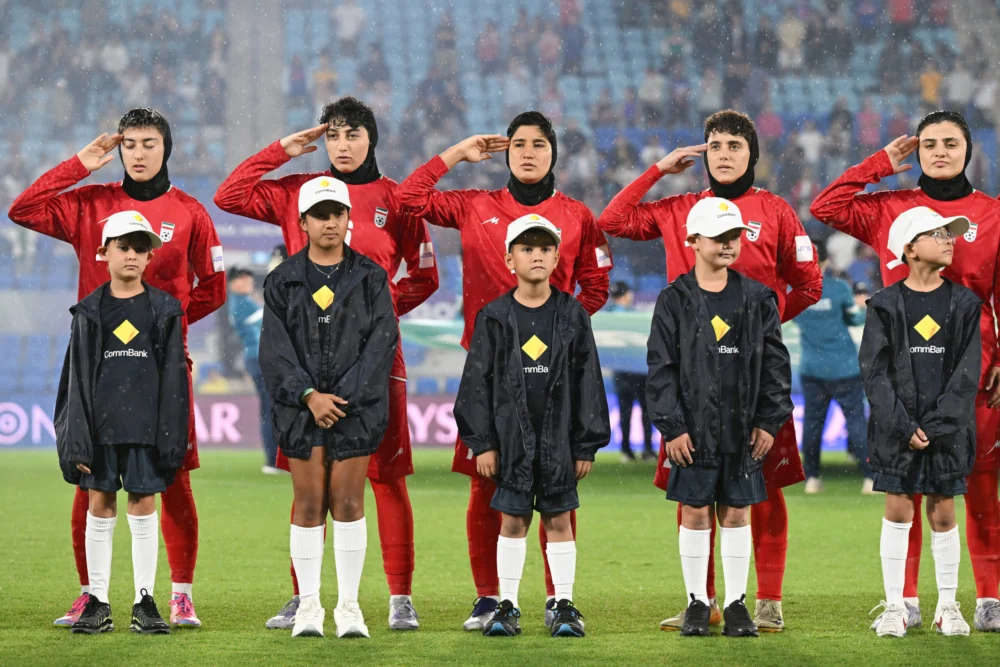
Players on the Iranian women’s national football team have sung and saluted during their national anthem prior to their final Women’s Asian Cup match, a stark contrast to their silent protest six days earlier that drew sharp criticism and accusations of disloyalty from state media back home. The team’s participation in the tournament concluded with a 2-0 loss to the Philippines at Gold Coast Stadium in Australia, marking the end of their campaign. Their recent actions have amplified anxieties among human rights advocates who have been closely monitoring the team’s situation, particularly in light of the ongoing geopolitical turmoil impacting Iran.
The Iranian squad’s presence in the continental championship coincided with heightened international conflict. Their tournament began just as the United States and Israel initiated air strikes on Iran on February 28, a campaign that has resulted in significant casualties, including the reported death of Supreme Leader Ali Khamenei. This backdrop of war has cast a long shadow over the team, with players and management expressing profound fears and concerns for the well-being of their families remaining in Iran.
In their opening match against South Korea, the Iranian team maintained a stoic demeanor and conspicuously chose not to sing their national anthem. This act of silent protest was met with immediate backlash within Iran. Mohammad Reza Shahbazi, a presenter for Islamic Republic of Iran Broadcasting, publicly decried the players’ actions in a video, labeling them as unpatriotic and the "pinnacle of dishonor." The state media’s strong condemnation highlighted the significant political sensitivities surrounding any perceived dissent within Iran, especially during times of heightened international tension.
Just days later, before their second match against the host nation, the Iranian team visibly participated in singing their national anthem, "Mehr-e Khavaran" (Eastern Sun), and performed a salute. This change in behavior immediately triggered renewed concerns among Australian human rights campaigners. They expressed fears that the players might have been subjected to coercion by government minders, suggesting that their shift in conduct was not a voluntary expression of patriotism but rather a response to pressure. No official explanation was provided by the team or its management for their initial decision to remain silent or their subsequent change in behavior.

Calls for Protection and Refugee Status
The unfolding situation surrounding the Iranian women’s football team has galvanized a significant humanitarian response in Australia. A petition launched on Change.org on Friday garnered over 51,000 signatures by late Sunday, urging the Australian government to provide refuge to the team. The petition specifically called upon Home Affairs Minister Tony Burke to ensure that the team is not compelled to depart Australia "while credible fears for their safety remain." While Minister Burke’s office has not yet commented on the petition’s demands, its widespread support underscores the deep public concern for the players’ welfare.
The petition’s authors emphasized the need for authorities to guarantee that any player seeking protection can do so "safely, privately, and without interference." It further implored Australia to affirm its commitment to its "humanitarian protection obligations in relation to any player at risk of persecution or serious harm." The petition’s text directly addressed the current geopolitical climate, stating, "Where credible evidence exists that visiting athletes may face persecution, imprisonment, coercion, or worse upon return, silence is not a neutral position." It explicitly linked the "current wartime environment" to intensified repression and increased risks for those perceived as disloyal by the Iranian regime.
Iranian Australian activist Tina Kordrostami, a member of Sydney’s Ryde Council, articulated the need for a secure environment for the players. She told The Australian newspaper that the team "need an opportunity, a safe space, a chance to actually speak up about what their needs are and what their requirements are." Kordrostami stressed that such a space cannot be provided "without the government helping us," highlighting the critical role of official support in facilitating any potential avenues for protection.
Government Response and Broader Implications
When questioned by national broadcaster ABC prior to the team’s final match, Foreign Minister Penny Wong acknowledged the profound impact of the Iranian team’s presence in Australia. She stated that it had been "really moving for Australians to see them in Australia." Wong also highlighted a moment of solidarity between the teams, noting that the sight of Australian players swapping shirts with their Iranian counterparts was "a very evocative moment." She described it as speaking "to solidarity and the way in which sport can bring us together."
The Foreign Minister did not shy away from the human rights record of the Iranian regime, commenting, "We know this regime has brutally oppressed many Iranian women. Obviously, this is a regime that we know has brutally cracked down on its people." Her remarks, while empathetic towards the team, stopped short of offering specific assurances regarding their potential asylum claims or future safety.

The escalating conflict involving Iran has widened, with the US and Israel continuing their extensive air strikes for a ninth day, extending the scope of the war to the Gulf region, Lebanon, and Iraq. This volatile international situation amplifies the stakes for any Iranian citizens abroad, particularly those who may have expressed sentiments contrary to the regime’s official narrative.
The players’ union, FIFPRO, had previously intervened, calling on the Asian Football Confederation (AFC) and FIFA to uphold their human rights obligations. FIFPRO urged both bodies to take all necessary steps to ensure the safety of Iran’s squad in the aftermath of the critical state media broadcasts. This call underscores the international sporting community’s growing awareness and concern regarding the intersection of sports, politics, and human rights.
Tournament Performance and Future Uncertainty
Despite the intense focus on their off-field circumstances, the Iranian women’s football team concluded their Asian Cup campaign without securing a single victory. They suffered defeats against South Korea (3-0) and Australia (4-0), in addition to their loss against the Philippines. This resulted in them finishing at the bottom of Group A, conceding nine goals and failing to score any.
Matildas Secure Late Draw in High-Scoring Encounter
In a separate match that concluded the group stage, the Australian women’s national team, the Matildas, secured a dramatic 3-3 draw against South Korea. Alanna Kennedy scored a crucial goal deep into stoppage time, salvaging a point for Australia. However, this late equalizer was ultimately insufficient to prevent South Korea from clinching the top spot in Group A, thanks to their superior goal difference across the three group fixtures.
The South Korean team, having secured first place, will advance to the quarterfinals to be held at Stadium Australia in Sydney. They are set to face a third-placed team from another group. The Matildas, meanwhile, will embark on a cross-country journey to Perth, where they will compete in the quarterfinals against either North Korea or the reigning champions, China, at Perth Rectangular Stadium. The focus for the Iranian team, however, remains on their immediate future and the potential ramifications of their participation in the tournament amidst a turbulent political climate. The concerns for their safety upon potential return to Iran continue to be a significant and unresolved issue.