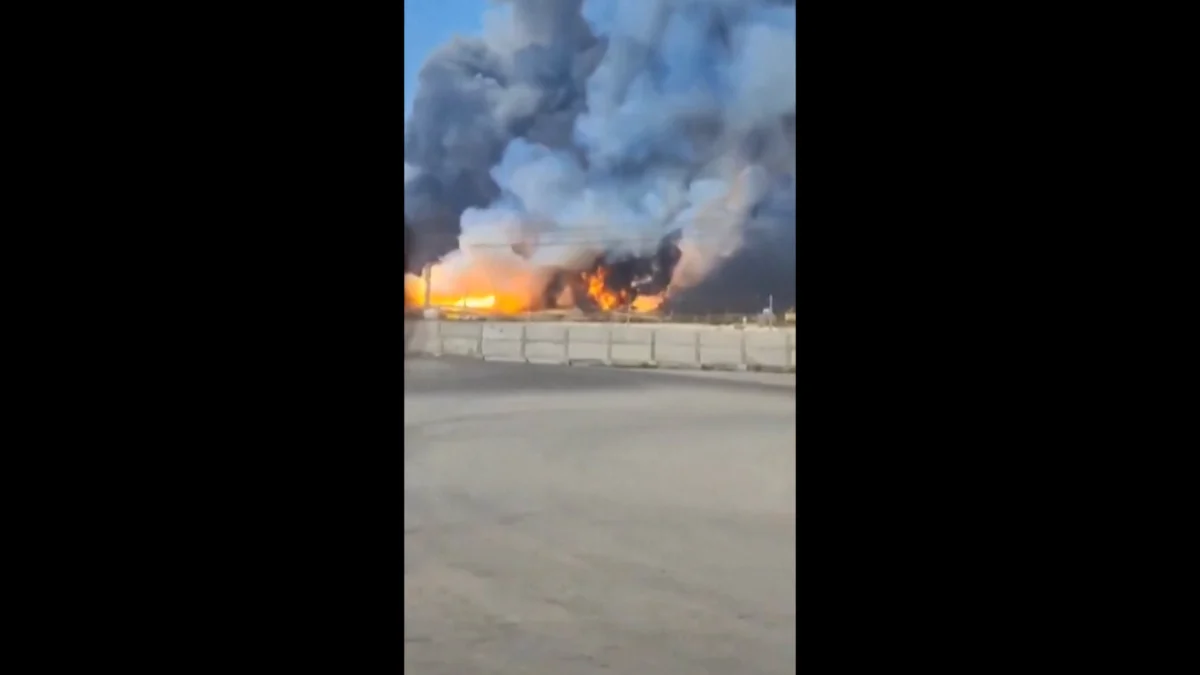
Former President Donald Trump has stated that the United States was unaware of an alleged Israeli strike targeting Iranian gas fields, a development that could significantly escalate regional tensions and potentially involve the United States in a broader conflict. Trump also issued a stern warning to Iran, cautioning against any actions that might jeopardize Qatar’s security or its critical energy infrastructure.
Diplomatic Fallout and Regional Instability
The assertion by the former president, made in the context of ongoing geopolitical shifts, highlights a complex and volatile international landscape. The alleged attack, if confirmed, represents a serious escalation in the shadow war between Israel and Iran, a conflict that has largely played out through proxy forces and covert operations. Trump’s statement, however, pivots the focus to direct actions and the potential for wider international involvement.
The South Pars gas field, located in the Persian Gulf, is a critical component of Iran’s energy sector and a significant source of natural gas for both domestic consumption and export. Any strike on such a vital facility would undoubtedly have far-reaching economic and political ramifications for Iran and the broader region. The claim of Israeli involvement, even if unconfirmed by official channels, injects a new layer of concern into the already fraught relationship between the two nations.
US Policy Under Scrutiny
Trump’s declaration that the U.S. was uninformed about the alleged strike raises questions about intelligence sharing and the extent of American awareness of Israeli military operations in the region. During his presidency, Trump often emphasized a strong alliance with Israel, but his current statement suggests a potential divergence in understanding or strategic priorities. This could be interpreted as an attempt to distance the U.S. from potential Israeli actions or, conversely, a genuine lack of direct knowledge regarding the specific operation.
The former president’s warning to Iran regarding Qatar is particularly noteworthy. Qatar is a major global supplier of liquefied natural gas (LNG) and plays a crucial role in global energy markets. Any threat to its production or export capabilities would have significant repercussions for energy security worldwide. Trump’s explicit mention of Qatar indicates a concern about Iran’s potential retaliatory actions and the broader implications for energy stability.
The Shadow War Between Iran and Israel
The ongoing clandestine conflict between Iran and Israel has been a persistent feature of Middle Eastern geopolitics for decades. This conflict is characterized by a series of tit-for-tat actions, including cyberattacks, assassinations, sabotage of nuclear facilities, and attacks on shipping. The alleged strike on the South Pars gas field, if attributed to Israel, would mark a significant departure from the usual covert nature of these operations, bringing it into the realm of more direct and potentially overt military action.
Iran views Israel as a primary adversary and has consistently accused it of seeking to destabilize the region and undermine its influence. Israel, in turn, cites Iran’s nuclear program and its support for regional militant groups as existential threats to its security. The dynamics of this conflict are further complicated by the involvement of other regional and international powers, each with their own strategic interests.
Economic Implications of Gas Field Attacks
Attacks on energy infrastructure, such as gas fields and pipelines, carry substantial economic consequences. For Iran, the South Pars field is a cornerstone of its economy, providing vital revenue through gas exports. Damage to this facility would not only disrupt these revenue streams but also potentially require extensive and costly repairs, further straining Iran’s already challenged economic situation.
For the global energy market, any disruption to Iranian gas production, especially if it were to escalate into broader regional instability, could lead to price volatility and concerns about supply security. Qatar’s role as a major LNG exporter means that any threat to its operations would be felt acutely by consuming nations, particularly in Europe and Asia, which rely heavily on Qatari gas.
Trump’s Stance and Potential Political Ramifications
Donald Trump’s intervention in this complex geopolitical issue is likely to be viewed through a political lens, both domestically and internationally. His assertion of U.S. ignorance regarding the alleged Israeli strike could be an attempt to portray himself as a decisive leader who prioritizes American interests and avoids entanglement in foreign conflicts without clear knowledge or strategic benefit.
Furthermore, his warning to Iran regarding Qatar could be seen as an effort to reassert American influence and leadership in the region, particularly if the current administration is perceived as being less assertive. The former president has often positioned himself as a strong proponent of American energy independence and security, and his statements on this matter align with that broader narrative.
The Role of Intelligence and Diplomacy
The credibility of Trump’s claim of U.S. unawareness hinges on the effectiveness and scope of American intelligence gathering in the Middle East. If the U.S. was indeed unaware of a significant Israeli military operation, it could point to potential shortcomings in intelligence sharing or analysis. This could have implications for future strategic planning and coordination between allies.
Conversely, if the U.S. was aware but Trump is choosing to deny it for political reasons, it would represent a different kind of strategic communication. The nuanced nature of intelligence operations and diplomatic maneuvering means that such events are often shrouded in ambiguity, making definitive pronouncements challenging.
Broader Geopolitical Context and Future Scenarios
The alleged Israeli strike and Trump’s response occur against a backdrop of shifting global alliances and a renewed focus on energy security. The ongoing war in Ukraine has already disrupted global energy markets, and any further instability in the Middle East, particularly involving major energy producers, would exacerbate these challenges.
The potential for escalation is a significant concern. If Iran perceives the alleged strike as a direct attack by Israel, its response could be significant. This could involve retaliatory strikes against Israeli interests, or actions against U.S. allies in the region, potentially drawing the United States into a more direct confrontation. The delicate balance of power in the Middle East could be further destabilized by such events.
International Reactions and Diplomatic Efforts
The international community will be closely watching for any official confirmation or denial of the alleged Israeli strike. Diplomatic channels are likely to be active as nations seek to de-escalate tensions and prevent a wider conflict. The United Nations and other international bodies may play a role in mediating any disputes and urging restraint from all parties involved.
The reactions from key regional players, such as Saudi Arabia and the United Arab Emirates, will also be crucial. These nations have been increasingly engaged in diplomatic efforts to stabilize the region and reduce tensions with Iran. Their response to an escalation of the conflict could significantly shape the diplomatic landscape.
The Stakes for Global Energy Security
The implications of any conflict involving major energy-producing nations in the Persian Gulf are immense. The region accounts for a significant portion of the world’s oil and gas production, and disruptions to supply can have immediate and severe impacts on global energy prices and availability. The interconnectedness of global energy markets means that even localized conflicts can have widespread economic repercussions.
The strategic importance of the South Pars gas field and Qatar’s LNG export capacity cannot be overstated. Any threat to these assets raises serious concerns about energy security for nations around the world. The potential for a domino effect, where a regional conflict leads to broader economic instability, is a real and present danger.
The Path Forward: Diplomacy or Escalation?
The coming days and weeks will be critical in determining the trajectory of this unfolding situation. The emphasis will likely be on de-escalation and diplomatic solutions. However, the history of the Israeli-Iranian conflict suggests that miscalculations and escalatory spirals are always a possibility.
The statements made by political figures like Donald Trump, even if unofficial, can influence public perception and diplomatic maneuvering. His emphasis on American awareness and his direct warning to Iran underscore the high stakes involved. The international community faces the challenge of navigating this complex situation, seeking to prevent further conflict while addressing the underlying security concerns of all parties involved. The future stability of the region, and indeed global energy markets, may well depend on the choices made in the immediate aftermath of these alleged actions.