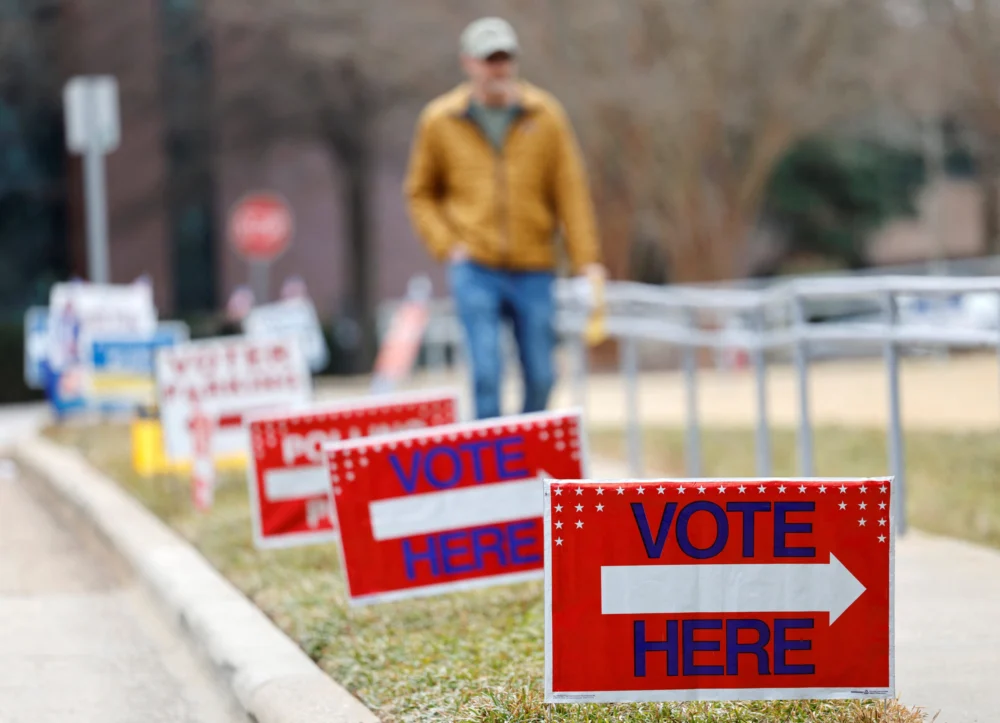
The crucial 2026 midterm primary season commenced this week across key states including Texas, North Carolina, and Arkansas, as American voters began selecting the candidates who will vie for Republican and Democratic party nominations in the November general elections. This initial phase of the electoral calendar unfolds in the immediate aftermath of significant US and Israeli military actions against Iran, igniting a volatile regional conflict that has already exacted a heavy human toll and reshaped the geopolitical landscape.
The timing of these primaries, initiating just four days after the initial strikes, places the escalating Iran war at the forefront of voter concerns. The conflict, characterized by retaliatory actions across the Middle East, has resulted in widespread casualties, including hundreds confirmed dead, with reports indicating at least 787 fatalities within Iran, six U.S. military personnel, and numerous civilians across the Gulf region. This grave situation injects an immediate and urgent dimension into the early stages of the election cycle, promising to influence campaign strategies and voter priorities.
H2: Iran War’s Shadow Over Midterm Battlegrounds
The ongoing hostilities in the Middle East are poised to become a defining issue of the 2026 midterm elections, touching upon core themes that are expected to dominate the national discourse. Democrats are leveraging the situation to highlight concerns about economic affordability for American families, while Republicans face the intricate task of reconciling President Donald Trump’s "America First" platform with the recent military engagement. This delicate balancing act underscores the complex foreign policy challenges confronting the administration and its impact on domestic political strategies.
The outcomes of these initial primary contests will serve as an early barometer of the American electorate’s sentiment ahead of the November midterms. These elections are critically important as they will determine whether Republicans maintain their narrow control over both the U.S. Senate and the House of Representatives, a outcome that could significantly shape the legislative agenda for the remainder of Trump’s term. The intensity of the Iran conflict and its perceived consequences are likely to amplify the stakes for voters deciding the fate of congressional power.
H2: Texas: A High-Stakes Proving Ground
In Texas, one of the nation’s largest and most politically significant states, the primaries represent a pivotal moment for both parties. Democrats have harbored long-standing ambitions of securing statewide office in Texas, a feat they have not accomplished since 1994. The state’s demographic shifts and evolving political landscape have fueled optimism that this year could mark a turning point, making the Texas primaries a crucial indicator of broader electoral trends.
The Democratic Senate race in Texas presents a compelling narrative, with political observers highlighting a potential matchup between James Talarico and Ken Paxton that could offer Democrats their strongest opportunity to flip a Senate seat. Talarico, a seminary student, has positioned himself as a centrist, Christian liberal, aiming to appeal directly to voters who may have supported Trump. His campaign rhetoric has carefully navigated the sensitive issue of the Iran war, echoing Trump’s own past pledges against "forever wars" with a message of "No More Forever Wars."
Talarico’s primary opponent in the Senate race, Democratic Congresswoman Jasmine Crockett, has adopted a more assertive and confrontational stance. Her approach aligns with her stated belief that the Democratic Party requires a more direct and forceful communication style in the current political climate. Crockett has directly addressed the human cost of the conflict, questioning "how many more lives will have to be lost before people will heed the warnings?" She has also voiced strong criticism of the president’s actions, stating, "This president has engaged in lawlessness since the day that he took office, and unfortunately, it is us — us Americans — that are going to suffer."
On the Republican side, Ken Paxton, the current Attorney General of Texas, has publicly defended President Trump’s actions in Iran. However, his messaging appears to be calibrated to appease the influential "Make America Great Again" (MAGA) movement, a significant faction within the Republican base. In the final days of the primary campaign, Paxton assured reporters that Trump was seeking a swift resolution to the conflict, emphasizing, "He wants to get this over with." This suggests a strategic effort to balance support for the president’s foreign policy with an understanding of the domestic political pressures he faces.
Incumbent Senator John Cornyn has also expressed satisfaction with President Trump’s justifications for the strikes, which the president framed as a necessary response to Iran’s "imminent threat" posed by its ballistic and nuclear capabilities. However, critics have pointed to a lack of substantial evidence provided to substantiate these claims. Cornyn acknowledged the challenging nature of military interventions, stating in a recent interview, "It takes a lot of political courage, because these things are easier to start than they are to end." His remarks reflect the inherent complexities and potential long-term ramifications of engaging in foreign conflicts.
H3: A Test of Party Direction and Messaging
The Iran war has not entirely supplanted existing campaign themes but has instead layered itself upon them, amplifying discussions on issues such as the cost of living, immigration, the rapid advancement of artificial intelligence, housing affordability, and healthcare access under the Trump administration. The conflict’s immediate impact adds a critical layer of urgency to these ongoing debates, forcing candidates to articulate their positions on both domestic well-being and national security.
H3: North Carolina: Progressive Voices and Foreign Policy
In North Carolina, progressive candidate Nida Allam has been vocal in connecting the Iran war to her opponent’s political backing. She has pointed to the financial support received by incumbent Representative Valerie Foushee from defense contractors and artificial intelligence super PACs, as well as Foushee’s past endorsements from the American Israel Public Affairs Committee (AIPAC). This line of attack aligns with Allam’s broader opposition to a proposed AI data center in her district, contributing to what has become the most expensive race in the state’s history.
Allam’s campaign released an advertisement highlighting the bombing of a girls’ school in Minab, Iran, which resulted in at least 165 fatalities. She presented herself as a "proudly un-compromised, pro-peace leader" in response to the incident, drawing a direct line between the conflict and the human cost. This message aims to resonate with voters concerned about the ethical implications of military actions and the potential for civilian casualties.
Conversely, Foushee has taken legislative action to constrain President Trump’s authority to initiate strikes against Iran. She has accused the president of "violating the Constitution and risking another open-ended war with no clear objectives and no exit strategy." Her stance reflects a growing concern among some lawmakers regarding the executive branch’s power in matters of war and peace, and the need for congressional oversight.
Both parties are also selecting their nominees for the open Senate seat vacated by retiring Republican Thom Tillis. Democrats are hopeful for an upset victory in North Carolina, a state characterized as "purple" due to its roughly equal distribution of Democratic and Republican voters. This race is seen as a key battleground for control of the Senate, with national implications for the balance of power.
H3: Senate Races in North Carolina and Texas
Former Governor Roy Cooper is considered the frontrunner in the crowded Democratic primary for the North Carolina Senate seat. He has voiced concerns about the potential for "another costly, drawn-out war that puts our troops in harm’s way and removes focus and resources from needs here at home." His message emphasizes the need to prioritize domestic issues and avoid prolonged foreign entanglements, a theme likely to resonate with voters weary of international conflicts.
On the Republican side, former Republican National Committee Chairman Michael Whatley is widely expected to win the nomination. Endorsed by President Trump, Whatley has pledged to be the president’s "ally in the Senate." His campaign strategy appears to center on reinforcing Trump’s agenda and garnering support from the president’s loyal base, signaling a continued alignment with the "America First" ideology. A strong showing of Democratic voter turnout in these primaries is viewed as a positive sign for the party heading into the general election, indicating potential enthusiasm and engagement.
In Texas, the Senate race features a notable contest between long-serving Representative Al Green and the younger Representative Christian Menefee. Both incumbents are vying for the Democratic ticket following the latest round of congressional redistricting in the state, which has reshaped electoral maps and forced incumbents into challenging primary battles. Green, who was notably ejected from Trump’s State of the Union address for displaying a sign accusing the president of racism, represents a more progressive wing of the party, while Menefee offers a potentially different appeal.
H3: Trump’s Enduring Influence on the GOP
The enduring influence of President Trump within the Republican Party will also be closely scrutinized in Texas. The race between Republican Representative Dan Crenshaw and challenger Steve Toth offers insight into the internal dynamics of the GOP. Crenshaw, a vocal supporter of many of Trump’s policies, including the decision to engage militarily with Iran, has also expressed criticisms of certain figures within the president’s inner circle. Notably, he is the only Republican House incumbent in Texas who has not received Trump’s endorsement, a detail that could impact his standing with the party’s core supporters.
The broader electoral landscape suggests that opposing parties often experience gains in U.S. midterm elections. Current polling indicates public dissatisfaction with Trump’s immigration policies, his handling of the U.S. economy, and his military actions in Venezuela and, most recently, Iran. Republicans, however, are working to capitalize on President Trump’s claims of policy successes during his first term, a period characterized by the expansion of presidential authority and significant governmental transformations.
The initial primary results from Texas, North Carolina, and Arkansas are expected to provide critical insights into voter priorities and the effectiveness of campaign strategies as the nation moves closer to the November general elections, with the shadow of the Iran war looming large over the political discourse.